Sacramento Republic vs New Mexico United: A Tactical Analysis
Under the pale floodlights of Heart Health Park, Sacramento Republic’s night ended with a familiar frustration: territorial control without incision, possession without payoff. New Mexico United, hardened by a season of tight margins, stole a 1–0 away win and, in doing so, offered a stark illustration of where these two squads are in their development.
I. The Big Picture – contrasting trajectories in the group
Following this result, the table tells a nuanced story. Sacramento sit 8th in USL 1 with 16 points and a goal difference of 1, their overall record across 12 matches balanced at 4 wins, 4 draws, and 4 defeats. New Mexico, meanwhile, hold 5th with 18 points and a goal difference of 0, built from 5 wins, 3 draws, and 4 losses over the same 12-match sample.
The season’s statistical DNA already framed this as a knife-edge contest. At home, Sacramento average 1.5 goals scored and 1.0 conceded, a profile of a side that generally imposes itself at Heart Health Park. New Mexico, on their travels, are more pragmatic: just 0.5 away goals scored on average, but only 1.0 conceded, leaning on structure and resilience rather than expansive attacking.
On the night, the final scoreline mirrored those trends more than the spectacle did. Sacramento probed, New Mexico absorbed. The visitors’ away goal record might be modest, but their fourth away clean sheet of the campaign overall underlines why they are so comfortable in these narrow, attritional contests.
II. Tactical Voids and Discipline – edges in the margins
With no formal list of absentees, both coaches appeared to have near-full decks to play from, which made the selection choices revealing.
For Sacramento, Neill Collins trusted a spine built around D. Vitiello in goal, the central defensive presence of J. Timmer and L. Desmond, and a double-pivot feel through D. Crisostomo and M. Kaye. Wide and advanced zones were left to the fluid movement of B. Willey, M. Rodriguez, R. Spaulding, and the focal point F. Ajago.
Dennis Sanchez mirrored that structural solidity with New Mexico: K. Shakes in goal, a defensive line anchored by K. Keller and flanked by N. Hamalainen and C. Gloster, and a midfield triangle shaped by O. Jabang, G. Zelalem, and D. Harris. Up front, the mobility of Z. Bailey and C. Nava supported G. Hurst as the nominal spearhead.
Discipline has been an undercurrent in both sides’ seasons. Heading into this game, Sacramento’s yellow-card profile showed a pronounced volatility around the interval and the closing stages: 27.27% of their bookings between 31–45 minutes, and another 27.27% from 76–90. New Mexico’s own pattern was similarly late-game heavy, with 21.62% of yellows between 61–75 and 24.32% from 76–90.
That shared tendency for late cautions shaped the closing rhythms here. Sacramento, chasing the game, pushed lines higher and took more risks in duels; New Mexico, protecting a slender lead, were content to foul and break up play when necessary. It was a match that lived in those small tactical fouls and time-management decisions as much as in open-play patterns.
III. Key Matchups – Hunter vs Shield, Engine Room vs Enforcer
Without explicit top-scorer data, the “Hunter vs Shield” duel is best understood in structural terms. Sacramento, at home, have been a 1.5 goals-per-game machine, while New Mexico’s away defence concedes 1.0 per match. On paper, that leans marginally towards the hosts, yet the visitors’ ability to post 3 away clean sheets overall hinted at a defensive unit comfortable under siege.
In that context, K. Shakes emerged as New Mexico’s quiet hero, the last line behind a back four that rarely panicked. The central pairing of K. Keller and the positionally disciplined O. Jabang in front of him formed a compact shield that forced Sacramento into wider, less threatening areas. Crosses were met early, second balls were contested relentlessly, and the visitors’ box never felt truly stretched for long spells.
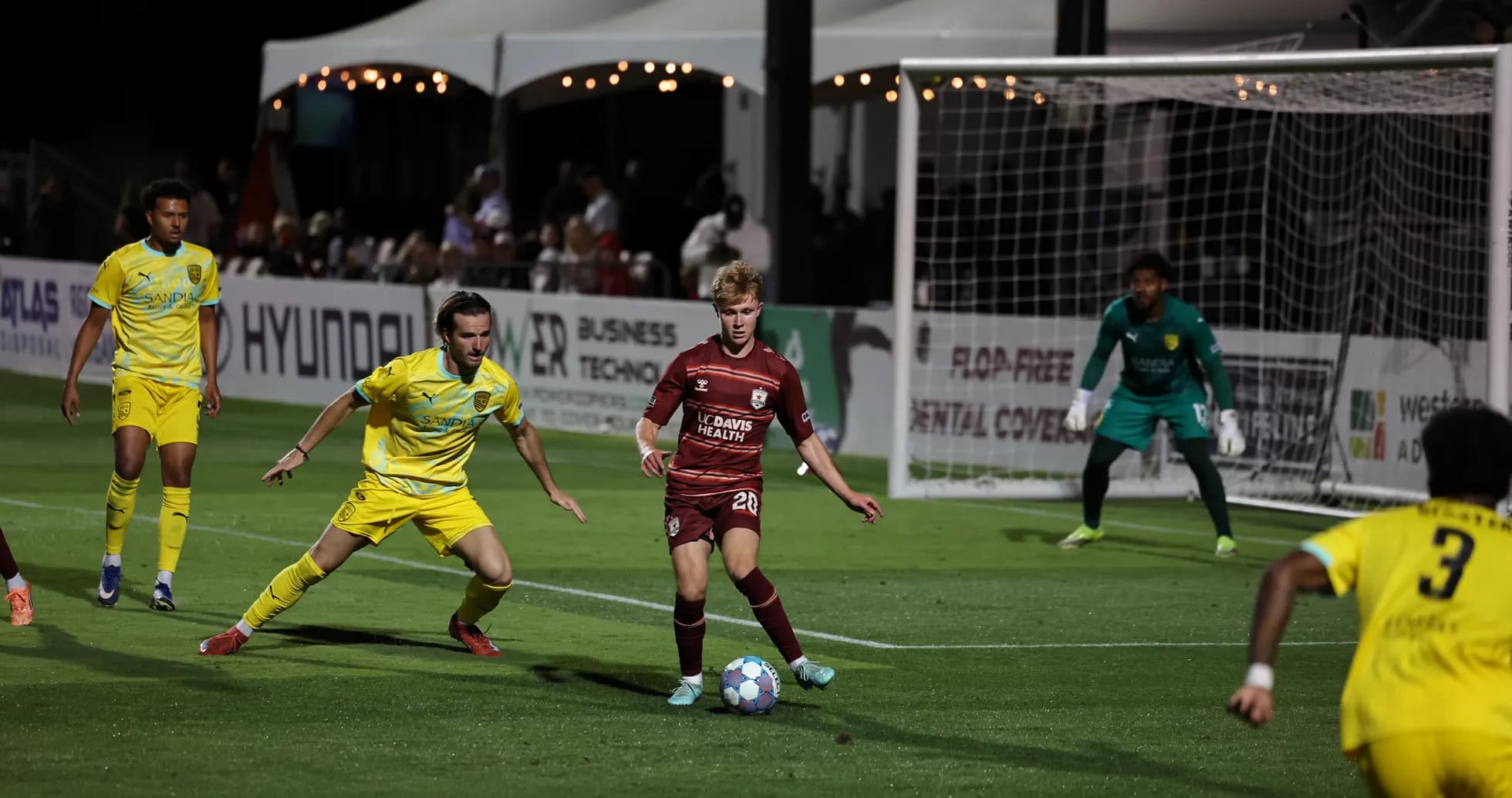
Sacramento’s “Hunter” was more collective than individual. F. Ajago’s presence as the central reference point was crucial, but it was the rotations of M. Rodriguez and B. Willey between the lines that tried to unpick New Mexico’s block. Rodriguez, wearing 8, drifted into pockets to link play, while Willey’s movement aimed to drag full-backs out of shape. Yet too often, the final ball lacked the precision to turn promising positions into clear chances.
In the “Engine Room” duel, the contrast was sharper. M. Kaye and D. Crisostomo tried to dictate tempo for Sacramento, recycling possession and stepping into half-spaces to compress New Mexico into their own third. Opposite them, G. Zelalem and D. Harris offered a different profile: Zelalem as the press-resistant pivot, Harris as the enforcer willing to break rhythm with fouls and tackles.
New Mexico’s midfield ultimately won the key battles without dominating the ball. They were content to let Sacramento have phases of possession, trusting their structure and waiting for moments to spring forward through Z. Bailey and C. Nava. When those transitions came, Sacramento’s back line – particularly J. Timmer and L. Desmond – were often forced to defend facing their own goal, a dynamic that eventually cracked under the weight of one decisive moment.
IV. Statistical Prognosis – what this result really says
Following this result, the numbers harden the narrative. Sacramento’s overall goals for (13) and against (12) keep their goal difference at 1, but the failure to score at home here adds to a season pattern of inconsistency in the final third: they have now failed to score in 3 matches overall. Their home scoring average of 1.5 remains respectable, yet performances like this underline the fragility of relying on narrow margins.
New Mexico, with 13 goals for and 13 against overall, remain the embodiment of balance. Their away attack may still average just 0.5 goals per game, but when combined with an away defence conceding 1.0 and the ability to keep 3 clean sheets on their travels, they are built for nights like this – low-event, high-discipline, opportunistic.
In xG terms, this had all the hallmarks of a match where Sacramento probably shaded the volume of half-chances, while New Mexico carved out fewer but cleaner looks in transition. The visitors’ season-long habit of grinding out results after setbacks – reflected in a form line of LLWWLDWLWDDW heading into this fixture – suggests a group comfortable living in those marginal spaces.
For Sacramento, the tactical takeaway is clear: the structural base is sound, especially at Heart Health Park, but the attacking mechanisms around F. Ajago, M. Rodriguez, and B. Willey must become more ruthless against compact, counter-punching sides. For New Mexico, this 1–0 win is less an outlier than a confirmation of identity: a team whose defensive solidity and game-management give them a platform to punch above the raw numbers of their away attack.
In a long group-stage campaign, these are the nights that quietly define trajectories. Sacramento will feel they left points on the table. New Mexico will leave Sacramento knowing this is precisely the kind of away performance that keeps them on course for the promotion playoffs and the 1/8-finals stage that awaits beyond.