Real Madrid vs Oviedo: La Liga Clash of Extremes
Estadio Santiago Bernabéu hosts a clash of extremes in La Liga on 14 May 2026, as 2nd-placed Real Madrid welcome bottom side Oviedo in Round 36 of the regular season. The stakes are very different: Madrid are closing in on a Champions League league-phase berth and still pushing for the title, while Oviedo are fighting to avoid what their table description already labels as relegation to LaLiga2.
With only three rounds left, the gap in both quality and momentum is stark. Real Madrid sit 2nd with 77 points, a goal difference of +37 and the league’s most potent attack (70 goals across all phases). Oviedo arrive in Madrid 20th with 29 points, a goal difference of -28 and the division’s weakest attack (26 goals).
Tactical landscape: Madrid’s firepower vs Oviedo’s survival block
Across all phases, Real Madrid’s season profile is that of a high-output, reasonably balanced side. They have 24 wins from 35 league matches, scoring 70 and conceding 33. At the Bernabéu, they have been particularly ruthless: 14 wins from 17 home games, with 39 goals scored and only 14 conceded. An average of 2.3 goals for and 0.8 against per home match underlines their capacity to dominate games on their own pitch.
Form-wise, Madrid’s long-run sequence – “WWWWWWLWWWWDDDWLWWWWWWWWLLWWWLDWDWL” – shows long winning streaks punctuated by short dips. In the league table their recent form reads “LWDWD”, suggesting a minor wobble but still a side that rarely goes two games without a result. Defensively, 12 clean sheets across all phases and only four matches where they have failed to score indicate a team that nearly always imposes itself.
The tactical base has been flexible but structured. The most-used shape is a 4-4-2 (16 times), with 4-2-3-1 (9 times) and 4-3-3 (6 times) also common. That variety allows Madrid to pair two forwards, field a No.10 behind a lone striker, or play with a front three depending on personnel.
Personnel, however, is a major subplot here. Real Madrid are without D. Ceballos (coach’s decision), Eder Militao, A. Guler and F. Mendy (all muscle injuries), Rodrygo (knee injury) and F. Valverde (head injury). D. Carvajal (toe injury), D. Huijsen (illness) and K. Mbappe (muscle injury) are all listed as questionable. That list strips depth from defence, full-back and midfield, and potentially removes one or both of their first-choice right-back and marquee forward.
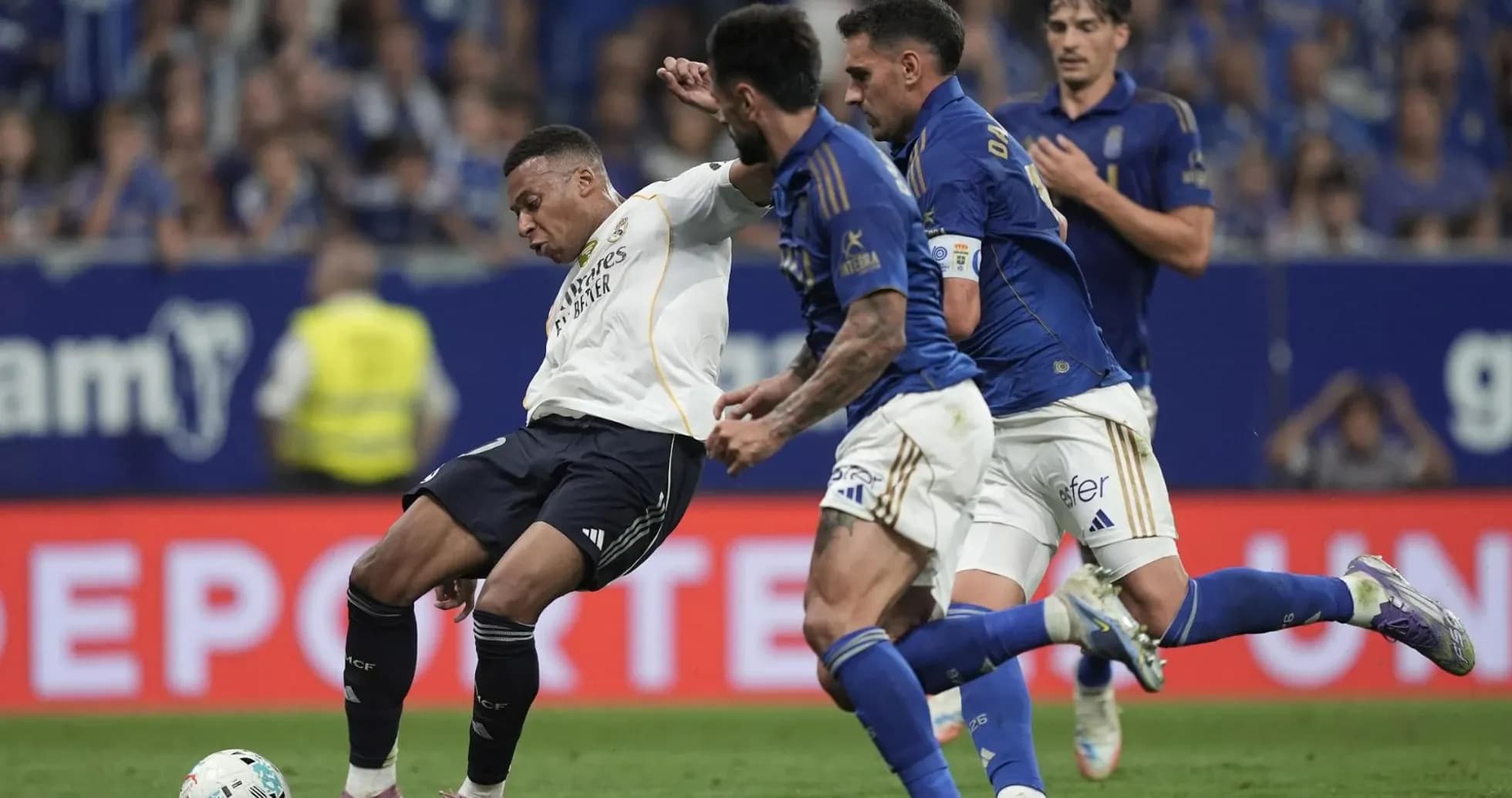
Even so, the attacking spearhead remains formidable. Kylian Mbappé is La Liga’s top scorer with 24 goals and 4 assists in 28 appearances, underpinned by 100 shots (61 on target) and a 7.6 average rating. His 8 penalties scored from 9 attempts show he is a high-volume, if not flawless, option from the spot. Vinícius Júnior adds 15 goals and 5 assists from 34 appearances, with 72 shots (45 on target) and a 7.52 rating. Between them they have 39 league goals; even if Mbappé is not fully fit, Vinícius’s dribbling volume (189 attempts, 86 successful) and duel count (390, with 194 won) suggest he can carry a huge share of the attacking burden.
Madrid’s team penalty record is perfect this season – 12 scored from 12 – giving them an extra edge in tight moments, even if individual takers have had the odd miss.
Oviedo’s approach: contain, survive, hope
For Oviedo, everything about this fixture screams damage limitation with opportunism. Across all phases they have just 6 wins from 35 matches, with 26 goals scored and 54 conceded. Away from home they have 2 wins, 4 draws and 11 defeats, scoring 17 and conceding 37; that is 1.0 goal scored and 2.2 conceded per away game.
Their long-term form line – “LLWLLLWLLDDLDLDLDDDLLWLDLLDWLWWDLLD” – is littered with defeats, with only brief respites. The league form column “DLLDW” hints at a slight recent uptick, but not enough to alter the underlying pattern of struggle.
Tactically, Oviedo are most often a 4-2-3-1 side (24 matches), occasionally shifting into 4-3-3 or 4-4-2. That double-pivot structure will likely be key at the Bernabéu: two holding midfielders screening a back four, wingers dropping deep, and a lone striker trying to exploit rare transitions. Their clean sheet count is surprisingly high – 10 across all phases, including 9 at home – but away they have managed just 1 shut-out, underlining how difficult it has been to replicate defensive solidity on the road.
They are also heavily reliant on keeping the scoreline tight. Oviedo have failed to score in 18 of 35 league matches, split evenly between home and away (9 each). Against a side with Madrid’s attacking numbers, that lack of threat is a major concern.
Team news compounds the challenge. B. Domingues is out with a knee injury, while J. Lopez and K. Sibo are suspended after red cards. Those absences reduce both defensive options and midfield energy. E. Bailly and L. Dendoncker are questionable through injury, potentially further weakening their ability to defend the box and compete aerially. Oviedo’s penalty record is 2 scored from 2 this season, but given how infrequently they reach the opposition box in numbers, relying on spot-kicks in Madrid would be optimistic.
Head-to-head snapshot
The recent competitive history between these sides in La Liga is limited in the data set. The only listed meeting is from 24 August 2025 at Estadio Nuevo Carlos Tartiere, where Oviedo lost 0-3 at home to Real Madrid in regular season Round 2. That match finished 0-1 at half-time and 0-3 at full-time, giving Madrid a clear away win.
On that basis, the last competitive head-to-head record reads:
- Real Madrid wins: 1
- Oviedo wins: 0
- Draws: 0
With no other competitive fixtures provided, there is no broader pattern to infer beyond Madrid’s clear superiority in that encounter.
Key battles and tactical nuances
Given Madrid’s injury list, Carlo Ancelotti (or the current coach) may lean towards the more stable 4-4-2 or 4-2-3-1, protecting a reshuffled back line and giving Vinícius licence to attack Oviedo’s weaker flanks. If Mbappé is fit enough to start or feature, Madrid can stretch Oviedo vertically with his runs in behind; if not, they may rely more on combination play and wide overloads.
Oviedo’s best route into the game lies in compressing central spaces, forcing Madrid wide, and hoping their centre-backs can cope with crosses. Their yellow and red card distribution – with a notable number of late cautions and dismissals – suggests discipline could be an issue, especially under sustained pressure at the Bernabéu.
The Verdict
All available data points towards a one-sided contest. Real Madrid are elite at home, averaging more than two goals per game and conceding less than one, with two of the league’s most productive forwards even amid injury doubts. Oviedo are bottom, porous away from home, and often toothless in attack, further weakened by injuries and suspensions.
Barring an extraordinary collapse from the hosts or an outlier defensive display from Oviedo, the logical expectation is a comfortable Real Madrid win, with a strong chance of multiple goals for the home side and a serious test of Oviedo’s already fragile survival hopes.