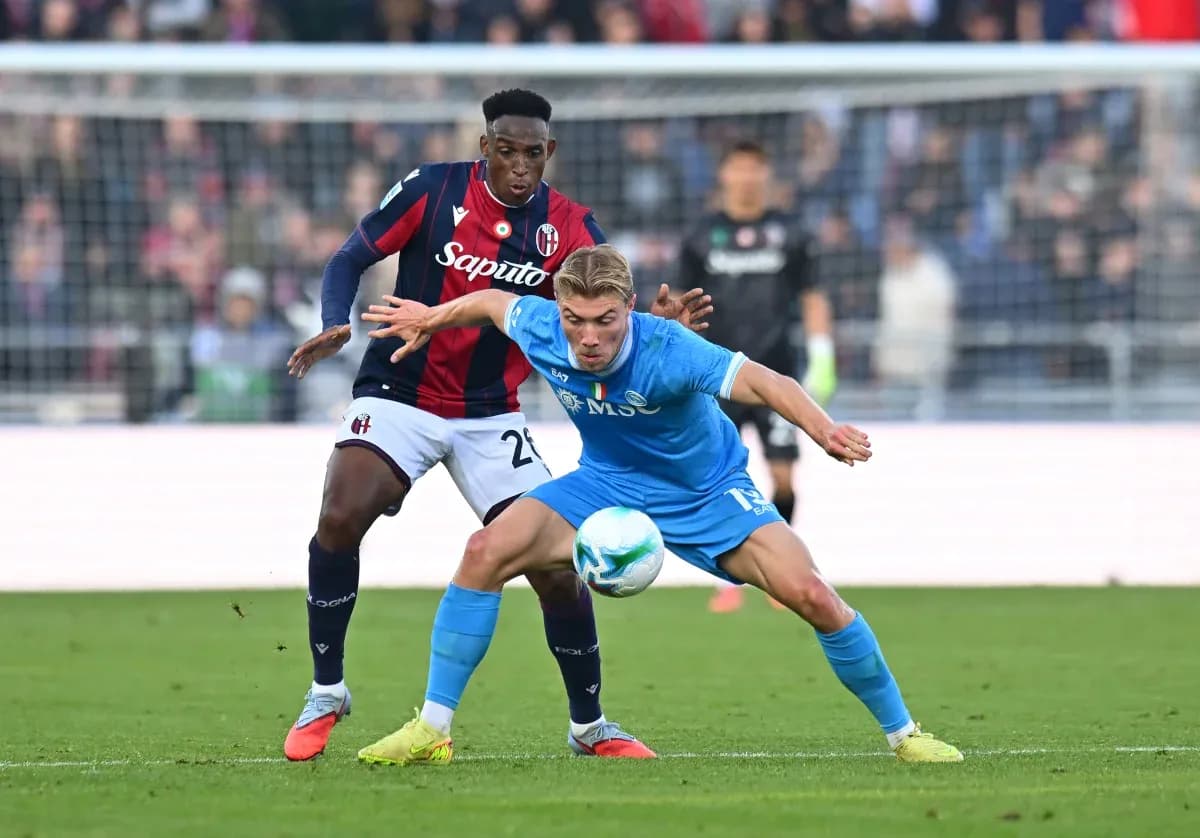
Napoli vs Bologna: Tactical Analysis of the 2-3 Home Defeat
Napoli’s 2-3 home defeat to Bologna at Stadio Diego Armando Maradona unfolded as a structurally complex game in which Antonio Conte’s 3-4-2-1 had long spells of control but was repeatedly punished by Vincenzo Italiano’s vertically aggressive 4-3-3. Despite edging possession 52% to 48%, producing 14 shots to 10 and 7 corners to 1, Napoli’s defensive structure and penalty-box protection were not aligned with their territorial dominance. Bologna, with fewer shots but better shot quality (xG 1.32 to Napoli’s 0.75), executed a clear plan: attack the wide spaces behind Napoli’s wing-backs, be ruthless in transitions, and lean on a compact mid-block rather than extended pressing.
Bologna’s scoring pattern underlined that clarity. On 10 minutes, Federico Bernardeschi (Bologna) struck the opener, assisted by Juan Miranda, exploiting Napoli’s wide defensive coverage before the back three could shift across. The second turning point came around the half-hour: at 33', a VAR check confirmed a penalty for Bologna, and at 34' Riccardo Orsolini (Bologna) converted from the spot for 0-2. Napoli’s response was immediate before the break: at 45', Giovanni Di Lorenzo (Napoli) pulled one back with a Normal Goal, arriving from the back line to finish and send the game into half-time at 1-2.
The second half started with Napoli leveraging their wing-backs higher and adding more direct runs from Rasmus Hojlund. At 48', that adjustment paid off: Alisson Santos (Napoli) equalised for 2-2 with a Normal Goal, assisted by Hojlund, who occupied central defenders to free the left channel. Yet Bologna’s bench made the decisive impact late on. Substitution patterns shifted the balance of energy, and at 90' J. Rowe (Bologna) produced the decisive Normal Goal, attacking space as Napoli’s back line lost compactness chasing the winner, sealing a 2-3 away victory.
The disciplinary profile was heavily tilted towards Bologna and shaped the match’s physical tone. There were five yellow cards in total: Napoli 1, Bologna 4, Total: 5. Listed chronologically:
- 38' João Mário (Bologna) — Foul
- 47' Federico Bernardeschi (Bologna) — Foul
- 58' Eivind Helland (Bologna) — Foul
- 69' Jhon Lucumí (Bologna) — Foul
- 84' Matteo Politano (Napoli) — Foul
These repeated Bologna infringements were largely tactical, breaking Napoli’s rhythm in wide areas and around second balls, while Politano’s late booking reflected Napoli’s increasing desperation in counter-press situations.
Tactically, Conte’s 3-4-2-1 for Napoli was built around controlled possession and wide overloads. The back three of Giovanni Di Lorenzo, Amir Rrahmani and Alessandro Buongiorno aimed to start play from deep, with Stanislav Lobotka as the nominal pivot and Scott McTominay offering vertical runs and second-ball presence. M. Gutierrez and Matteo Politano provided width as wing-backs, while Giovane and Alisson Santos supported Rasmus Hojlund centrally.
Napoli’s structure with 484 passes, 425 accurate (88%), underlined their capacity to circulate the ball and pin Bologna back. However, their 11 shots inside the box from 14 total attempts produced only 0.75 xG, a clear indicator that Bologna’s back four successfully forced many of those efforts into suboptimal body shapes or crowded zones. The 7 corners reflected sustained pressure, but Napoli rarely destabilised the central pairing of E. Fauske Helland and Jhon Lucumí enough to generate clear-cut chances.
Out of possession, Napoli’s 3-4-2-1 morphed into a 5-2-3, with both wing-backs dropping. The key tactical flaw was the space behind Gutierrez and Politano when Napoli lost the ball high. Bologna’s first and third goals came from precisely those channels: quick switches and early balls into the feet of Bernardeschi and later J. Rowe, attacking isolated wide centre-backs. With only 1 official Goalkeeper Save and a negative goals prevented figure of -0.82, V. Milinkovic-Savic’s day encapsulated Napoli’s defensive issues: he was not overworked, but the shots he faced were of high quality and poorly protected by the block in front of him.
Conte’s substitutions were clearly aimed at injecting creativity and fresh legs between the lines. At 76', Eljif Elmas (IN) came on for Giovane (OUT), and B. Gilmour (IN) came on for S. Lobotka (OUT), shifting Napoli towards a more progressive double pivot and adding line-breaking passing. Later, at 85', L. Spinazzola (IN) came on for M. Politano (OUT), and at 87' P. Mazzocchi (IN) came on for M. Gutierrez (OUT), essentially renewing both flanks to keep Bologna pinned back. Yet this wave of substitutions also disrupted Napoli’s defensive reference points in transition, especially as both original wing-backs, who knew the pressing triggers, were removed.
Vincenzo Italiano’s Bologna, in a 4-3-3, were more direct and opportunistic. The back four of Joao Mario, E. Fauske Helland, Jhon Lucumí and Juan Miranda stayed relatively narrow, inviting crosses and trusting central density. The midfield trio of T. Pobega, Remo Freuler and Lewis Ferguson prioritised verticality over sterile possession, which is reflected in Bologna’s 458 passes, 386 accurate (84%) — slightly less volume and precision than Napoli but oriented to progression. Up front, Bernardeschi, S. Castro and Orsolini attacked the half-spaces and channels, constantly looking to exploit Napoli’s high wing-backs.
Bologna’s bench management was decisive. At 64', N. Zortea (IN) came on for Joao Mario (OUT), adding fresh legs and defensive solidity on the flank. At 73', J. Rowe (IN) came on for F. Bernardeschi (OUT), a like-for-like change that later proved match-winning. The triple wave at 81'-82' further rebalanced energy: at 81', N. Moro (IN) came on for T. Pobega (OUT) and S. Sohm (IN) came on for L. Ferguson (OUT), while at 82' T. Heggem (IN) came on for E. Fauske Helland (OUT). Italiano essentially rebuilt his right side and part of his midfield, ensuring Bologna could withstand Napoli’s late pressure and still carry threat in transition — culminating in Rowe’s 90' winner.
Statistically, the outcome aligns more with shot quality than volume. Napoli’s higher possession and shot count did not translate into high xG; many attacks stalled around the edge of the box or ended in low-percentage attempts. Bologna, with fewer shots but an xG of 1.32, maximised their best situations: a penalty, a clean early finish, and a late transition goal. Defensively, both goalkeepers posted the same negative goals prevented figure (-0.82), but the context differs: M. Pessina had to make 3 saves behind a compact block, while Milinkovic-Savic made only 1 save, meaning Bologna turned a higher proportion of their dangerous moments into goals.
In terms of season context, this match will weigh differently on each side’s trajectory. For Napoli, it highlights a gap between overall form with the ball and their Defensive Index: they can dominate territory but remain vulnerable to direct play and wide transitions. For Bologna, the performance reinforces a profile of tactical maturity and efficiency — a team comfortable without the ball, capable of absorbing pressure, and ruthless when space appears, particularly through wide forwards and impact substitutes.