World Cup Controversies: Iran's Absence and Russia's Future
The World Cup was supposed to be the showpiece. Instead, as around 1,600 delegates from more than 200 member associations gather, football’s biggest political fires are crackling at the doors of FIFA’s Congress.
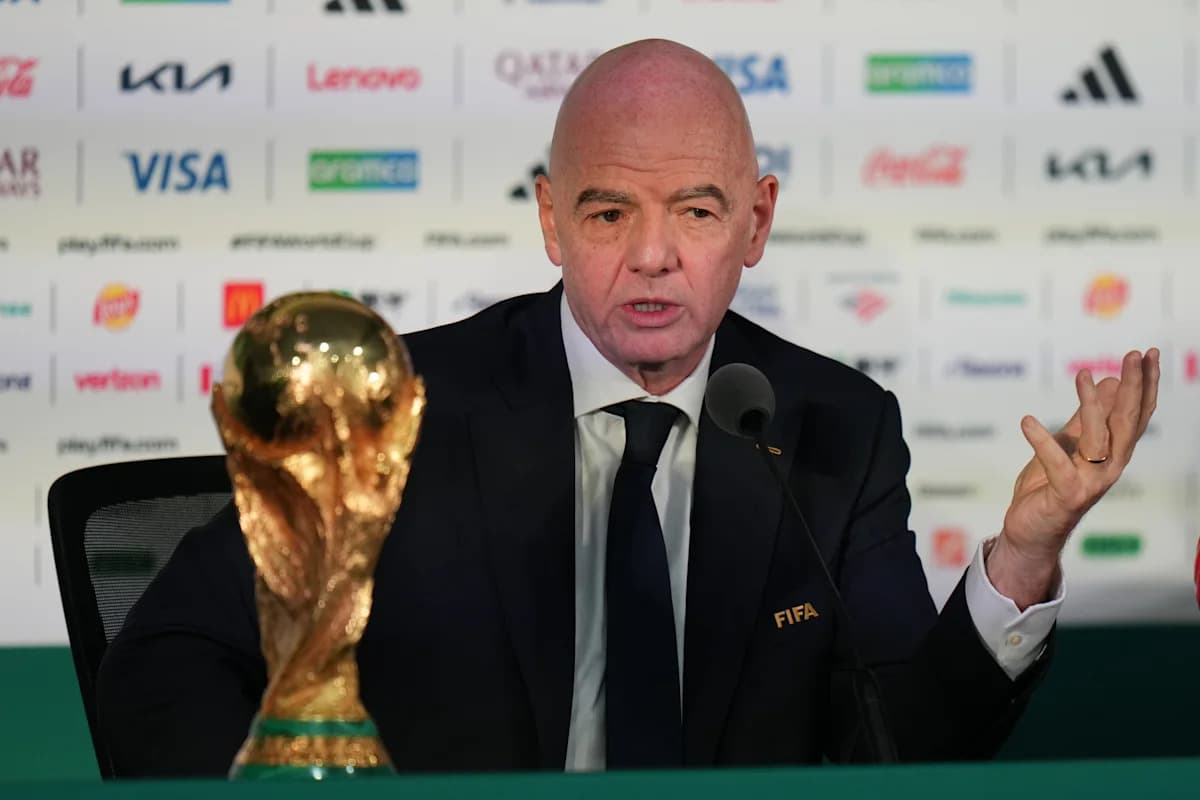
At the heart of it all: Iran, Russia, money, and the man who sits at the top of the sport, Gianni Infantino.
Iran’s no-show ignites diplomatic flashpoint
Iran’s absence is already casting a long shadow over the meeting.
Officials from the Football Federation of the Islamic Republic of Iran (FFIRI) landed in Toronto earlier this week, then abruptly turned around. Their onward trip to Vancouver, where the Congress is being held, never happened. They flew home.
Iranian media reported that FFIRI president Mehdi Taj — a former member of Tehran’s Islamic Revolutionary Guard Corps (IRGC) — and two colleagues left after being “insulted” by Canadian immigration officers.
Canada’s position is blunt. The government designated the IRGC a terrorist organization in 2024 and has made clear that anyone linked to the force is not welcome.
“IRGC officials are inadmissible to Canada and have no place in our country,” the immigration agency said in a statement, while declining to comment on specific cases because of privacy laws.
That single incident has blown fresh uncertainty across Iran’s World Cup campaign. The country’s participation was already under a cloud since the Middle East war erupted on February 28, following a wave of attacks by the United States and Israel.
Iranian football officials revealed last month that they had floated a drastic proposal: move their three World Cup group matches from the United States to co-hosts Mexico. The idea died quickly. FIFA President Gianni Infantino shut it down.
Iran, he insisted to AFP, will play “where they are supposed to be, according to the draw.”
Washington’s stance is more nuanced. US Secretary of State Marco Rubio said last week that Iran’s footballers would be welcome to compete at the tournament on American soil. Yet he also warned that the United States could still bar entry to members of the Iranian delegation with ties to the IRGC.
So the team can come. Some officials might not. The logistical headache is now a political minefield, and it sits right in the middle of FIFA’s biggest event.
Infantino under fire on multiple fronts
All of this lands at a delicate moment for Infantino.
The FIFA president walks into Thursday’s Congress under scrutiny not just for geopolitics, but for the way the World Cup itself is being run — and sold.
World Cup ticket prices have soared, triggering anger among fans and grumbling from national associations. Behind closed doors, several World Cup-qualified teams warned FIFA they could actually lose money by taking part, pointing to spiralling costs for travel, taxes and overall operations at a sprawling, multi-country tournament.
FIFA’s response came on Tuesday. The governing body announced a sharp increase in World Cup financial distributions, lifting the pot to nearly $900 million from the $727 million first announced in December. It was a sizeable adjustment, but also an admission: the economics of this World Cup are biting hard.
Infantino’s problems do not stop at balance sheets.
His close friendship with US President Donald Trump continues to draw criticism, especially from those who see FIFA’s leadership as too comfortable with power and too slow to challenge it. That tension is now tied directly to the tournament’s atmosphere off the pitch.
Rights groups are demanding clear guarantees that fans, journalists and local communities will not be swept up in what they describe as the Trump administration’s harsh immigration and security measures.
“FIFA President Gianni Infantino has yet to publicly outline how fans, journalists and local communities will be safe from arbitrary detention, mass deportations and crackdowns on free expression,” said Steve Cockburn, Amnesty International’s head of economic and social justice.
“This FIFA Congress should be the moment he does so, and the global football community must receive more than empty platitudes.”
That is the challenge. Infantino is expected to address delegates, but many will be listening less for his usual rhetoric and more for concrete assurances.
The Trump prize that will not go away
Another thorn in Infantino’s side is one he created himself.
During last December’s World Cup draw in Washington, he awarded the FIFA Peace Prize to Trump — a move that baffled and angered many inside the game. The backlash has not faded.
“We want to see (the prize) abolished,” Norwegian football association president Lise Klaveness told reporters this week. “We don’t think it’s part of FIFA’s mandate to give such a prize.”
That criticism cuts deeper than a single ceremony. It questions what FIFA is for, and where its authority begins and ends. When the Congress convenes, the Peace Prize may be a symbolic item on a crowded agenda, but it is a symbol that speaks loudly about the organization’s direction.
Russia’s exile back on the table
Hovering over all of this is another unresolved fault line: Russia.
The country remains banned from international football, a sanction imposed after the 2022 invasion of Ukraine. The war has not ended. The ban has not been lifted. Yet the debate is back.
Infantino has already signalled he wants the issue reopened.
“We have to (look at readmitting Russia). Definitely,” he told Britain’s Sky News earlier this year. “This ban has not achieved anything, it has just created more frustration and hatred.”
Those words guarantee a fierce argument. Some associations see any move to bring Russia back as a betrayal of Ukrainian football and a surrender of the sport’s moral stance. Others argue that isolating Russian footballers and fans does nothing to change events on the ground.
Thursday’s Congress may not deliver a final verdict, but it will show how far FIFA’s members are prepared to follow their president on one of the most divisive questions in modern sport.
Football’s biggest stage, under strain
So the scene in Vancouver is set: Iran’s delegation turned away, Russia’s exile under review, World Cup finances patched up under pressure, and the president facing questions about his alliances and his judgement.
The ball has not yet rolled at the World Cup, but the politics around it are already at full speed. The next moves belong to Infantino and the associations staring back at him from the Congress floor.