The Most Expensive World Cup Squads in 2026: Who Has the Deepest Pockets — and Who Has the Best Chance?
Squad market values make headlines every time Transfermarkt updates its numbers. But when the World Cup begins on June 11, the spreadsheets get put away and football takes over. Here is a look at the ten most valuable squads heading to North America this summer — and what those numbers actually mean once the tournament starts squeezing.
What "Expensive" Actually Tells You
Raw squad value is a useful starting point, but it only tells part of the story. The more revealing questions are about concentration — how much of a squad's value sits in one or two players — flexibility, meaning whether a coach can change shape without losing quality, and bench depth, because the teams that go deep in tournaments are almost always the ones whose substitutes can change a game rather than simply fill a shirt.
With that in mind, here are the ten most valuable squads at the 2026 World Cup, ranked from tenth to first.
10. Türkiye — €460 million
Türkiye sneak into the top ten on the back of a young, volatile attacking roster that is as capable of brilliance as it is of disappearing for long stretches. Their squad value of around €460 million is built around players who can change a match in a single touch — but consistency across 90 minutes remains the challenge. Drawn into Group D alongside the USA, Australia and Paraguay, Türkiye will need to convert their individual quality into collective results. Their emotional, high-intensity style of play can drag richer opponents into uncomfortable territory — and that is a genuine tournament asset.
9. Argentina — €570 million
Argentina's squad value has dropped to approximately €570 million — a number that would have seemed unthinkable a few years ago for the reigning world champions. But market value and menace are different things, and Argentina have always been more dangerous than their numbers suggest. Group J — Algeria, Austria and Jordan — is navigable, and Lautaro Martínez's individual valuation of €85 million signals that genuine finishing quality remains in the squad. Argentina do not arrive to participate. They arrive to impose. No spreadsheet has ever captured that.
8. Netherlands — €720 million
The Dutch sit at around €720 million, with a squad built for versatility rather than spectacle. Group F — Japan, Tunisia and a European playoff slot — demands patience and defensive discipline, particularly against a Japanese side that punishes poor spacing with ruthless efficiency. The Netherlands' defining quality in 2026 is their ability to win matches in different ways: through controlled possession on good nights, through organised chaos when control breaks down. That adaptability is worth more than the valuation alone suggests.
7. Italy — €730 million
Italy come in at approximately €730 million — but their place at the tournament is not yet guaranteed, with a playoff hurdle still to clear. If they get through, Group B offers a relatively clear path through Canada, Qatar and Switzerland. Italy's cultural identity remains unchanged regardless of era: make every match uncomfortable, defend every inch, and let the opponent work for nothing. Their upgraded athleticism suggests they can do all of that while moving at a higher tempo than previous generations. A qualified Italy is always worth taking seriously.
6. Germany — €850 million
Germany sit at roughly €850 million, with Jamal Musiala — valued at €130 million despite recent injury uncertainty — as the player capable of breaking open any defence in the world. Group E includes Côte d'Ivoire, Curaçao and Ecuador — a group that punishes complacency but rewards organised quality. Germany's challenge in 2026 is balancing their natural instinct for structure and tempo with the need to win ugly when the situation demands it. Modern tournaments penalise predictability. This Germany must be prepared to suffer occasionally, even while carrying one of the tournament's most valuable rosters.
5. Portugal — €850 million
Portugal match Germany at approximately €850 million, with a squad that blends genuine world-class talent with the perennial question of how Cristiano Ronaldo, at 41, fits into the team's attacking system. Group K — Colombia, Uzbekistan and a playoff qualifier — is full of potential traps, particularly Colombia, who arrived at this tournament having beaten both Argentina and Brazil in CONMEBOL qualifying. Portugal's strength lies in their ability to shift gears: possession football for long stretches, then sudden, direct transitions that exploit space. Whether they can maintain that discipline through the pressure of a knockout tournament is the question Martínez will need to answer.
4. Spain — €920 million
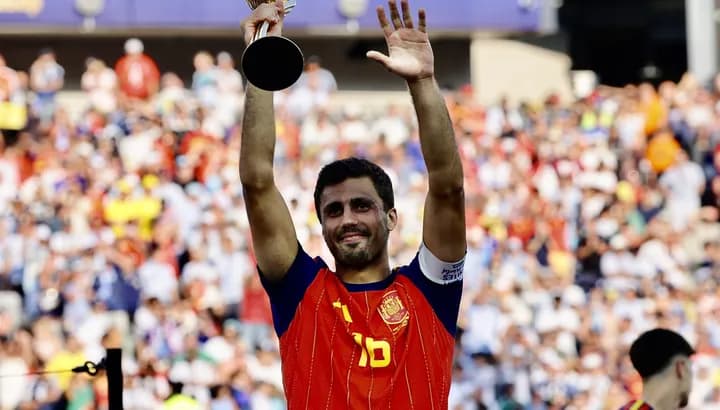
Spain are the world's top-ranked nation entering 2026 and carry a squad valued at approximately €920 million — with Lamine Yamal's individual valuation of €200 million reflecting just how dramatically the teenager has reshaped the market. Group H — Uruguay, Saudi Arabia and Cape Verde — guarantees bruises before the knockout rounds begin. Uruguay will not be intimidated, Saudi Arabia have nothing to fear and Cape Verde will treat every minute as an audition. Spain's identity remains built around the ball doing the work — but possession-based football faces the most sophisticated pressing systems it has ever encountered at a modern World Cup. That is the test awaiting the favourites.
3. Brazil — €1.00 billion
Brazil cross the psychological billion-euro threshold at approximately €1.00 billion, arriving in Group C alongside Morocco, Haiti and Scotland. Vinícius Júnior's valuation of €150 million headlines the attacking numbers, but the more interesting development is the growing value attached to Brazil's defensive spine — Gabriel Magalhães at €75 million signals that Ancelotti has been building something more rounded than previous iterations of the Seleção. Morocco will defend with organisation and sprint with menace. Scotland will make every match physical and emotional. Brazil must navigate all of it while carrying the expectation that they should not just win, but entertain while doing so.
2. France — €1.28 billion
France sit at approximately €1.28 billion — just behind England at the top of the table, but arguably the most complete squad in the tournament. Kylian Mbappé's valuation of €200 million is the headline, but France's real advantage is the depth behind him: the players other nations would build entire systems around who come off the French bench as options rather than starters. Group I — Senegal, Norway and a playoff qualifier — demands focus rather than flair. France carry tournament expectation with an almost unsettling calm. They have reached the last two World Cup finals. They expect to be in this one.
1. England — €1.30 billion
England top the table at approximately €1.30 billion — the most expensive squad at the 2026 World Cup by any measure. Jude Bellingham (€160 million), Bukayo Saka (€130 million) and Cole Palmer (€120 million) represent a generation of talent that has never been assembled in an England shirt before. Group L — Croatia, Ghana and Panama — will not allow them to coast: Croatia will slow the tempo, Ghana will challenge at pace, Panama will make every set piece dangerous.
The billion-euro question for England is not whether they have the talent. They clearly do. It is whether this generation can convert that talent into tournament results under the specific kind of pressure that the World Cup generates — the noise, the expectation and the accumulated weight of a football culture that has waited since 1966. The money sits on the bench. The more important question is whether the belief sits in the changing room.
When the Numbers Stop Mattering
Every four years, the most expensive squads arrive at the World Cup with their market values, their FIFA rankings and their expectations — and the tournament immediately begins the process of humbling them. France might cruise to the quarter-finals and then concede in the 89th minute to a team worth a tenth of their squad value. England might dominate possession for 270 minutes and then lose on penalties to Croatia. Spain might play the most technically correct football of the tournament and still lose to Uruguay on a set piece.
The trophy does not read Transfermarkt. It rewards the team that can stay together on the bad nights, adapt under pressure and hold their nerve when everything else strips away. The ten squads on this list all have the quality to win the tournament. Which of them has the character — that is the question that only June and July can answer.