Saudi Arabia Holds Uruguay to 1-1 Draw in World Cup Opener
Saudi Arabia’s 1-1 draw with Uruguay at Hard Rock Stadium was a classic case of structural compactness and defensive resilience resisting a high-possession, high-volume attacking machine. Georgios Donis set Saudi Arabia up in a 4-4-2 that functioned for long stretches as a low-to-mid block, while Marcelo Bielsa’s Uruguay, in a 4-2-3-1, monopolised the ball (67% possession) and racked up 27 total shots to 7, yet needed an 80th-minute equaliser from Maximiliano Araújo to salvage a point in this World Cup group opener.
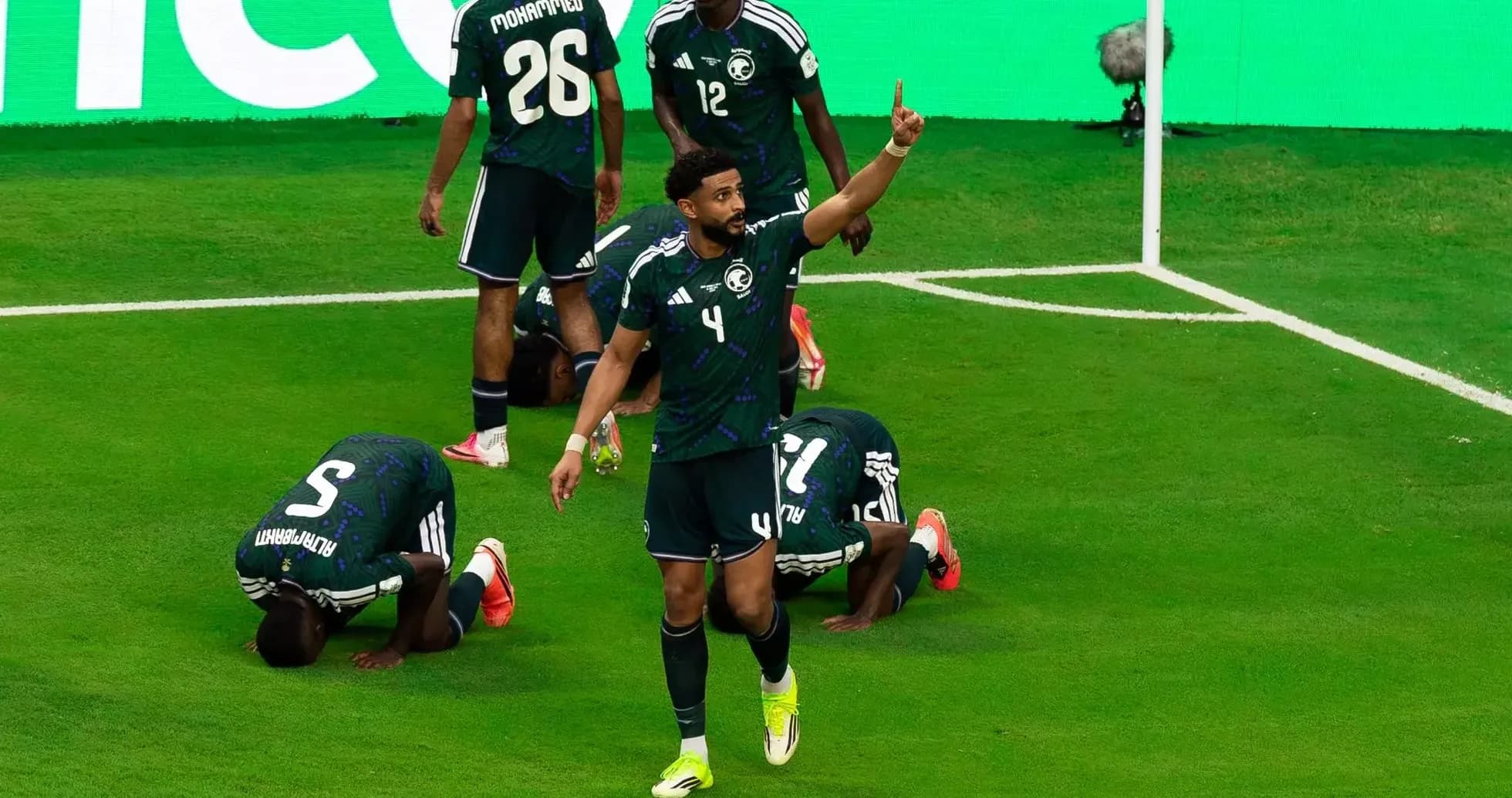
The scoring pattern underlines the tactical storyline. Saudi Arabia struck first in the 41st minute: Abdulelah Al-Amri rose as the decisive figure, converting for 1-0 with a “Normal Goal” finish that rewarded Saudi Arabia’s willingness to commit numbers forward selectively from their 4-4-2 structure. That same defender then walked a disciplinary tightrope, receiving a yellow card three minutes later at 44' — “Foul” — which forced Donis to manage his back line’s aggression carefully for the remainder of the match.
Uruguay’s response was territorial and relentless rather than immediately clinical. Bielsa’s side pushed their full-backs high and maintained pressure through repeated entries into the final third, but they only broke through in the 80th minute, when Maximiliano Araújo found the equaliser with a “Normal Goal” to make it 1-1. The lack of any assist on either goal in the data reinforces the impression of second-phase or broken-play situations rather than carefully scripted combination patterns.
From a disciplinary standpoint, the match was remarkably clean: only one card was issued. At 44', Abdulelah Al-Amri (Saudi Arabia) was booked — “Foul”. Uruguay finished without a single yellow or red. That single caution, to a central defender who had already scored, subtly influenced Saudi Arabia’s defensive behaviour, especially in how aggressively they could step into duels around the box.
Structurally, Saudi Arabia’s 4-4-2 was built to absorb and survive. With Firas Al-Buraikan and Musab Al Juwayr starting up front, the first line of pressure was more about screening passes into Uruguay’s double pivot than about forcing high turnovers. The wide midfielders, Salem Al-Dawsari on one flank and Mohammed Abu Al-Shamat initially on the other, were key in collapsing back to form a flat line of four, protecting the half-spaces where Federico Valverde and Maximiliano Araújo sought to combine.
The numbers show how deep and committed that block became: Saudi Arabia allowed 16 shots inside the box and 27 in total, yet restricted Uruguay to just 1 goal from 1.72 xG. The difference was largely down to Mohammed Al-Owais (Saudi Arabia), who made 9 saves. His shot-stopping under constant pressure was the backbone of the result, especially given that Saudi Arabia blocked only 1 shot; most of Uruguay’s efforts reached the target or at least passed the first line of defenders.
Out of possession, Saudi Arabia accepted long phases without the ball — only 33% possession and 322 total passes, of which 236 were accurate (73%). This reflects a team comfortable defending in their own half, compressing central lanes, and relying on clearances rather than controlled build-up. When they did play, the 4-4-2 offered simple vertical references: direct balls into the forwards, second balls contested by Mohamed Kanno and Abdullah Al-Khaibari, and occasional wide overloads via the full-backs Saud Abdulhamid and Moteb Al-Harbi.
Uruguay’s 4-2-3-1, by contrast, was designed to dominate territory and rhythm. With 612 total passes and 540 accurate (88%), they circulated the ball with patience, using Rodrigo Bentancur and Manuel Ugarte at the base (before Ugarte was replaced by Nicolás de la Cruz via substitution) to recycle possession and keep Saudi Arabia pinned back. The full-backs, Matías Viña and Mathías Olivera, pushed high to create width, allowing Federico Valverde and Maximiliano Araújo to drift into pockets between the lines.
The shot profile underscores Uruguay’s territorial dominance: 10 shots on goal, 10 off goal, and 7 blocked, with 14 corner kicks and 6 offsides, showing a team constantly probing the last line and repeatedly attacking the box. Yet their finishing and decision-making in the final third did not match the volume of their approach play, and they were also met by a goalkeeper in form. Fernando Muslera (Uruguay), by comparison, was relatively untested, making 2 saves from Saudi Arabia’s 3 shots on goal.
The substitution pattern adds another tactical layer. Bielsa acted aggressively at half-time: at 46', Darwin Núñez (OUT) was replaced as Agustín Canobbio (IN) came on, and Matías Viña (OUT) made way as Juan Sanabria (IN) entered. These changes suggested a desire for more dynamism and width, with Canobbio adding direct running and Sanabria offering fresh legs down the flank. Later, at 72', Manuel Ugarte (OUT) was replaced when Nicolás de la Cruz (IN) came on, tilting the midfield further towards creativity and late box arrivals rather than pure ball-winning.
On the Saudi side, Donis’ changes were more about energy management and preserving structure than altering the game model. At 63', Musab Al Juwayr (OUT) was replaced as Nasser Al-Dawsari (IN) came on, shoring up the midfield line. Then, in a flurry of 90' substitutions, Saud Abdulhamid (OUT) made way for Ali Lajami (IN), Firas Al-Buraikan (OUT) was replaced by Ala'a Al-Hejji (IN), and Moteb Al-Harbi (OUT) was swapped for Abdullah Al-Hamdan (IN). These late moves were consistent with a side protecting a point rather than chasing a winner, refreshing the defensive unit and forward pressing without changing the underlying 4-4-2 shell.
Statistically, Uruguay’s underlying numbers point to a missed opportunity. Their 1.72 xG versus Saudi Arabia’s 0.66 reflects a clear advantage in chance quality and quantity. They also committed fewer fouls (6 to 11), maintained far higher passing volume and accuracy, and forced 14 corners to Saudi Arabia’s 4. Yet both teams finished with the same goals prevented figure (-0.35), suggesting that, relative to the xG they faced, neither goalkeeper significantly overperformed or underperformed in pure model terms, even if the raw save count of Mohammed Al-Owais (Saudi Arabia) was far higher.
In the context of a World Cup group stage, this 1-1 result feels like a tactical victory for Saudi Arabia’s game plan and a warning sign for Uruguay’s efficiency in front of goal. Uruguay’s overall form metrics — possession, passing, xG, and shot volume — were superior, but Saudi Arabia’s defensive index on the night, anchored by their compact 4-4-2 and a busy goalkeeper, was enough to secure a valuable point.