Spain Crowned World Champions After Extra Time Victory Over Argentina
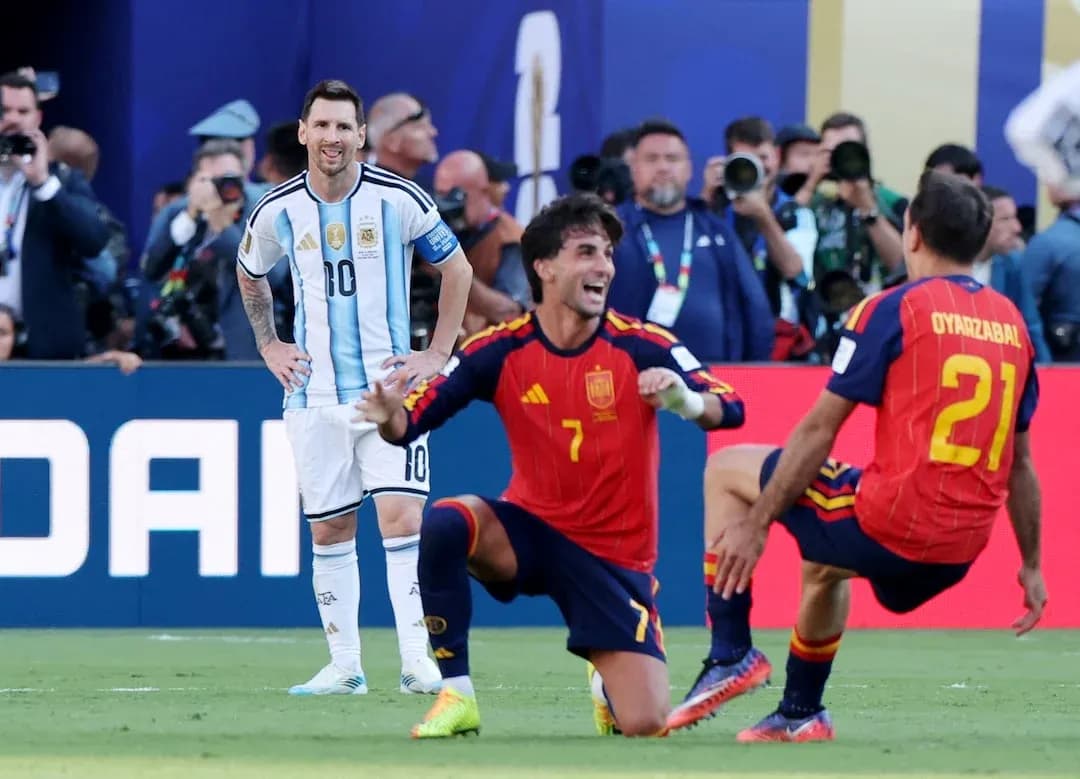
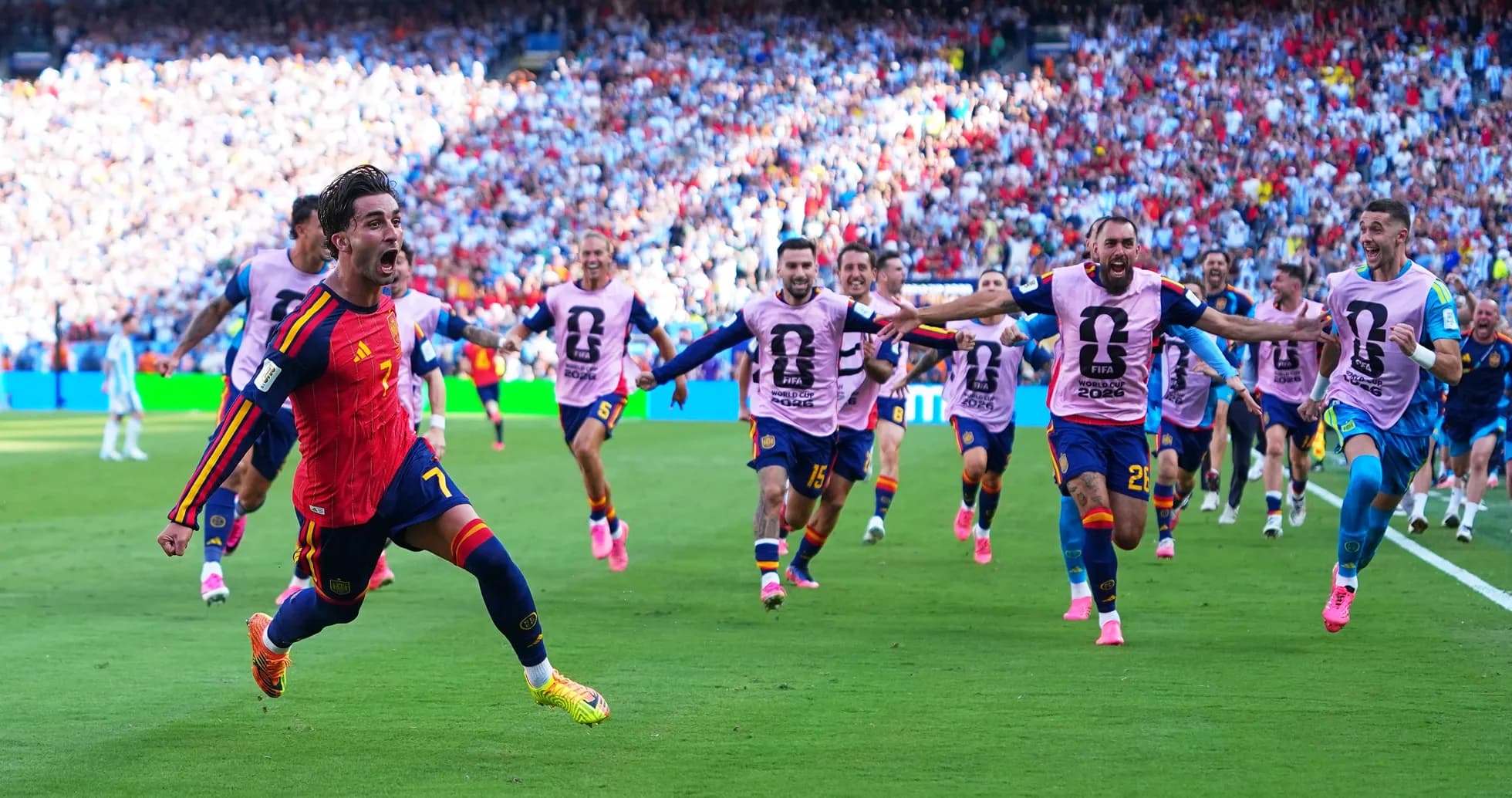
Spain 1-0 Argentina (after extra time) at MetLife Stadium crowns Spain as world champions, decided by Ferrán Torres’s extra-time winner. After a goalless 90 minutes, Spain’s territorial dominance and control of the ball finally translated into the decisive goal, securing the title at the end of a campaign in which they had already impressed in the group stage.
Match Report
The final opened with Spain asserting their possession game, while Argentina looked to compress space and counter. The first major disciplinary note arrived on 41', when Lisandro Martínez (Argentina) was booked for a foul: [41'] Lisandro Martínez (Argentina) — yellow card (Foul), a sign of the strain Spain’s circulation was placing on Argentina’s back line.
Argentina’s first reshuffle came before the break. On 44', Nicolás Otamendi replaced Lisandro Martínez (Argentina), a like-for-like centre-back change that suggested either an early fitness concern or a tactical decision to add aerial security. Just a minute later, on 45', Leandro Paredes replaced Nicolás Iván González (Argentina), moving Argentina towards a more conservative midfield structure to cope with Spain’s control between the lines.
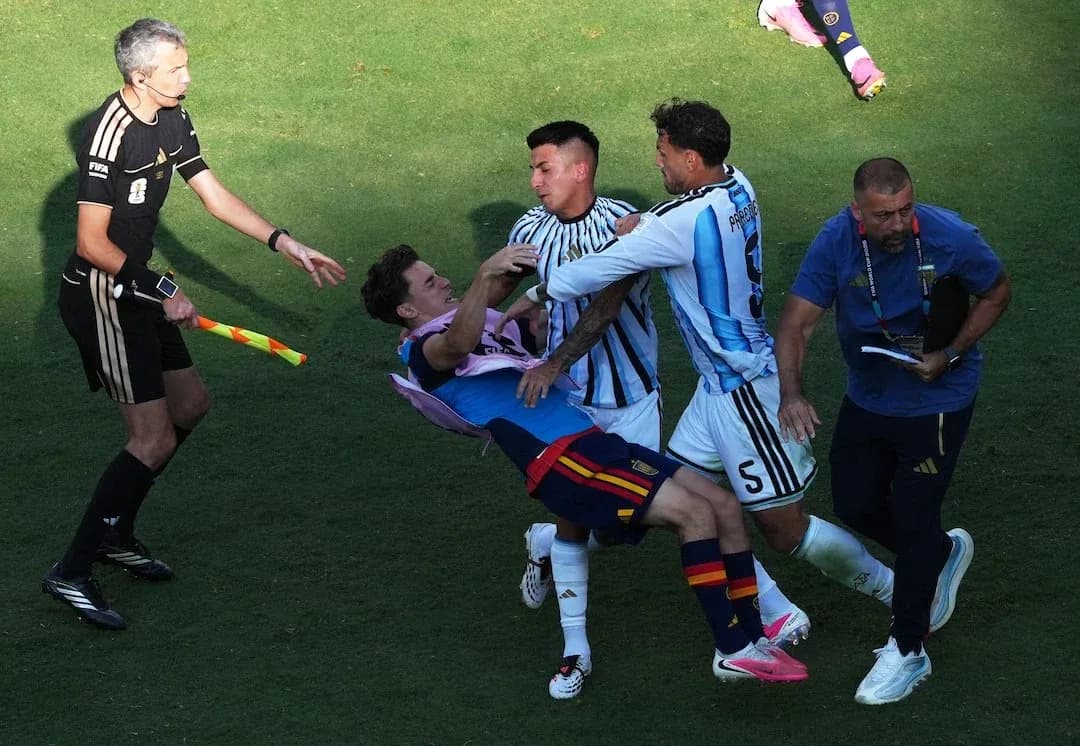
Early in the second half, Argentina’s discipline frayed again. On 52', Leandro Paredes (Argentina) — yellow card (Argument), reflecting rising tension as Spain continued to dictate tempo without finding a breakthrough.
Scaloni adjusted his full-backs on 58', with Nahuel Molina replacing Gonzalo Montiel (Argentina), seeking fresher legs on the right to deal with Lamine Yamal’s threat and to offer more thrust in transition.
Spain responded with a double attacking change on 62'. Ferrán Torres replaced Mikel Oyarzabal (Spain), adding more direct running in behind, while Pedri replaced Fabián Ruiz (Spain), injecting extra creativity and line-breaking passing from midfield.
Argentina then made a defensive double change on 70'. Facundo Medina replaced Cristian Romero (Argentina), altering the profile of the centre-back pairing, and Giuliano Simeone Baldini replaced Rodrigo De Paul (Argentina), a notable shift that introduced a forward for a midfielder and hinted at a more direct, vertical approach when Argentina could break.
Spain kept refreshing their attacking structure on 75'. Nico Williams replaced Alejandro Baena Rodríguez (Spain), adding one‑v‑one dribbling on the flank, and Mikel Merino replaced Daniel Olmo Carvajal (Spain), providing fresh legs and aerial presence from midfield.
Argentina’s frustration with Spain’s control was underlined on 82', when Enzo Fernández (Argentina) — yellow card (Dissent). That pattern continued into stoppage time of normal play: on 90+2', Cristian Romero (Argentina) — yellow card (Dissent), emblematic of a side increasingly reacting without the ball and struggling to sustain attacks.
Extra time began with Spain continuing to rotate. On 99', Martín Zubimendi replaced Rodrigo Hernandez Cascante (Spain), a like-for-like holding midfielder swap to maintain defensive balance, and Eric García replaced Aymeric Laporte (Spain), ensuring freshness in the back line against any late Argentine surges.
Argentina’s next change on 102' was more drastic: Marcos Senesi replaced Julián Álvarez (Argentina), effectively sacrificing a striker for a defender and further prioritising defensive solidity as the game edged towards a potential shootout.
The tension on the Argentine bench boiled over on 104', when head coach Lionel Sebastián Scaloni (Argentina) — yellow card (Dissent), underlining the pressure Spain’s territorial dominance was exerting on the defending team.
The decisive moment came on 106'. Spain finally converted their superiority: [106'] Spain goal — Ferrán Torres (assisted by Nico Williams). Williams attacked from the flank and delivered for Torres, whose finish broke the deadlock and put Spain 1-0 up in extra time.
Argentina, now chasing the game, continued to struggle to channel their aggression effectively. On 111', Alexis Mac Allister (Argentina) — yellow card (Foul), another booking in a sequence that reflected a side frequently defending in emergency situations rather than in a controlled block.
Spain then managed the remaining minutes with controlled possession and structured pressing, seeing out a 1-0 extra-time victory without further major incidents.
Fixture Statistics & Tactical Audit
- xG: not provided vs not provided
- Possession: Spain 65% vs 35% Argentina
- Shots on Target: Spain 12 vs 0 Argentina
- Goalkeeper Saves: Spain 0 vs 11 Argentina
- Blocked Shots: Spain 3 vs 1 Argentina
Spain’s win was rooted in structural dominance with and without the ball. Their possession share (65%) was translated into sustained pressure, reflected in a huge shots-on-target differential (12-0). Although the exact xG is not listed, the volume and accuracy of Spain’s shooting, plus Argentina’s 11 goalkeeper saves, indicate that Spain consistently generated higher-quality chances. Argentina’s game plan was reactive, sitting in a compact 4-4-2, but their inability to register a single shot on target (0) shows how rarely they transitioned with enough numbers or precision to threaten Unai Simón. Spain’s high pressing and counter-pressing limited Argentina to just two total shots, and the eventual breakthrough in extra time felt like a delayed reward for that territorial and chance-creation superiority.
Standings Update & Seasonal Impact
Spain entered the knockout phase from Group H with 7 points, 5 goals scored and none conceded. Adding this 1-0 victory in the final takes them to 10 points across their World Cup campaign to date in the standings sample, with 6 goals for and still only 0 against, improving their goal difference to +6. Argentina, who arrived from Group J with a perfect 9 points and a +7 goal difference (8 scored, 1 conceded), finish their tournament with the same points tally in that sample but now with 8 goals for and 2 against, reducing their goal difference to +6. In the context of the World Cup, Spain’s defensive record and narrow win in the final confirm them as the most balanced side in the competition, while Argentina’s defeat halts what had been a flawless run from the group stage.
Lineups & Personnel
Spain Starting XI
- GK: Unai Simón
- DF: Pedro Porro, Pau Cubarsí Paredes, Aymeric Laporte, Marc Cucurella
- MF: Rodri, Dani Olmo, Fabián Ruiz, Álex Baena
- FW: Lamine Yamal, Mikel Oyarzabal
Argentina Starting XI
- GK: E. Martínez
- DF: G. Montiel, C. Romero, Lisandro Martínez, N. Tagliafico
- MF: R. De Paul, E. Fernández, A. Mac Allister
- FW: N. González, L. Messi, J. Álvarez
Post-Match Verdict
This was a dominant Spain performance (65% possession, 20 total shots to 2, 12-0 shots on target) that only the brilliance of E. Martínez kept alive for so long (11 saves). Spain’s positional play and pressing structure repeatedly pinned Argentina back, forcing them into fouls and dissent (five yellow cards plus one for Scaloni) and preventing any meaningful attacking rhythm. The eventual extra-time winner from Ferrán Torres, created by Nico Williams, was the logical outcome of that sustained superiority.
From Argentina’s perspective, this was a defensive rearguard that was resilient but ultimately unsustainable. While their block produced a high number of defensive interventions (11 saves, 1 blocked shot, 25 fouls), the lack of offensive output (2 shots, 0 on target, 35% possession) meant they were always living on the edge. Tactical tweaks — extra midfield control via Paredes, defensive reinforcements with Otamendi, Medina and Senesi — could not compensate for their inability to progress the ball through Spain’s press. In the end, Spain’s control, chance volume and defensive security delivered a deserved 1-0 extra-time win and the World Cup crown.