Sassuolo vs Lecce: A Tactical Duel in Serie A
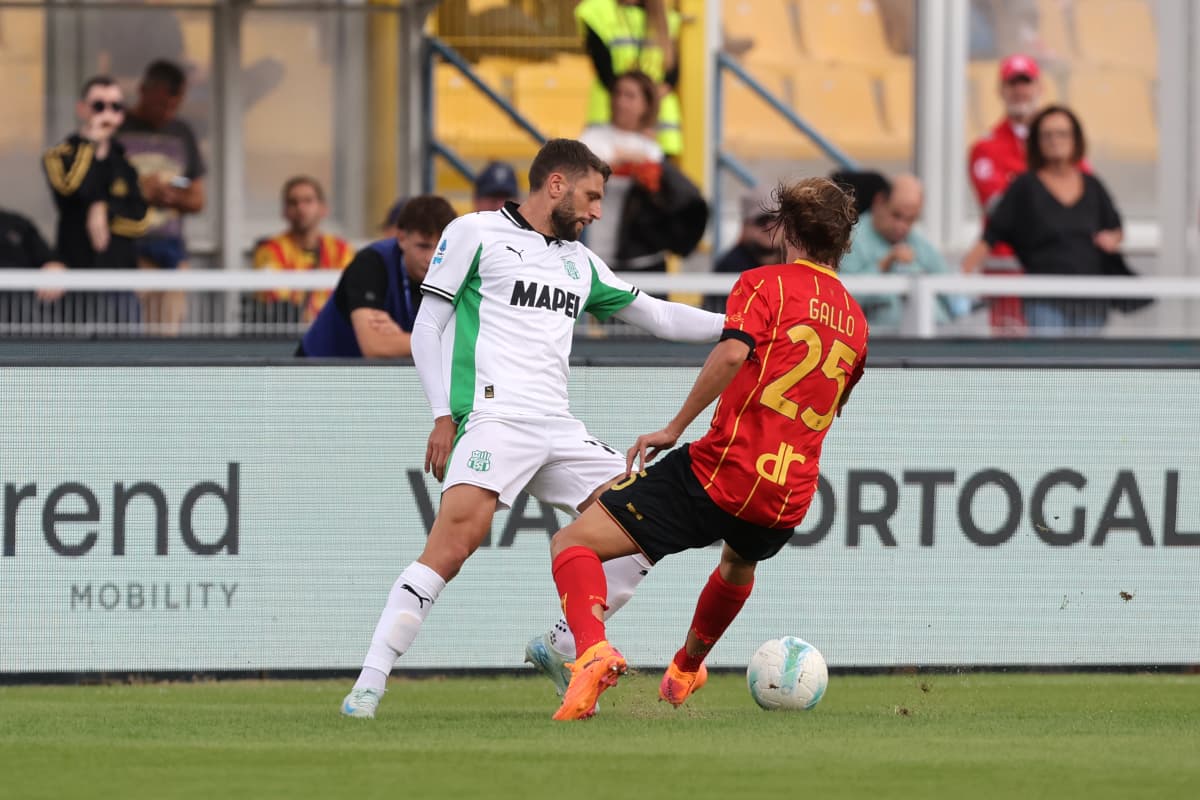
The evening at MAPEI Stadium – Città del Tricolore closed on a knife-edge: Sassuolo 2, Lecce 3, a result that crystallised the contrasting identities of two sides heading into the penultimate act of their Serie A season. In total this campaign, Sassuolo have been the more expansive outfit, their 46 goals for and 49 against yielding a goal difference of -3 and a mid-table cushion in 11th on 49 points. Lecce, by contrast, have lived closer to the relegation trapdoor in 17th, their 27 goals for and 50 conceded leaving them at -23 and perpetually one bad week from crisis.
Yet on this night, it was Lecce who imposed their narrative.
Team Lineups
Fabio Grosso’s Sassuolo lined up in their familiar 4-3-3, a structure that has underpinned 35 of their 37 league outings. S. Turati sat behind a back four of W. Coulibaly, Pedro Felipe, T. Muharemovic and U. Garcia, with N. Matic anchoring midfield between K. Thorstvedt and I. Kone. Up front, the creative burden fell on D. Berardi and A. Laurienté flanking M. Nzola.
Eusebio Di Francesco answered with Lecce’s most-used shape of the season, a 4-2-3-1 that has featured in 21 league matches. W. Falcone marshalled a back line of D. Veiga, J. Siebert, Tiago Gabriel and A. Gallo. In front of them, Y. Ramadani and O. Ngom formed a double pivot, freeing a band of three – S. Pierotti, L. Coulibaly and the volatile, high-impact L. Banda – to support lone striker W. Cheddira.
Absences and Tactical Voids
The absences framed the tactical voids. Sassuolo were without D. Boloca (muscle injury), F. Cande and E. Pieragnolo (both knee injuries), plus long-term inactive defenders F. Romagna and A. Vranckx and the sidelined S. Walukiewicz. That cluster of defensive and midfield absences reduced Grosso’s options to switch into a more conservative back five or to rotate his holding role if Matic came under pressure. Lecce, for their part, travelled without M. Berisha (thigh injury) and R. Sottil (back injury), removing a potential rotation option in midfield and a different profile out wide.
Discipline
Discipline has been a season-long sub-plot for both. Heading into this game, Sassuolo’s yellow-card distribution told of a side that often loses composure late: 29.63% of their bookings arrive between 76-90', with another 14.81% in added time. Lecce mirror that volatility: 29.85% of their yellows also fall in the 76-90' window, and 13.43% beyond 90'. With N. Matic (7 yellows, 1 red) and K. Thorstvedt (8 yellows) on one side and serial offenders Y. Ramadani and Danilo Veiga (9 yellows each) on the other, this fixture was always likely to tilt into a card-strewn finale.
Offensive and Defensive Patterns
The “Hunter vs Shield” duel was layered. Sassuolo’s primary hunters this season have been A. Pinamonti (9 league goals) and D. Berardi (8), with Laurienté adding 7 from the flank. Collectively, they feed an attack averaging 1.3 goals at home and 1.2 in total. Lecce’s shield, however, is more fragile: on their travels they concede 1.4 goals per game, 26 in 19 away matches. The visitors compensate not with volume of goals but with structure and timing; in total this campaign they score only 0.8 goals per game away, but 25.00% of their goals arrive in the opening 15 minutes and 21.43% between 76-90', a profile of ambush starts and late punches.
Sassuolo’s own scoring map is even more revealing. In total this campaign, their most prolific window is 46-60' (23.40% of goals), followed closely by 61-75' (21.28%). They are a side that often emerges from the interval with clarity, then rides that momentum into the mid-second-half. But their defensive timing is a problem: 22.92% of their goals conceded arrive in the first 15 minutes and 20.83% between 76-90'. This is a team that can be stunned early and undone late.
Lecce’s attacking pattern intersects those weaknesses almost perfectly. They are relatively quiet from 46-60' (7.14% of their goals) – right when Sassuolo usually surge – but they are most dangerous from 0-15' and 76-90', precisely the periods where Sassuolo are most porous. The 3-2 scoreline, with Lecce holding a 2-1 half-time lead, fits that script: a visiting side ready to strike early and then survive the mid-game storm.
Engine Room Battle
In the “Engine Room” battle, Matic and Thorstvedt carried contrasting responsibilities. Matic’s season numbers – 1 goal, 1 assist, 1,699 completed passes at 86% accuracy, plus 43 tackles and 10 successful blocks – mark him as Sassuolo’s metronome and screen. Thorstvedt, with 4 goals, 4 assists and 32 key passes, is the vertical thrust from midfield. Opposite them, Ramadani’s 90 tackles, 11 blocked shots and 46 interceptions framed him as Lecce’s enforcer, tasked with disrupting Laurienté’s inside drifts and Berardi’s half-space play. Over 3,125 minutes this season, Ramadani has lived in the collision zones; this match was no exception.
Creative Load
Out wide, Laurienté’s creative load was immense. Heading into this game, he led Serie A’s assist charts with 9, adding 7 goals, 54 key passes and 79 dribble attempts (29 successful). His duel with D. Veiga, a defender who has made 95 tackles and blocked 14 shots, was always going to be a hinge point. Veiga’s 9 yellow cards underline how often he is stretched to the limit by elite dribblers; containing Laurienté without conceding dangerous set-pieces was a central part of Lecce’s plan.
Penalty Narrative
Up front, Sassuolo’s penalty narrative added another layer of risk. In total this campaign they had won and taken 2 penalties, scoring 2 but with 1 miss on the individual ledger for Pinamonti. Lecce, by contrast, were perfect from the spot (1 scored from 1 total, 100.00%), a small but psychologically sharp edge in a match where marginal gains matter.
Statistical Overview
Statistically, Sassuolo’s season-long profile – 14 wins, 7 draws, 16 defeats, 8 clean sheets and 11 matches without scoring – paints a team that oscillates between fluid brilliance and structural fragility. Lecce’s 9 wins, 8 draws, 20 defeats, 9 clean sheets and 19 games without a goal show a side that lives on narrow margins, often needing their defensive block and late surges to compensate for blunt attacking output.
Following this result, the numbers tell of a contest that unfolded along those pre-drawn lines: Sassuolo’s mid-game potency was not enough to overcome their early and late-game defensive softness, while Lecce’s disciplined 4-2-3-1, anchored by Ramadani’s engine and Banda’s high-variance threat, found just enough incision to tilt a volatile, card-prone battle in their favour. In xG terms, this was always going to be a tight, low-margin game; Lecce’s ability to hit Sassuolo exactly where their timing charts are weakest ultimately justified the 3-2 scoreline on the night.