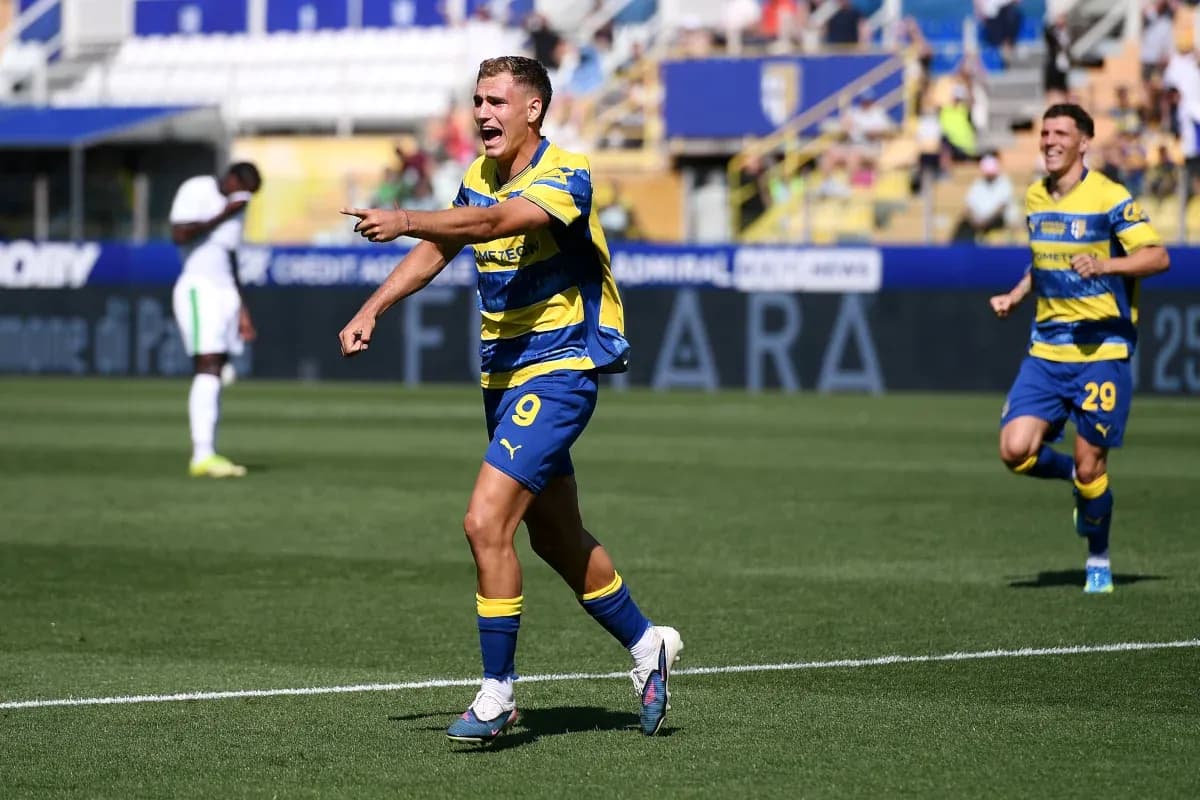
Parma Secures 1–0 Victory Over Sassuolo in Serie A Finale
Under the May sun at Stadio Ennio Tardini, Parma closed their Serie A season with a narrow but resonant 1–0 win over Sassuolo, a result that crystallised the contrasting identities of these two mid‑table sides. Following this result, Parma finished 13th on 45 points, with a goal difference of -18, while Sassuolo settled in 11th on 49 points and a goal difference of -4.
It was a meeting between one of the league’s most conservative attacks and a visiting side built on front‑foot flair. Overall this campaign, Parma scored just 28 league goals and conceded 46 across 38 matches. At home they averaged 0.8 goals for and 1.3 against, a profile of a team that survives through structure rather than firepower. Sassuolo, by contrast, lived in higher‑scoring territory: overall they hit 46 and shipped 50, averaging 1.2 goals both for and against. On their travels, they scored 21 and conceded 24, with an away average of 1.1 goals scored and 1.3 conceded.
Within that context, a single‑goal home win feels almost archetypal: Parma keeping the game tight, Sassuolo unable to translate their attacking pedigree into end‑product.
Tactical Voids and Absences
The team sheets told their own story of patched‑up squads and late‑season attrition. Carlos Cuesta doubled down on Parma’s defensive DNA with a 3‑5‑2, but did so without a swathe of creative and attacking options: A. Bernabe (muscle injury), B. Cremaschi (knee), N. Elphege (thigh), M. Frigan (knee), J. Ondrejka (leg), G. Oristanio (knee) and G. Strefezza (ankle) were all listed as missing. That cluster of absentees stripped Parma of dribblers between the lines and secondary goal threats, putting even more creative and physical load on Mateo Pellegrino and the double‑pivot behind him.
Sassuolo’s absences were more defensive and structural. Fabio Grosso had to navigate without D. Bakola, D. Boloca, F. Cande, E. Pieragnolo, S. Walukiewicz (all injured) and the inactive F. Romagna and A. Vranckx. The result was a back four where W. Coulibaly, T. Macchioni, J. Idzes and U. Garcia carried both build‑up responsibility and the burden of dealing with Parma’s direct play.
Disciplinary profiles framed the risk landscape. Parma’s season‑long card distribution shows a clear spike in yellow cards between 46–60 minutes and again in 76–90 minutes, both at 21.21%. The red‑card pattern is particularly telling: 40.00% of their reds came between 31–45 minutes, with further incidents in 61–75, 76–90 and 91–105. This is a side that can tilt into chaos in transition phases or when protecting a lead.
Sassuolo, meanwhile, were serial late‑game offenders. A striking 28.92% of their yellow cards arrived between 76–90 minutes, with another 14.46% in 91–105. Their red cards peaked between 46–60 minutes (50.00%), with additional dismissals in 16–30 and 76–90. Grosso’s team, for all their attacking verve, have a habit of losing emotional control just when game‑states become most volatile.
Key Matchups
Hunter vs Shield
At the sharp end, this fixture carried a fascinating duel between leading scorers. For Parma, Pellegrino entered as their primary finisher: overall he scored 9 league goals and added 1 assist, doing so while engaging in 546 duels and winning 233. He is not just a penalty‑box striker; he is the first defender and a constant aerial and physical reference. Parma’s overall attacking output at home – 16 goals in 19 matches – underlines how much of their end‑product flows through him.
Facing him was a Sassuolo defence that, on their travels, conceded 24 goals in 19 games. The away average of 1.3 goals against hints at vulnerability, particularly when the back line is stretched. J. Idzes and T. Macchioni were asked to hold a high line behind an adventurous 4‑3‑3, but against a player like Pellegrino, who thrives in contact and second balls, every long pass from the Parma back three became a potential crisis.
On the other side, Sassuolo arrived with two elite attacking weapons. A. Pinamonti matched Pellegrino’s league tally with 9 goals and 3 assists, taking 57 shots with 30 on target. His penalty record, though, carried a blemish: he missed 1 spot‑kick this season, a small but telling detail in a game decided by fine margins. Alongside him, D. Berardi contributed 8 goals and 4 assists, scoring 2 penalties but also missing 1. Their combined shot volume and set‑piece threat are usually the foundation of Sassuolo’s 1.2 goals per game.
Yet Parma’s defensive structure is built for exactly this sort of test. Across the season they kept 13 clean sheets overall, with the back three a key part of that resilience. M. Troilo, one of Serie A’s most card‑prone defenders, embodies their risk‑reward approach. In his 21 appearances he blocked 18 shots, a remarkable figure that speaks to a defender who lives in the line of fire. But his card ledger – 7 yellows, 1 yellow‑red and 1 straight red – shows how often that aggression spills over. Against Pinamonti’s penalty‑box movement and Berardi’s diagonal drifts inside, Troilo’s timing and restraint were always going to be decisive.
Engine Room
In midfield, the “engine room” battle set Parma’s collective against Sassuolo’s individual quality. H. Nicolussi Caviglia, C. Ordonez and M. Keita formed the central triangle in Cuesta’s 3‑5‑2, tasked with both screening and linking. Their job was to compress space around K. Thorstvedt, Sassuolo’s all‑action midfielder.
Thorstvedt’s season numbers underline his dual role. He scored 4 goals and supplied 4 assists, but also attempted 31 shots, made 44 tackles, 13 successful blocks and 32 interceptions. With 9 yellow cards, he walks the disciplinary tightrope, yet his 1055 passes at 82% accuracy show how often play flows through him. He is both enforcer and playmaker, the man who stitches Sassuolo’s 4‑3‑3 together.
Behind him, Nemanja Matic – one of the league’s top red‑card recipients – brings control and risk in equal measure. He completed 1721 passes at 86% accuracy, won 123 of 226 duels and made 43 tackles with 10 successful blocks. But his 7 yellow cards and 1 red are a constant caveat: as games become stretched, his interventions can turn from calming to catastrophic.
For Parma, the tactical brief was clear: deny Thorstvedt and Matic the central lanes, force Sassuolo wide, and trust the back three to handle crosses. The 3‑5‑2’s congestion in the middle, with wing‑backs S. Britschgi and E. Valeri dropping into a five when out of possession, effectively built a funnel that squeezed Sassuolo into predictable patterns.
On the flanks, A. Laurienté represented Sassuolo’s most creative outlet. Over the season he scored 7 goals and delivered 9 assists, with 54 key passes and 80 attempted dribbles, 29 of them successful. His duel count – 285, with 111 won – illustrates his willingness to repeatedly take on defenders. Against Parma’s left side, anchored by L. Valenti and supported by Valeri, this became a running subplot: the dribbler against the organiser.
Statistical Prognosis and Tactical Verdict
Following this result, the numbers and the narrative align. Parma, a side that averaged just 0.7 goals per game overall and failed to score in 16 matches, found precisely the type of contest they wanted: low‑tempo, territorially balanced, decided by a single moment. Their 13 clean sheets are not an accident; they are the product of a structure that values compactness over ambition.
Sassuolo’s season‑long xG profile (implied by their 46 goals from a 1.2‑per‑game average) suggests a team capable of creating enough to score in most matches, but their 50 goals conceded point to a defensive xG against that is too high for a side with European aspirations. On their travels, the blend of 1.1 goals scored and 1.3 conceded is the statistical fingerprint of volatility: they are rarely outclassed, but often undone by moments in both boxes.
In this match, Parma’s defensive solidity – epitomised by Troilo’s blocks and the collective discipline of the back three – suffocated Sassuolo’s front line just enough. Pinamonti and Berardi, both with penalties missed on their seasonal record, symbolise a broader inefficiency in critical moments. Laurienté’s creativity was channelled into wide areas where crosses met a forest of yellow shirts.
The tactical verdict is that Cuesta’s 3‑5‑2 out‑managed Grosso’s 4‑3‑3 in game‑state control. Parma leaned into their identity: low scoring, structurally rigid, willing to suffer. Sassuolo leaned into theirs: expansive, reliant on individual quality, but defensively porous. Over 90 minutes, the side with the clearer defensive blueprint prevailed, and the 1–0 scoreline feels less like a surprise and more like the logical endpoint of two season‑long trajectories intersecting on the final day.