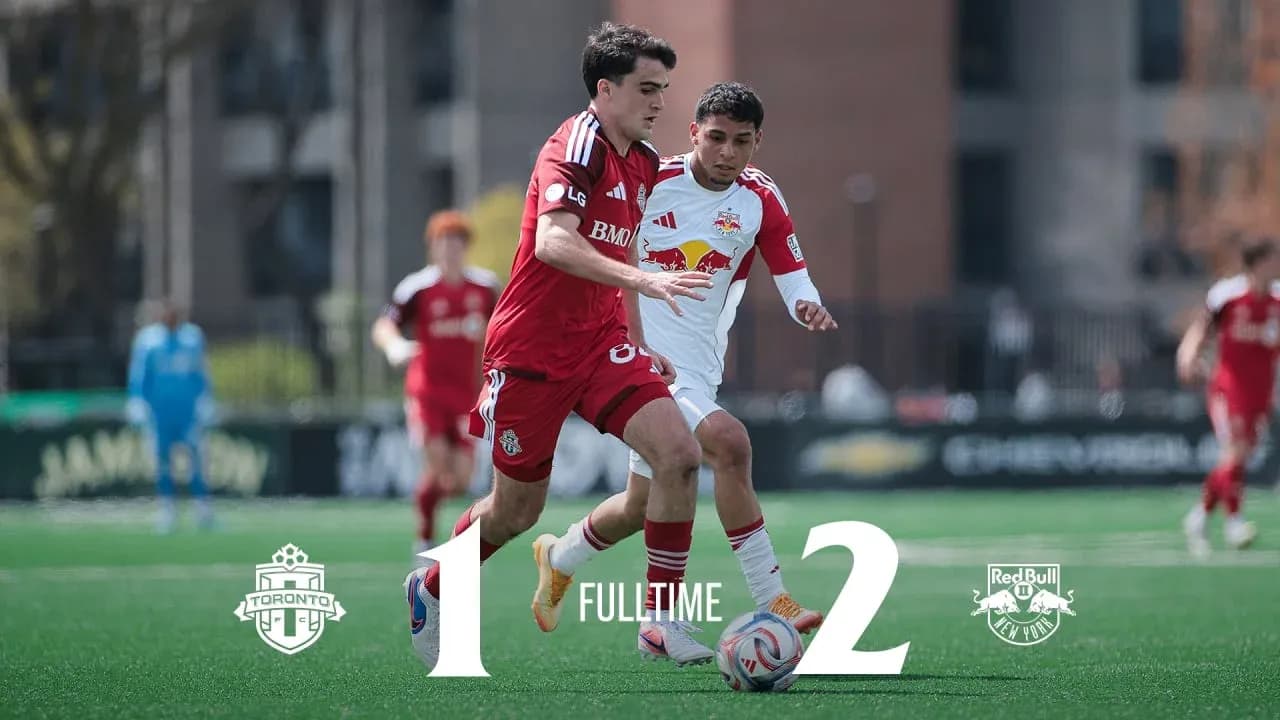
New York RB II Dominates Toronto II in MLS Next Pro Clash
The floodlights at York Lions Stadium dimmed on a 2–1 defeat for Toronto II, but the story of this MLS Next Pro Group Stage clash with New York RB II runs deeper than the scoreline. Following this result, the league’s form team from the Northeast Division extended their authority, while a fragile Toronto side were again reminded of the fine margins that define their season.
Match Overview
Heading into this game, the table already sketched the imbalance. Toronto II sat 4th in the Northeast Division and 10th in the Eastern Conference with 11 points from 9 matches, their overall goal difference at -1 from 14 goals for and 15 against. New York RB II, by contrast, arrived as Eastern Conference leaders, 1st in both their division and conference with 23 points from 9 games and a commanding overall goal difference of 13, built on 22 goals scored and only 9 conceded. This was the league’s most ruthless attack visiting a side whose season has swung between promise and collapse.
Seasonal Trends
Toronto’s seasonal DNA is that of volatility. Overall they average 1.6 goals for per game and 1.9 against, a profile that screams openness rather than control. At home, they had been slightly more convincing: 7 goals scored and 7 conceded across 4 matches, an average of 1.8 goals for and 1.8 against at York Lions Stadium. New York RB II, meanwhile, have been a machine. Overall they average 2.4 goals for and 1.2 against; on their travels, they still carry menace with 7 goals in 4 away games at an average of 1.8, conceding only 4 at an away average of 1.3.
Lineups
Gianni Cimini’s lineup reflected a young side still searching for a stable spine. A. De Rosario led the XI, flanked by the likes of R. Campbell-Dennis, R. Fisher, and J. Gilman, with L. Costabile and B. Boneau among those tasked with providing structure. T. Fortier and S. Pinnock offered running lanes, while A. Bossenberry, D. Dixon, and E. Khodri completed a group heavy on energy but light on proven MLS Next Pro experience.
On the opposite bench, New York RB II leaned into their identity: high tempo, vertical, and aggressive. T. Szewczyk, A. Modelo, J. Bazan, and A. Sanchez formed part of a side built to compress the pitch, while J. Masanka Bungi and N. Worth provided the connective tissue between lines. D. Cadigan and A. Rojas added guile, with D. Gjengaar, M. Jimenez, and D. Nelich giving the visitors multiple points of penetration.
Tactical Analysis
If tactical voids were to shape this match, they came not from formal absences but from structural weaknesses that have haunted Toronto II all season. Their goalsAgainst minute distribution paints a clear picture: 31.25% of their conceded goals arrive between 76–90 minutes, with another 25.00% between 46–60. This is a team that fades badly around the hour mark and again in the final quarter-hour. Offensively, their own surge is late: 30.77% of their goals come between 61–75 minutes and 23.08% between 76–90. The result is chaos at precisely the stages of the match where New York RB II are most comfortable turning the screw.
New York’s offensive timing is more balanced but equally ominous. They are at their most incisive between 16–30 minutes, where 22.73% of their goals are scored, and then maintain a steady threat: 18.18% in each of the 31–45, 61–75, and 76–90 windows. Against a Toronto side whose defensive structure unravels after the break, that consistency was always likely to tell.
Discipline and Tension
Discipline added another layer of tension. Toronto’s yellow-card profile shows a pronounced spike just before half-time and deep into the second half: 30.77% of their cautions come between 31–45 minutes and 23.08% between 76–90, with further weight in the 46–75 window. New York RB II, for their part, are a late-game powder keg: 40.00% of their yellows arrive between 76–90 minutes, and 20.00% between 61–75, with a red card already on their seasonal record in the 61–75 range. This is a side that does not back down as the match stretches; they escalate.
Match Dynamics
Within that context, the “Hunter vs Shield” dynamic was tilted heavily toward the visitors. New York RB II’s overall attack, averaging 3.0 goals at home and 1.8 away, faced a Toronto defense that concedes 1.8 at home and 2.0 on their travels. The intersection of New York’s late-game scoring consistency (18.18% of goals in both 61–75 and 76–90) with Toronto’s defensive collapse in those same windows (18.75% conceded from 61–75 and 31.25% from 76–90) always threatened to decide the contest. The 2–1 full-time scoreline simply confirmed the statistical script.
Engine Room
In the “Engine Room,” Toronto’s collective lacked a true metronome. Players like L. Costabile and B. Boneau were left to juggle ball progression with defensive fire-fighting. New York’s midfield cluster of N. Worth, D. Cadigan, and A. Rojas, by contrast, were able to impose the visitors’ pressing triggers, turning loose balls into quick, vertical attacks. With both sides boasting a perfect penalty record overall—each 1 scored from 1 taken, with no penalties missed—this match was always likely to be settled in open play rather than from the spot.
Expected Goals Perspective
From an Expected Goals perspective, New York RB II’s season-long profile suggests they consistently generate high-quality chances while limiting opponents. Their low overall goalsAgainst average of 1.2 and the fact that none of their matches have gone over the 3.5 or 4.5 conceded thresholds underline a defensive unit that bends but rarely breaks. Toronto II, with only 2 clean sheets overall and 3 matches where they failed to score, are more erratic at both ends.
Conclusion
Following this result, the prognosis for both squads diverges. For New York RB II, the 2–1 away win fits seamlessly into a campaign defined by control, late-game resilience, and a clear tactical identity. For Toronto II, it is another reminder that their attacking promise—1.8 goals at home on average—is being undermined by structural fragility in the very minutes when champions close games out. The numbers had warned of this storyline; the ninety minutes at York Lions Stadium simply wrote it in bolder ink.