Netherlands vs Japan: Tactical Analysis of the 2-2 World Cup Draw
Netherlands and Japan opened their World Cup Group Stage campaigns at AT&T Stadium with a tactically rich 2-2 draw that showcased contrasting structures and game plans. Ronald Koeman’s Netherlands imposed themselves for long stretches through a 4-3-3 focused on ball circulation and territorial control, while Hajime Moriyasu’s Japan, in a 3-4-2-1, leaned into compactness, vertical transitions and late-game attacking tweaks. The statistical profile underlines the balance: Netherlands had more of the ball and higher xG (0.79 to 0.54), but Japan’s structural flexibility and well-timed substitutions allowed them to recover twice and leave with a point.
Match Summary
Virgil van Dijk’s opener for Netherlands in the 51st minute, assisted by Ryan Gravenberch, was the natural outcome of sustained Dutch pressure and set-piece or second-phase dominance from their back line. Japan’s response was swift: six minutes later, Keito Nakamura equalised at 57’, finishing a move created by Takefusa Kubo’s supply from between the lines. The match’s disciplinary tone began to surface on 61’, when Crysencio Summerville (Netherlands) received a yellow card — “Foul” — reflecting the Oranje’s need to disrupt Japanese transitions.
Summerville immediately rebalanced his ledger in footballing terms, restoring the Dutch lead at 64’ with a goal assisted again by Gravenberch, a sequence that underlined the importance of Netherlands’ advanced interiors combining with wide forwards in the 4-3-3. The benches then became central to the tactical story. At 66’, Junya Ito (IN) came on for Daizen Maeda (OUT), giving Japan more direct wide running on the right. Koeman answered with a triple substitution at 70’: Teun Koopmeiners (IN) came on for Tijjani Reijnders (OUT), Quinten Timber (IN) came on for Crysencio Summerville (OUT), and Memphis Depay (IN) came on for Donyell Malen (OUT), collectively shifting Netherlands towards more control in midfield and a different reference point in attack.
Moriyasu’s decisive structural reshaping arrived at 75’, when Koki Ogawa (IN) came on for Takefusa Kubo (OUT), Takehiro Tomiyasu (IN) came on for Ritsu Doan (OUT), and Yukinari Sugawara (IN) came on for Tsuyoshi Watanabe (OUT). This reconfigured the Japanese back line and front unit, adding a more orthodox striker profile in Ogawa and fresh defensive legs. Netherlands made another defensive-leaning change at 81’, with Nathan Aké (IN) coming on for Ryan Gravenberch (OUT), sacrificing some progressive passing for stability on the left side.
The game’s disciplinary narrative continued at 83’, when Memphis Depay (Netherlands) was booked — “Foul” — a sign of Japan’s increasing ability to break Dutch lines and force emergency defending. At 84’, Kento Shiogai (IN) came on for Ayase Ueda (OUT), giving Japan another fresh forward. Netherlands’ final attacking adjustment arrived at 85’, with Brian Brobbey (IN) coming on for Cody Gakpo (OUT), adding physicality and depth running up front.
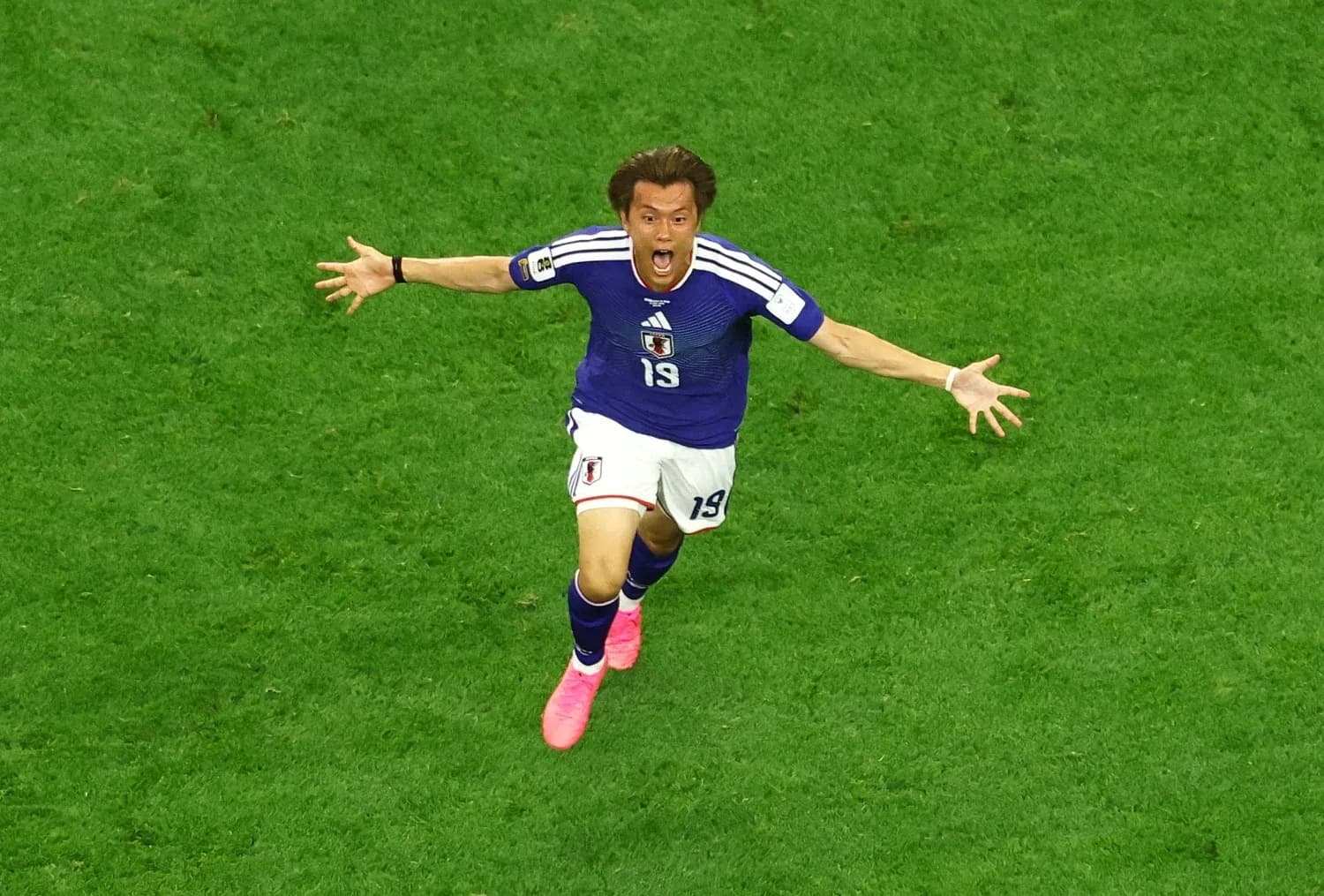
Japan’s persistence was rewarded in the 89th minute: Daichi Kamada struck the 2-2 equaliser, assisted by Koki Ogawa, a goal emblematic of Japan’s late-game territorial gains and improved presence around the Dutch box. The last major incident came in added time at 90+1’, when Micky van de Ven (Netherlands) received a yellow card — “Professional foul” — encapsulating the Netherlands’ need to halt a dangerous Japanese break and protect a point that had seemed within their grasp.
Tactical Overview
Structurally, Netherlands’ 4-3-3 sought to dominate through a high-volume passing game and positional width. With 60% possession and 525 total passes, they built patiently, funnelling progression through Frenkie de Jong and Ryan Gravenberch from the midfield three, with Tijjani Reijnders offering balance on the left side. The front line of Crysencio Summerville, Donyell Malen and Cody Gakpo stretched Japan horizontally, enabling full-backs — particularly Denzel Dumfries — to occupy advanced lanes and pin Japan’s wing-backs.
Japan’s 3-4-2-1, by contrast, prioritised central compactness and quick vertical access to their front three. The back three of Hiroki Itō, Shogo Taniguchi and Tsuyoshi Watanabe formed a narrow block, with Kaishu Sano and Daichi Kamada screening in front. Ritsu Doan and Keito Nakamura provided width and half-space occupation from the “midfield” band, while Takefusa Kubo and Daizen Maeda initially operated as mobile forwards ahead of Ayase Ueda. This structure aimed to absorb Dutch pressure, then break through Kubo’s creativity and Maeda’s runs into the channels.
Statistics
The shot profile reflects the tactical duel. Both sides registered 10 total shots and 1 blocked shot each, but Netherlands put 6 on target to Japan’s 3, mirroring their more consistent territorial dominance and ability to generate clean looks inside the box (10 Dutch shots inside the box versus 6 for Japan). Japan, however, diversified their threat with 4 shots from outside the box, a product of their attacking midfielders finding pockets at the edge of the area once the game opened up.
In possession, Netherlands were cleaner and more methodical: 525 passes, 464 accurate (88%), underscored a well-rehearsed positional play model. Japan’s 342 passes with 287 accurate (84%) showed a more direct and vertical approach, sacrificing volume for incision. Corner kicks (5 for Netherlands, 4 for Japan) were relatively balanced, but the Netherlands’ aerial threat, embodied by Virgil van Dijk’s goal, turned set-piece phases into a core attacking weapon.
Defensively, both teams committed 7 fouls, but the card distribution was asymmetric: Netherlands collected three yellows (Summerville, Depay, van de Ven), Japan none. This points to the Oranje being forced into more last-ditch or tactical interventions as Japan grew into the game. In goal, Bart Verbruggen (Netherlands) made 1 save, aligning with Japan’s 3 shots on target and their lower xG of 0.54; Zion Suzuki (Japan) produced 4 saves against 6 Dutch shots on goal, an important contribution in preserving the draw. The goals prevented metric (0.62 for both teams) suggests that each goalkeeper slightly outperformed the quality of chances faced, reinforcing the sense of a finely balanced contest where structural choices and in-game adjustments, rather than sheer chance volume, defined the 2-2 outcome.