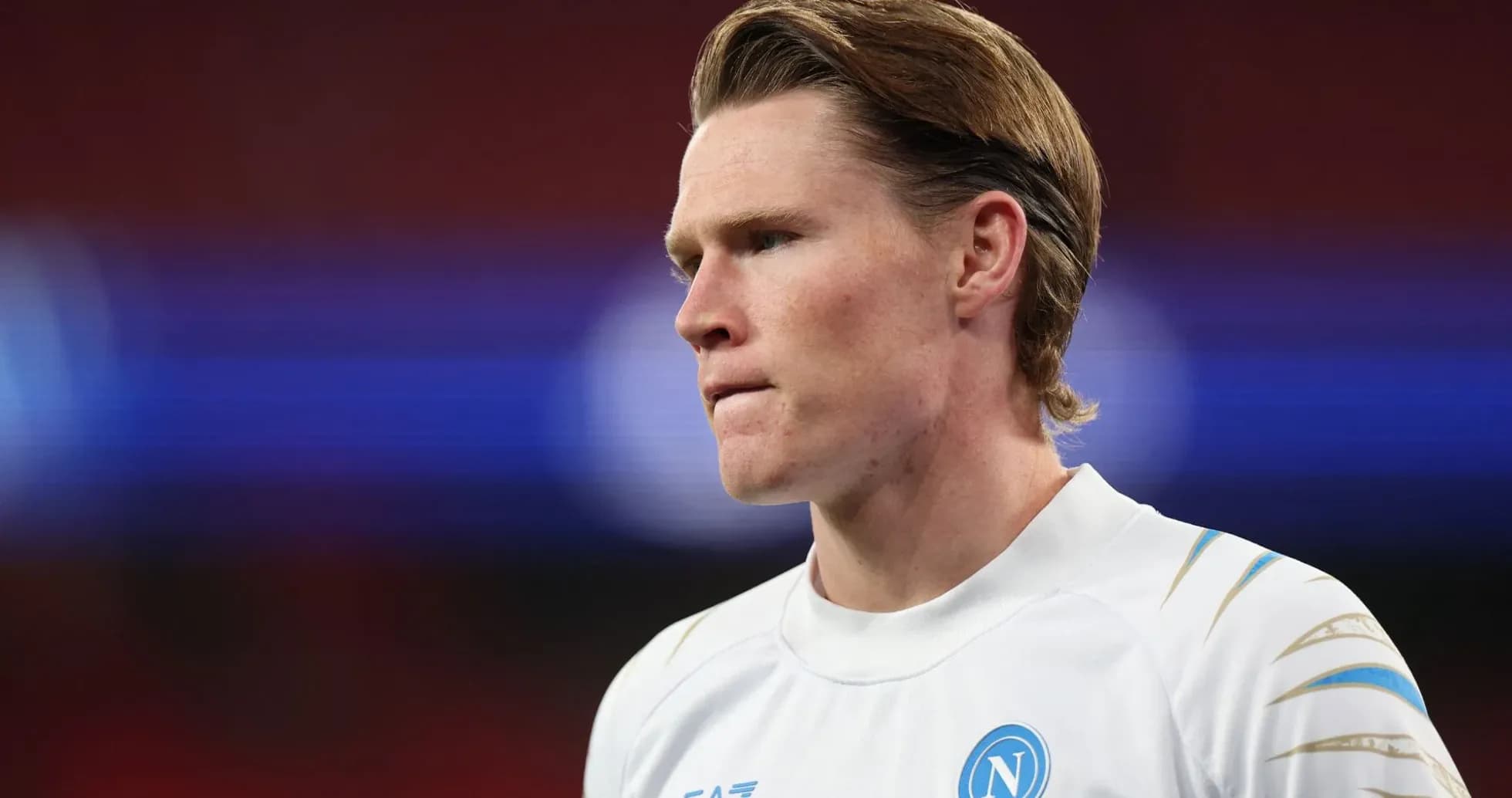
Scott McTominay's Transformation in Naples: From Manchester United to Star Player
Scott McTominay left Old Trafford with questions hanging over his ceiling. He has answered most of them in Naples.
Manchester United banked £26 million ($35m) when they sold the academy graduate after 255 senior appearances. He had been a regular, but never untouchable. A useful squad piece, not the heartbeat. Used largely as a deep-lying shield under Jose Mourinho and those who followed, his natural urge to break lines and attack was chained to the edge of his own box.
In Italy, those chains are gone.
From holding role to headline act
Napoli handed McTominay a different script and watched him tear it up. Pushed into a buccaneering No.10 role at Stadio Diego Armando Maradona, he has turned into a relentless runner between the lines, a late-arriving finisher and, crucially, a match-winner.
The numbers tell the story bluntly: 27 goals across two seasons. A league title. Division MVP. Ballon d’Or chatter that would have sounded fanciful during his final months in Manchester.
While United wrestle with their own identity, they are forced to watch one of their own thriving as the face of a new project elsewhere. Criticism has followed the club for letting a home-grown talent slip away just as he hit his peak years.
The noise around McTominay has not gone quiet in Naples either. Exit rumours have circled over the last couple of transfer windows, with Premier League links never far away. At the same time, reports suggest fresh terms running through to 2030 are on the table, underlining just how central he has become.
“Somebody in England” will be watching
For former Scotland defender Colin Hendry, McTominay’s renaissance in Serie A feels like a warning shot to clubs back home. Speaking to GOAL in association with Estafa.info, he made it clear that English sides will have taken note.
“Seeing what he's done for Napoli a couple of years back, such a massive influence on them and what they achieved, then there's going to be somebody in England probably thinking, ‘you know what, we wouldn't mind bringing that here because he has got that winning mentality’,” Hendry said.
He stressed that elite clubs are not short of ambition, but still see something rare in McTominay’s edge.
“And I'm not saying that the top six, top eight clubs don't have a winning mentality, but over the years, it’s not easy to find. So Scott, he was going to be a big player for us in the World Cup and the World Cup didn't work I don't think for him as it didn’t for a lot of Scottish players.”
World Cup high, World Cup hurt
McTominay’s role in dragging Scotland back to a World Cup for the first time since 1998 should not be forgotten. He supplied one of the campaign’s defining images with a stunning overhead kick in a crucial qualifier against Denmark, a goal that seemed to belong to a different era of Scottish footballing swagger.
Then came North America and another brutal lesson.
Scotland exited at the group stage again, with McTominay among those unable to bend the tournament to his will. Hendry did not hide his frustration when looking back.
“I was disappointed with Scotland in the World Cup, if I'm being honest. Then again, I suppose a lot of people would say that we were disappointing in 1998,” he admitted.
The on-field story jarred with the colour off it. The Tartan Army flooded the host cities, turning streets into a moving mass of blue and saltire flags. For Hendry, that travelling support became the tournament’s saving grace from a Scottish perspective.
“The one shining light about the World Cup in 2026 was the Tartan Army. They've now got history in America that's totally untouched. I've even seen some of the fans that are local to me, North East Tartan Army from Peterhead, they're back out in Boston in October - they're going back, they've got the boat and everything organised, it’s remarkable.”
The mood, though, shifted quickly once the football started to bite.
Fine margins, familiar regrets
“I think everybody was completely disappointed after 1-0 against Haiti,” Hendry said of the opening defeat that knocked the wind out of Scotland’s campaign. “The initial game really set us up - I mean, really, really set us up.”
Then came Morocco, and a bizarre twist of momentum.
“And in a strange fashion as well, us going down 1-0 within 70 seconds against Morocco actually worked in our favour a little bit because they had their noses in front and we had to then react. The good thing is that they didn't score a second or a third goal, but we had to actually react to that and had a practically whole game to do that.”
Scotland pushed, chased, appealed. Hendry is still convinced one key moment went against them.
“Could we have had a penalty on John McGinn? I think so. I think generally if that's a free-kick outside the box, which it would have been given as a free-kick outside the box, it's obviously a penalty if it's in the box and it wasn't given.”
One decision does not define a tournament, but it deepened the sense of opportunity missed. The parallels with 1998 were hard to ignore for Hendry, who lived through that campaign as a player.
“But I think on the whole, we were disappointing. But then again, as I said, people going back to 1998, it was disappointing in the end because we ended up getting gubbed by Morocco in the final game, which was a disappointment as well.”
For McTominay, the contrast is stark. A driving force in Naples, a nearly-man on the World Cup stage. The question now is not whether he belongs at the top level. It is where he chooses to show it next – under the southern Italian sun, or back under the glare of English floodlights.