Manchester United Dominates Brighton in Premier League Finale
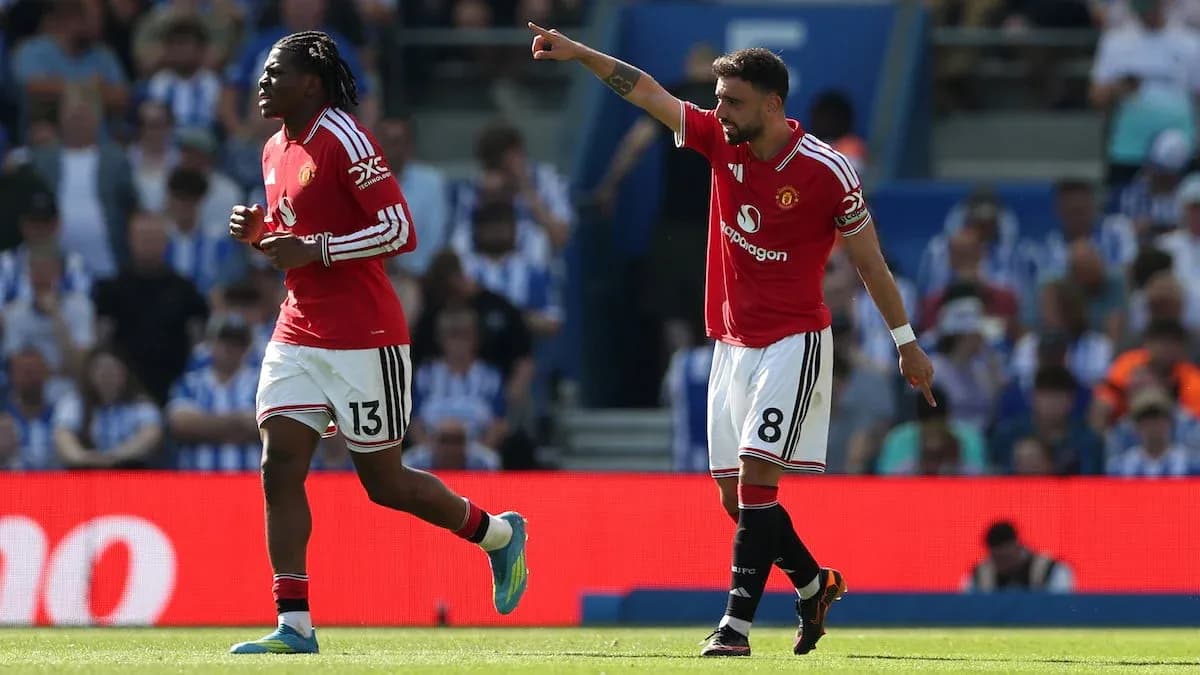
The Amex Stadium closed its Premier League season under a grey Sussex sky, but the narrative was painted in Manchester United red. Following this result, a 3–0 away win, Brighton’s ambitious push from mid‑table artistry to European regulars met the cold edge of an elite attack, while United under Michael Carrick underlined why they finished 3rd with 71 points and a total goal difference of 19.
Brighton, 8th with 53 points and a total goal difference of 6, came into the day as one of the division’s more balanced sides: in total this campaign they scored 52 and conceded 46, with a controlled home profile of 30 goals for and 20 against. Manchester United, meanwhile, travelled south as a high‑ceiling, occasionally chaotic machine: in total they hit 69 league goals and shipped 50, with 30 scored and 26 conceded on their travels. This was always going to be a duel between Brighton’s structured 4‑2‑3‑1 and United’s more explosive mirror shape.
I. The Big Picture – Shapes, context, and seasonal DNA
Both coaches went with their most familiar blueprint. Fabian Hurzeler trusted the 4‑2‑3‑1 that has been Brighton’s staple, a system they used in 33 league matches. Bart Verbruggen started behind a back four of M. Wieffer, Jan Paul van Hecke, Lewis Dunk and Ferdi Kadioglu. In front, the double pivot of Pascal Gross and James Milner was tasked with knitting build‑up, with a line of three – Diego Gomez, Jack Hinshelwood, and Milan De Cuyper – supporting lone forward Danny Welbeck.
Carrick matched the structure but not the intention. His 4‑2‑3‑1, used 20 times this league season, was more vertical and transition‑oriented. Senne Lammens was protected by a back four of Noussair Mazraoui, Harry Maguire, Lisandro Martinez and Luke Shaw. Kobbie Mainoo and Mason Mount formed the central platform, with Amad Diallo and Patrick Dorgu flanking Bruno Fernandes, while Bryan Mbeumo led the line.
Across the season, the numbers hinted at the underlying script. At home, Brighton averaged 1.6 goals for and 1.1 against; they were comfortable controlling territory but not ruthless. United away averaged 1.6 goals for and 1.4 against – dangerous but open. On this final day, the visitors imposed their attacking ceiling while largely muting Brighton’s usual Amex rhythm.
II. Tactical Voids – Absences and discipline
Both sides arrived with notable absentees that subtly reshaped their identities. Brighton were without Kaoru Mitoma, whose hamstring injury robbed Hurzeler of his most direct wide threat, and without S. Tzimas and Adam Webster, removing a rotation centre‑back option and some aerial security. That absence pushed more responsibility onto Dunk and van Hecke to manage United’s forwards in open space.
United were missing Casemiro, Benjamin Sesko and Matthijs de Ligt. Without Casemiro’s destructive presence and his 90 tackles plus 27 successful blocks across the league campaign, Carrick doubled down on a more technical pivot in Mainoo and Mount. The lack of De Ligt reduced aerial dominance at the back, but Maguire and Martinez compensated with positioning and aggression.
Across the season, the disciplinary profiles framed the emotional temperature of this fixture. Brighton’s yellow‑card distribution peaked between 46–60 minutes, where 27.91% of their bookings arrived, followed by late‑game spikes at 76–90 and 91–105 minutes (both 15.12%). United’s yellows also surged after the break, with 21.88% between 46–60 and 20.31% between 76–90, plus a notable 17.19% in stoppage time. Both teams have a habit of escalating intensity after half‑time; in a match where United raced to a 2–0 half‑time lead, that urgency manifested more in Brighton’s chasing than in United’s risk‑taking.
Crucially, United’s red‑card history – two between 46–60 minutes (66.67% of their reds) and one between 76–90 – did not resurface here. With Champions League football already secured, Carrick’s side managed the game with discipline, avoiding the self‑sabotage that has occasionally accompanied their aggression.
III. Key Matchups – Hunter vs Shield, Engine Room battles
The headline attacking duel was “Hunter vs Shield”: Bryan Mbeumo against Brighton’s defensive core. Mbeumo closed the league season as United’s leading scorer in this fixture context, with 11 goals and 3 assists in total this campaign. His 59 shots (32 on target) and 265 total duels, of which he won 86, underline a forward who constantly tests back lines with both movement and contact.
Up against him, Lewis Dunk embodied Brighton’s shield. Over 33 league appearances he amassed 27 successful blocks and 30 interceptions, alongside 217 duels with 127 won. Dunk’s distribution – 2,484 passes at 92% accuracy – usually allows Brighton to turn defence into controlled possession. But with Mitoma absent and Brighton’s wide outlets less explosive, United were able to press the first pass and keep Dunk penned in his own third rather than stepping into midfield.
In the “Engine Room”, the contrast was stark. Pascal Gross and Milner are metronomes rather than destroyers, and against United’s trio of Mainoo, Mount and Fernandes they were often outnumbered between the lines. Bruno Fernandes, the league’s top creator with 21 assists and 9 goals, orchestrated the central channel. His 1,994 passes with 137 key passes and 7.63 average rating this season speak to a player who doesn’t just see the game – he bends it.
Without Casemiro, United’s pressing and counter‑pressing were more collective than anchored. Mainoo’s positioning and Mount’s energy allowed Fernandes to stay higher, constantly exploiting the pockets behind Brighton’s double pivot. For Brighton, Diego Gomez and Hinshelwood tried to occupy those same spaces, but United’s back four, especially Martinez stepping into midfield, squeezed them effectively.
Out wide, Shaw’s duel with De Cuyper and Hinshelwood was another hinge. Shaw, who committed 49 fouls and collected 9 yellow cards in total this campaign, played on the edge but effectively. His willingness to step high restricted Brighton’s left‑side combinations, and with no Mitoma to threaten the space behind him, he could be aggressive without constant fear of the ball over the top.
Up front, Danny Welbeck carried Brighton’s scoring burden. With 13 goals and 1 assist in total this campaign, plus 46 shots (28 on target), he has been their penalty‑box reference. Yet his penalty record – 1 scored but 2 missed – hints at a finishing profile that can be streaky. Against Maguire and Martinez, Welbeck was often isolated, forced to drop into midfield to connect play rather than attacking the box in numbers.
IV. Statistical Prognosis – xG logic and defensive solidity
Even without explicit xG values in the data, the season‑long trends explain why a 3–0 away win for United fits the underlying pattern. On their travels, United’s 1.6 average goals for and 1.4 against suggest high‑event matches where their attacking quality usually wins out. Brighton at home, with 1.6 goals for and 1.1 against, are solid but not suffocating; they rely on efficiency rather than volume.
Defensively, Brighton’s total of 10 clean sheets (5 at home, 5 away) shows a competent but not elite back line. United’s 8 clean sheets (4 home, 4 away) are similar, but their attacking ceiling – 69 total goals versus Brighton’s 52 – gives them a larger margin for error. When United score first, especially away, their transition game and Fernandes‑led creativity tend to inflate the shot quality of subsequent chances.
Brighton’s penalty record – 3 taken, all 3 scored in total this campaign – is perfect from the spot, but Welbeck’s individual tally of 2 misses reminds us that not every high‑value chance has been converted. United, by contrast, were ruthless from 12 yards, scoring all 4 penalties they took in total this season, with Fernandes himself converting 4 but also missing 2. Across the campaign, both sides have flirted with volatility in big moments, yet United’s volume of chances has consistently outweighed their occasional wastefulness.
Following this result, the story of the day and the season converge: Brighton, 8th and heading into Conference League qualification, remain one of the league’s most tactically literate sides, but their lack of top‑end firepower and the absence of Mitoma limited their threat when chasing the game. Manchester United, 3rd and bound for the Champions League league phase, showed that when their 4‑2‑3‑1 clicks – with Mbeumo stretching, Fernandes scheming, and a disciplined back four – their attacking structure and statistical profile justify their place among the Premier League’s elite.