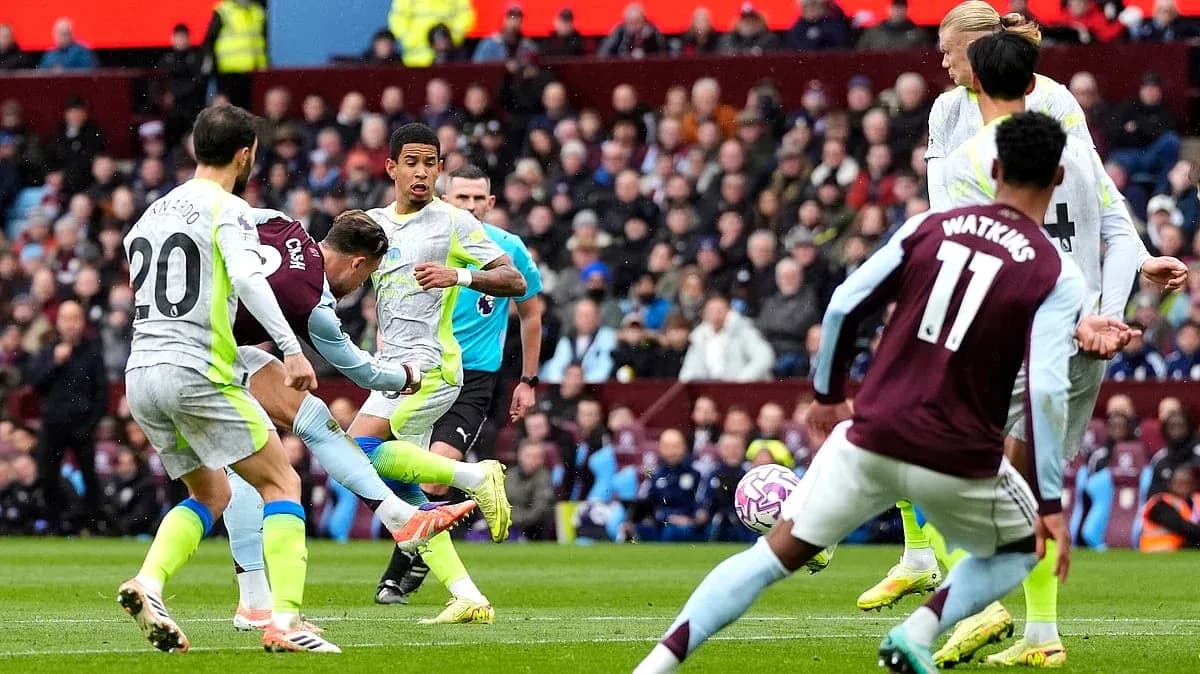
Manchester City vs Aston Villa: A Final-Day Upset
Etihad Stadium’s final-day drama ended with the script flipped: Manchester City, chasing perfection at home, beaten 2-1 by an Aston Villa side that arrived patched-up but tactically precise. Following this result, City close the Premier League season in 2nd on 78 points, with a goal difference of 42 (77 scored, 35 conceded), while Villa cement 4th on 65 points, their own goal difference a far slimmer 7 (56 for, 49 against). Over 38 matches, City’s campaign has been defined by control and volume – 77 goals in total at an average of 2.0 per game – but here they were undone by Emery’s structural clarity and Villa’s ruthless use of their attacking spearhead.
I. The Big Picture – Structures and Season DNA
Guardiola rolled out a bold 4-2-2-2, an echo of his more experimental shapes this season. J. Trafford in goal sat behind a back four of R. Lewis, J. Stones, R. Dias and N. Ake. Ahead of them, the double pivot of Nico and B. Silva underpinned two attacking midfield lanes: A. Semenyo and Savinho. Up front, P. Foden and T. Reijnders formed a fluid front two, both comfortable dropping into pockets rather than playing as a fixed No.9.
It was an aggressive twist on a season-long template. Heading into this game, City at home had been a machine: 14 wins from 19, scoring 45 at an average of 2.4 and conceding just 14 at 0.7. The 4-2-2-2 had only been used twice across the campaign, but the underlying idea was familiar – overloads between the lines, width from the “tens”, and full-backs stepping into midfield when possible.
Unai Emery answered with his trusted 4-2-3-1, a shape Aston Villa have used in 34 league matches. M. Bizot replaced the injured E. Martinez in goal, with a back four of A. Garcia, V. Lindelof, T. Mings and I. Maatsen. The double pivot of L. Bogarde and Douglas Luiz sat behind a creative band of three – L. Bailey, R. Barkley and E. Buendia – supporting lone striker O. Watkins.
Villa’s seasonal identity is clear in the numbers: 56 goals in total at 1.5 per game, but with more incision at home (1.7) than on their travels (1.3). Defensively, they concede 1.3 overall, rising to 1.4 away. Yet their ceiling is high – an eight-match winning streak, and the ability to win away 0-2 when their structure bites.
II. Tactical Voids – Absences and Discipline
The team sheets underlined Villa’s jeopardy. Alysson, B. Kamara and E. Martinez were all listed as “Missing Fixture”, stripping Emery of his first-choice goalkeeper and a key midfield enforcer. That pushed greater responsibility onto Douglas Luiz as the senior pivot and forced Bogarde into a role where his positioning, rather than pure physicality, would be tested.
City, by contrast, arrived without major flagged absences in this dataset, but with the tactical void of no orthodox No.9 on the pitch despite E. Haaland’s 27 league goals in total this season. Leaving such a penalty-box force on the bench – and a player who has both 27 goals and 8 assists in total – framed the narrative: could Guardiola’s positional play outthink Villa’s compact 4-2-3-1 without its most brutal finisher?
Disciplinary trends hinted where the contest might turn spiky. Over the season, City’s yellow cards skew late, with a peak between 76-90 minutes at 20.90%, while Villa’s discipline frays just after half-time, with 29.31% of their yellows arriving between 46-60 minutes. Although specific bookings from this match are not listed, the underlying pattern suggested a second-half in which City might grow increasingly desperate and Villa increasingly cynical in transition.
III. Key Matchups – Hunter vs Shield, Engine Room
The headline duel was always going to be O. Watkins against City’s defensive shield. Watkins has 16 league goals in total, supported by 3 assists, off 60 shots with 38 on target – a classic modern No.9 who thrives on early balls into channels and quick combinations around the box. His battle with R. Dias and J. Stones was as much about movement as muscle: peeling into the space behind Lewis or Maatsen, testing City’s high line.
Across the season, City’s defensive platform has been elite. Overall they concede just 0.9 goals per game, and at home that drops to 0.7. The centre-back pairing has been the core of that, with Dias’ aggression and Stones’ stepping into midfield to create overloads. Yet Villa’s away profile – 24 goals scored, 27 conceded – is that of a team happy to trade punches if they can drag the game into broken phases.
The true chessboard, though, lay in the engine room. B. Silva, with 2 goals, 4 assists and 2196 passes at 90% accuracy in total, is City’s metronome and agitator, and his 53 tackles plus 6 blocked shots underline how hard he works without the ball. He had to orchestrate against Douglas Luiz and Bogarde, who were tasked with screening the lines into Foden and Reijnders while also tracking the inward drifts of Savinho and Semenyo.
On Villa’s side, creativity is usually heavily channelled through M. Rogers over the season – 10 goals, 6 assists and 1067 passes in total – but in this fixture he did not feature in the listed XI, pushing more responsibility onto Barkley and Buendia as the central and left-sided creators. That made L. Bailey’s role on the right critical: his pace against N. Ake and the half-space outside Stones offered Villa an obvious out-ball whenever they broke City’s press.
Off the bench, Guardiola had the league’s second-ranked assist provider R. Cherki (12 assists in total) and the multi-functional M. Nunes and M. Kovacic. Emery could turn to L. Digne, whose 6 assists in total from left-back reflect his crossing threat, and J. McGinn to stiffen midfield or add late pressing energy.
IV. Statistical Prognosis and Tactical Verdict
From a pure numbers perspective, City’s home metrics and defensive record suggest they would usually control xG, pin Villa back and limit them to counters. Their 16 clean sheets in total, 9 of them at home, underline that solidity. Villa, with just 3 away clean sheets and 27 goals conceded on their travels, typically allow chances.
Yet this match unfolded as the exception that proves the rule. The 1-2 full-time scoreline at the Etihad speaks of Villa maximising the moments when City’s shape stretched. With City’s yellow-card peak in the final quarter and Villa’s knack for turning games in the early second half, the tactical intersection was always going to be around the 46-75 minute window: City pushing for control, Villa waiting for the transition that would tilt the xG balance with a high-quality counter.
Following this result, the broader tactical lesson is stark. City’s season-long xG profile would still likely show them as the stronger side in chance volume, but Villa’s structure, Watkins’ efficiency and Emery’s use of a disciplined 4-2-3-1 allowed them to out-punch a side that, on paper, should suffocate opponents at the Etihad. In a campaign defined by City’s relentless control and Villa’s surging streaks, this final-day meeting became the moment where Emery’s hunters slipped past Guardiola’s shield.