Liverpool vs Brentford: Premier League Season Finale Review
Anfield’s final act of the 2025–26 Premier League season ended in stalemate, a 1–1 draw between Liverpool and Brentford that neatly distilled both teams’ seasonal identities. In total this campaign, Liverpool finished 5th on 60 points with a goal difference of 10 (63 scored, 53 conceded), while Brentford closed in 9th on 53 points and a goal difference of 3 (55 scored, 52 conceded). Following this result in Round 38, the table tells of a Liverpool side that attacked with ambition but leaked too many goals, and a Brentford outfit that punched above its weight with a defined structure and a ruthless centre-forward.
Arne Slot doubled down on Liverpool’s season-long template, rolling out the familiar 4-2-3-1 that has been his default (34 league matches with this shape). Alisson sat behind a back four of C. Jones, Ibrahima Konaté, Virgil van Dijk and Andrew Robertson. In front, a double pivot of Ryan Gravenberch and Alexis Mac Allister sought to control tempo, with an attacking trio of Mohamed Salah, Dominik Szoboszlai and the young R. Ngumoha supplying Cody Gakpo as the lone forward.
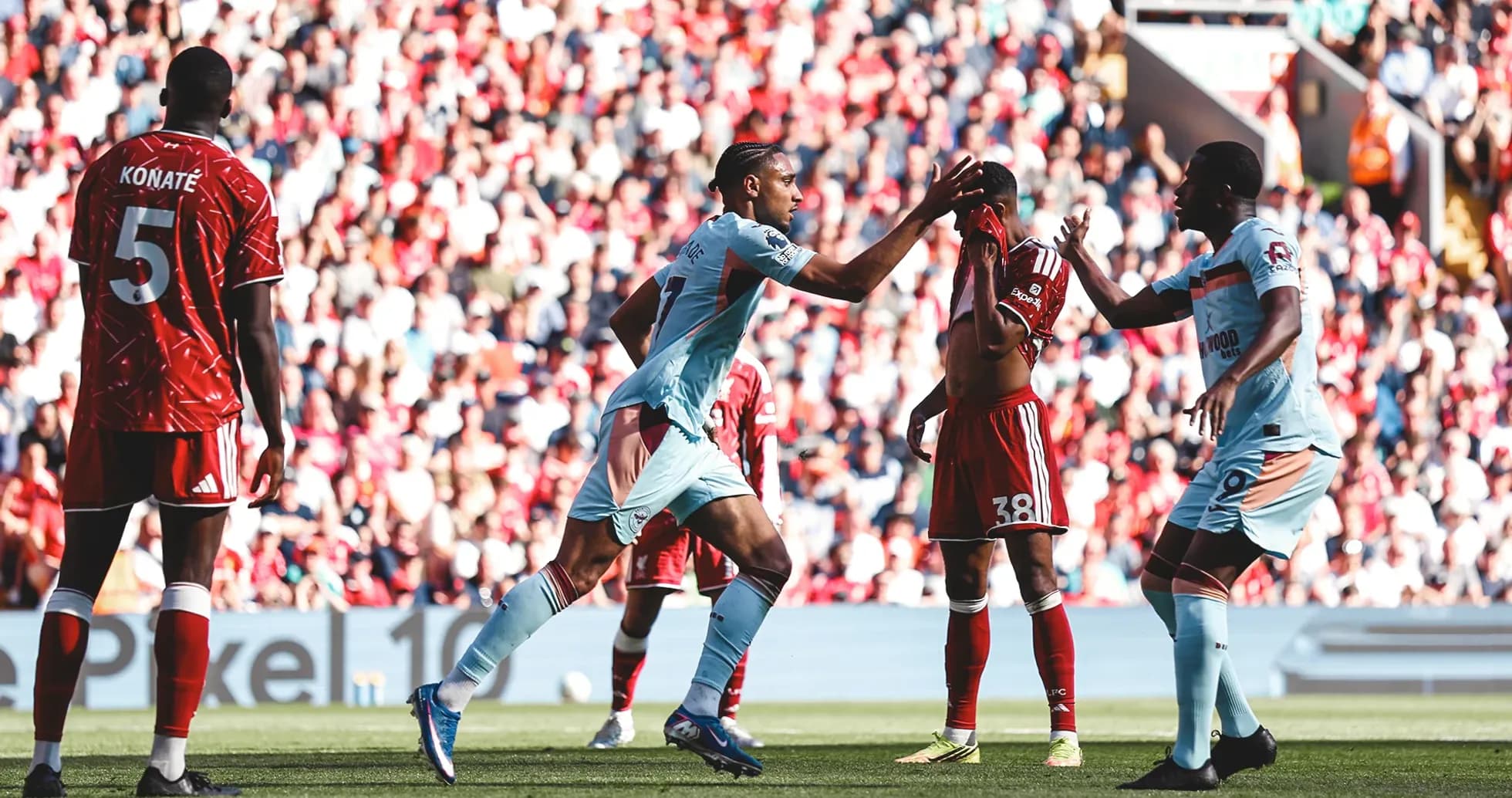
Across from them, Keith Andrews mirrored the structure with his own 4-2-3-1, a shape Brentford have used 29 times in total this season. Caoimhín Kelleher, returning to Anfield in different colours, marshalled a defence of M. Kayode, Sepp van den Berg, Nathan Collins and K. Lewis-Potter. The midfield screen came from J. Henderson and Vitaly Janelt, while D. Ouattara, Mathias Jensen and Kevin Schade buzzed behind the league’s second-ranked marksman: Igor Thiago.
The tactical voids on both sides were significant. Liverpool’s absentee list – S. Bajcetic (hamstring), C. Bradley (knee), H. Ekitike (Achilles) and G. Leoni (knee) – stripped Slot of both depth and variety. Ekitike’s absence was particularly acute: in total this campaign he scored 11 league goals and added 4 assists, a secondary scoring threat that would have allowed Liverpool to flex between a central target and more fluid wide rotations. Without him, Gakpo had to shoulder more of the penalty-box burden, with Salah and Szoboszlai asked to create and finish in equal measure.
Brentford, too, were shorn of key options. Fábio Carvalho (knee), Rico Henry (hamstring) and A. Milambo (knee) all missed out, limiting Andrews’ ability to switch into the more conservative 5-3-2 he has used 5 times this season. The absence of Henry, in particular, removed a natural left-sided outlet and forced Lewis-Potter into a more defensive brief than his instincts prefer.
Discipline has quietly shaped both squads’ personalities. Heading into this game, Liverpool’s yellow cards showed a pronounced late-game spike: 31.58% of their cautions arrived between 76-90 minutes, a reflection of a side that often chases matches with aggressive pressing. Their only red card in the league came from Szoboszlai, shown in the 91-105 minute window, underlining how his high-energy style can teeter on the edge. Brentford, for their part, also skew late: 26.09% of their yellows fell in the 76-90 band, while their lone red was shown between 31-45 minutes, a reminder that their combative edge can occasionally spill over before half-time.
Within that disciplinary frame, the individual duels were compelling. In the “Hunter vs Shield” matchup, Igor Thiago arrived as Brentford’s spearhead and one of the league’s most efficient finishers. In total this campaign he scored 22 league goals with 1 assist, hitting the target with 43 of his 67 shots. He also converted 8 penalties but missed 1, a small but telling blemish that prevents his record from being flawless from the spot. His physical profile – 524 duels contested, 202 won – makes him a constant wrestling match for centre-backs.
Waiting for him was van Dijk, the anchor of a Liverpool defence that, in total, conceded 53 league goals. At home, though, Liverpool were tighter: only 20 goals conceded at Anfield, an average of 1.1 per game, supported by 5 home clean sheets. Konaté’s aggression alongside van Dijk’s composure was designed to limit Thiago’s touches in the box and to win first contact on crosses, a crucial detail against a striker who thrives on quick service and second balls.
In the “Engine Room” battle, Szoboszlai and Mac Allister squared up against Henderson and Janelt. Szoboszlai’s numbers across the season underline his status as Liverpool’s metronome and aggressor: in total 6 goals, 7 assists, 2,184 passes with 78 key passes and an 87% accuracy rate, plus 55 tackles and 8 blocked shots. His one missed penalty this season also looms in the background – a reminder that even his reliability has limits in high-pressure moments. Mac Allister, quieter statistically, complements him with positional intelligence and progressive passing lanes.
Brentford’s answer lay in Henderson’s experience and Janelt’s work rate. Their job was twofold: compress the central spaces where Szoboszlai likes to step into shooting positions, and shepherd Liverpool’s attacks wide, where crosses could be attacked by Collins and van den Berg. Schade, meanwhile, walked the disciplinary tightrope: 6 yellows and 1 red in total, plus 2 penalties won but 1 missed, embodying Brentford’s risk-reward edge on the counter.
From a statistical standpoint, the 1–1 scoreline felt like a meeting point between Liverpool’s attacking volume and defensive fragility, and Brentford’s efficiency and resilience. At home, Liverpool averaged 1.8 goals scored and 1.1 conceded; Brentford, on their travels, averaged 1.2 scored and 1.6 conceded. The expected pattern, then, was a match where Liverpool generated the higher xG through sustained pressure and shot volume, while Brentford sought to keep the game within a single moment for Thiago or a late surge.
Given Liverpool’s tendency to collect cards late (31.58% of yellows in the final quarter-hour) and Brentford’s own late-booking profile (26.09% in the same window), the closing stages were always likely to be frantic, with tired legs and stretched distances opening channels for counters and set-piece drama. The underlying numbers suggest Liverpool’s xG edge would have been narrow rather than overwhelming, offset by Brentford’s knack for turning limited chances into high-quality looks for their No. 9.
Following this result, the narrative is of a Liverpool side that remains a Champions League-level force in total – 63 goals scored at an average of 1.7 per game – but one still searching for defensive control away from Anfield. Brentford, meanwhile, leave with a point and a statement: a mid-table ranking masking a side with a clear tactical identity, a prolific centre-forward, and enough structure in a 4-2-3-1 to trouble the league’s elite on their own turf.