Ivory Coast vs Ecuador: World Cup Group E Tactical Analysis
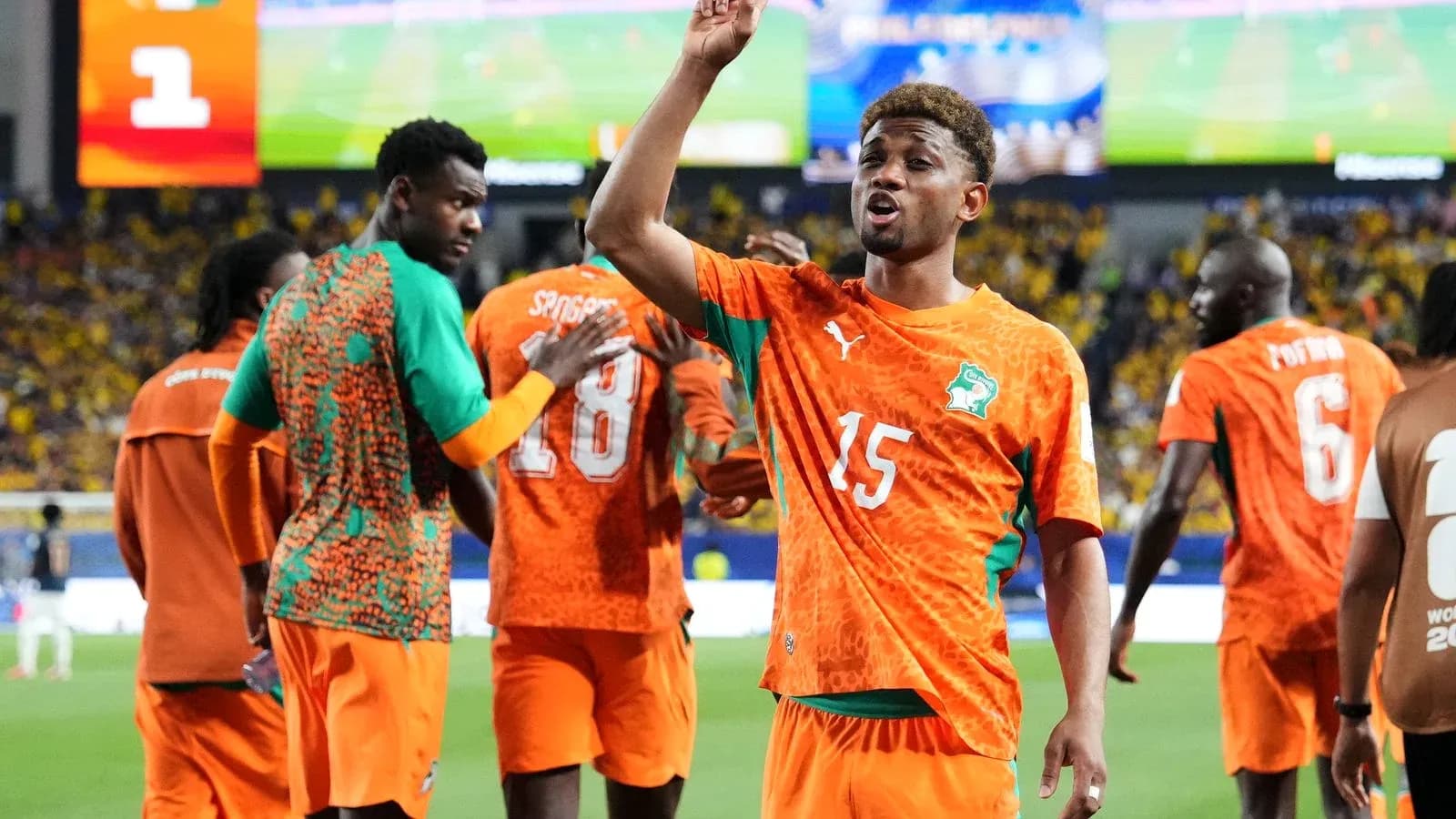
On a humid Philadelphia night at Lincoln Financial Field, Ivory Coast and Ecuador opened their World Cup Group E campaigns with a contest that felt more like a knockout tie than a group-stage curtain-raiser. The 1–0 scoreline to Ivory Coast, sealed in regulation time, was narrow, but the implications were broad: three points, a clean sheet, and a statement of tactical clarity from Emerse Fae.
Following this result, the standings snapshot is simple but telling. Ivory Coast sit 2nd in Group E with 3 points and a goal difference of +1, having scored 1 and conceded 0 in total. Ecuador, beaten 1–0, occupy 3rd with 0 points and a goal difference of -1, yet to score and already chasing the group.
I. The Big Picture – Two 4-4-2s, One Clearer Identity
Both sides lined up in a 4-4-2, but the symmetry ended on paper. Ivory Coast’s version was aggressive and vertical: Y. Fofana in goal; a back four of G. Konan, E. Agbadou, W. Singo, and G. Doue; a powerful midfield band of B. Toure, S. Fofana, F. Kessie, and Y. Diomande; and the front pairing of N. Pepe and E. Wahi.
Ecuador mirrored the shape but with a different intention. H. Galindez anchored a back line of P. Hincapie, W. Pacho, J. Ordonez, and A. Franco. Across midfield, A. Minda, P. Vite, M. Caicedo, and J. Yeboah were tasked with knitting transitions to the strike duo of G. Plata and E. Valencia.
Heading into this game, Ivory Coast’s seasonal DNA was already clear from the small sample: 1 win from 1, 1.0 goalsFor total at home on average, 0.0 goalsAgainst total, and a 4-4-2 used in all fixtures. Ecuador arrived with a mirror image in reverse: 1 loss from 1, 0.0 goalsFor total, 1.0 goalsAgainst away on average, and the same 4-4-2 framework but without the same cutting edge.
II. Tactical Voids – Discipline, Risk, and the Edges of Control
With no official absentees listed pre-match, both coaches had full decks to play from. The differences emerged in how they managed risk.
Ivory Coast’s card profile across the tournament so far shows a first-half edge. All of their yellow cards have come before the interval, with 33.33% between 16–30 minutes and 66.67% between 31–45 minutes. That aggressiveness was embodied by S. Fofana, who not only took a yellow card but also blocked 1 shot and made 2 interceptions in his 77 minutes. He walked the line between control and chaos, and Fae’s decision to withdraw him late was as much about tournament management as it was about the night.
Ecuador’s disciplinary curve is different. Their only recorded yellow card so far lands between 61–75 minutes, a 100.00% concentration in that phase. J. Porozo, introduced from the bench, committed 2 fouls and took a booking in his 28 minutes, underlining a reactive, chase-the-game mentality rather than proactive control. The absence of any red cards for either side keeps the narrative to fine margins rather than implosion, but Ecuador’s defensive substitutes were clearly firefighting rather than dictating.
III. Key Matchups – Hunter vs Shield, Engine Room vs Enforcer
Hunter vs Shield
In total this campaign, Ivory Coast have been ruthlessly economical: 1 goal from 1 match, 1.0 goalsFor average at home, and 0.0 goalsAgainst total. Ecuador’s defensive record – 1 goal conceded in total, all on their travels, for an average of 1.0 away – suggests they are not porous, but they are not impenetrable either.
The defining attacking “hunter” in this Ivorian side is, intriguingly, not one of the starting forwards but A. Diallo. From the bench, he has produced 1 goal in 34 minutes, with 2 shots total, both on target, and an 8.2 rating. His 6 dribble attempts with 5 successes and 8 duels with 6 won paint him as a late-game disruptor – the kind of wide forward who can tear at tiring full-backs in the 60–90 minute band.
Against an Ecuador defence that leans on the composure of W. Pacho and the aggression of P. Hincapie, Diallo’s ability to receive under pressure, beat his man, and still maintain an 82% pass accuracy (17 passes total, 1 key pass) is a direct threat to their structure. Ecuador’s clean-sheet record – 0 in total – underlines that their “shield” is still unproven at this level.
Engine Room – Kessie and S. Fofana vs M. Caicedo
The midfield battle was and will remain the true axis of this matchup. F. Kessie, operating as the stabilising eight, allowed S. Fofana to oscillate between lines. Fofana’s 36 passes total with 88% accuracy and 1 key pass show a player who can both circulate and puncture. His defensive output – 1 blocked shot, 2 interceptions – hints at a two-way role that tilts the pitch in Ivory Coast’s favour.
Across from them, M. Caicedo is Ecuador’s enforcer and metronome. While his individual stat line is not detailed here, his positional brief is clear from the structure: shield the back four, launch transitions to Plata and Valencia, and compress space between the lines. The problem for Ecuador is that with 0 goalsFor total and 1.0 goalsAgainst away on average, the balance between his defensive duties and progressive passing is not yet translating into end product.
IV. Statistical Prognosis – Margins, xG Logic, and Tournament Trajectories
Even without explicit xG numbers, the patterns are readable. Ivory Coast create enough to justify their 1.0 goalsFor total; they have not yet failed to score in any match and have 1 clean sheet in total. Their failedToScore total is 0, their penalty record is neutral (0 taken, 0 missed), and their biggest home win – 1–0 – matches this result exactly. This is a side whose scorelines may be tight, but whose control metrics are strong.
Ecuador, by contrast, sit on 0 goalsFor total and have already failed to score once on their travels. Their away goalsAgainst average of 1.0 suggests they are consistently in one-goal games but currently on the wrong side of the margins. With no penalties won or missed, there is no easy route to inflate their xG via spot-kicks; they must manufacture chances from open play.
Following this result, the tactical verdict is clear. Ivory Coast’s 4-4-2 is not just a formation; it is an identity built on a disciplined first-half press, a physically dominant midfield, and the option to unleash A. Diallo as a late-game accelerator. Ecuador’s mirrored shape lacks that same vertical threat and is overly reliant on M. Caicedo’s ability to both destroy and create.
If we project forward on expected goals logic, Ivory Coast’s combination of solid defensive numbers (0.0 goalsAgainst total) and reliable scoring (1.0 goalsFor total, no failures to score) positions them as favourites in similarly balanced fixtures. Ecuador will need to shift their midfield risk profile and find a way to turn structure into shots; otherwise, they remain a team whose defensive solidity is not enough to outweigh their attacking bluntness.