Iran and New Zealand Play to Tactical 2-2 Draw
Iran and New Zealand played out a tactically nuanced 2-2 draw at SoFi Stadium, a match where contrasting structures and in-game adjustments produced a genuinely balanced contest. Iran’s 4-4-2 under Amir Ghalenoei sought verticality and wing progression, while D. Bazeley’s New Zealand used a 4-2-3-1 to control rhythm through an extra man in midfield. The statistical profile — 52% possession and cleaner passing for New Zealand against Iran’s shot volume and territorial surges — underlined a clash of styles in which neither side fully imposed itself for long stretches, but both found repeatable attacking patterns.
Executive Summary
Iran’s 4-4-2 was built around direct connections into the front two and aggressive full-back involvement, particularly from Ramin Rezaeian on the right. New Zealand’s 4-2-3-1 revolved around Chris Wood as a reference point, with Sarpreet Singh and Elijah Just rotating in the half-spaces. The 2-2 scoreline reflected the underlying numbers: Iran generated 17 total shots (10 inside the box) and 1.5 xG, New Zealand 14 shots (also 10 inside the box) and 1.24 xG. Each side had clear attacking triggers, but defensive structures were repeatedly stressed by the opponent’s strongest channels.
Scoring Sequence & Disciplinary Log
New Zealand struck first from a classic 4-2-3-1 pattern. At 7', Elijah Just (New Zealand) finished a move assisted by Chris Wood, exploiting the space between Iran’s centre-backs and full-backs as the front four combined quickly once the double pivot had secured possession.
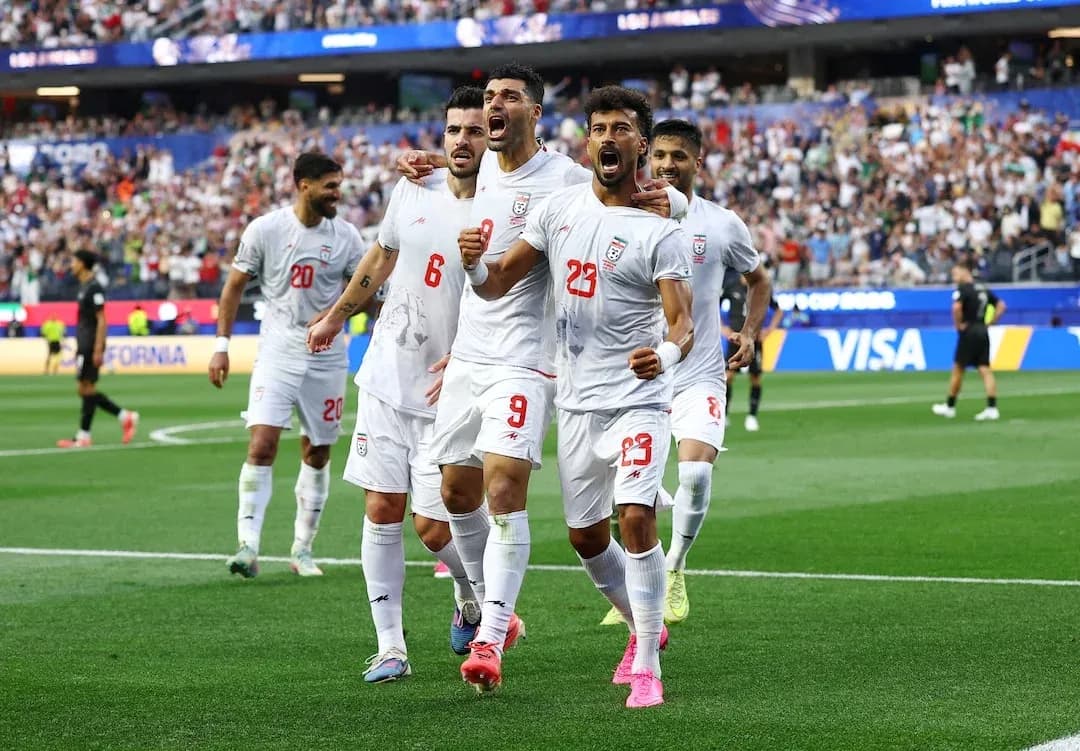
Iran’s response at 32' came from their right flank. Ramin Rezaeian (Iran), nominally the right-back in the 4-4-2, advanced high and found himself in a finishing position, levelling the match 1-1. The goal encapsulated Iran’s intent to overload wide zones and push both full-backs beyond the midfield line.
New Zealand reasserted themselves at 54' with a near carbon copy of their opener. Again, Elijah Just (New Zealand) scored, again assisted by Chris Wood. The 4-2-3-1’s vertical connection from Wood into the band of three exposed Iran’s back line, which struggled to compress space between defence and midfield when the first line of pressure was bypassed.
Iran equalised again at 64'. Mohammad Mohebi (Iran) scored, assisted by Ramin Rezaeian. This time, Iran’s right side combined more intricately, with Rezaeian acting as a playmaker from deep and wide, threading into Mohebi’s run from midfield. The 2-2 scoreline at that point accurately reflected the game’s end-to-end nature.
Discipline was minimal but notable for Iran. At 89', Ehsan Hajsafi (Iran) received a yellow card — Tripping — in a moment that highlighted Iran’s increasing defensive desperation as New Zealand sought late territory. New Zealand finished without a booking, consistent with their relatively controlled defensive approach and lower foul count (8 to Iran’s 10).
Tactical Breakdown & Personnel
Iran’s 4-4-2 was structured with Shahriar Moghanlou and Mehdi Taremi as the nominal strike pair, supported by a flat but flexible midfield four of Aria Yousefi, Saeid Ezatolahi, Saman Ghoddos and Mohammad Mohebi. The key attacking lever was the right flank: Rezaeian overlapped aggressively, Mohebi drifted infield from the right-side band, and the near-side forward often pulled wide to create a three-man channel. Both Iran goals emerged from this corridor, underlining how Ghalenoei tilted his 4-4-2 into an asymmetrical shape in possession.
Out of possession, Iran’s front two tried to screen New Zealand’s double pivot of Joe Bell and Marko Stamenic, but the 4-4-2 line often sat too flat. New Zealand’s 52% possession and superior passing efficiency — 446 passes, 377 accurate (85%) — showed how comfortably they circulated around Iran’s first line, especially via Liberato Cacace on the left and Tim Payne on the right stepping into higher zones.
New Zealand’s 4-2-3-1 was built on structural control. Bell and Stamenic provided a stable base, allowing Sarpreet Singh, Callum McCowatt and Elijah Just to interchange behind Wood. The repeated combination of Wood dropping to link and Just attacking the space beyond was central: both New Zealand goals came from Just finishing moves initiated or assisted by Wood, a textbook exploitation of the extra central attacking midfielder against a two-man Iranian midfield core.
Substitutions subtly shifted the dynamic. For Iran, Mahdi Ghayedi (IN) came on for Aria Yousefi (OUT) at 46', adding more dribbling threat and narrowing the right side, while Ali Alipour (IN) for Shahriar Moghanlou (OUT) at 53' refreshed the front line’s running in behind. Later, Ehsan Hajsafi (IN) for Saman Ghoddos (OUT) at 65' gave Iran a more conservative left-sided presence, and Amirhossein Hosseinzadeh (IN) for Mehdi Taremi (OUT) at 80' injected fresh legs for late transitions.
New Zealand’s changes were more about maintaining structure than altering it. Benjamin Old (IN) replaced Liberato Cacace (OUT) at 68', Ryan Thomas (IN) came on for Callum McCowatt (OUT) also at 68', Callan Elliot (IN) for Tim Payne (OUT) at 78', Jesse Randall (IN) for Sarpreet Singh (OUT) at 90+2', and Tyler Bindon (IN) for Marko Stamenic (OUT) at 90+2'. These moves preserved the 4-2-3-1 shell while refreshing wide and central roles to protect the draw.
In goal, Alireza Beiranvand (Iran) faced a heavy workload. Iran’s statistics show 6 goalkeeper saves, reflecting how often New Zealand’s front four managed to generate clear sights of goal despite having fewer total shots. At the other end, Max Crocombe (New Zealand) made 2 saves, which aligns with Iran’s tendency to shoot frequently (17 shots) but not always force high-quality on-target efforts.
The Statistical Verdict
The underlying metrics point to a match that was tactically balanced and statistically fair. Iran’s 17 total shots to New Zealand’s 14, and 10 shots inside the box for both sides, underline parity in chance creation zones. New Zealand’s higher shots on goal (8 to Iran’s 4) and Beiranvand’s 6 saves suggest their chances were more efficiently converted into on-target efforts, even if the xG edge slightly favoured Iran (1.5 vs 1.24).
Possession and passing quality tilted toward New Zealand: 52% of the ball, 446 passes with 377 accurate (85%), compared with Iran’s 405 passes, 312 accurate (77%) and 48% possession. That reflects the structural advantage of the 4-2-3-1 in midfield circulation and progression. Iran, however, compensated with volume and set-piece threat, winning more corners (4 to 1) and registering 5 blocked shots, indicative of sustained pressure phases.
Discipline also mirrored tactical intent: Iran’s 10 fouls and the single yellow card for Hajsafi contrasted with New Zealand’s 8 fouls and clean card record, underscoring Iran’s more combative, risk-accepting defensive posture. With both goalkeepers showing negative goals prevented values and the xG nearly level, the 2-2 result at SoFi Stadium stands as a statistically coherent outcome of two well-drilled but imperfect game plans.