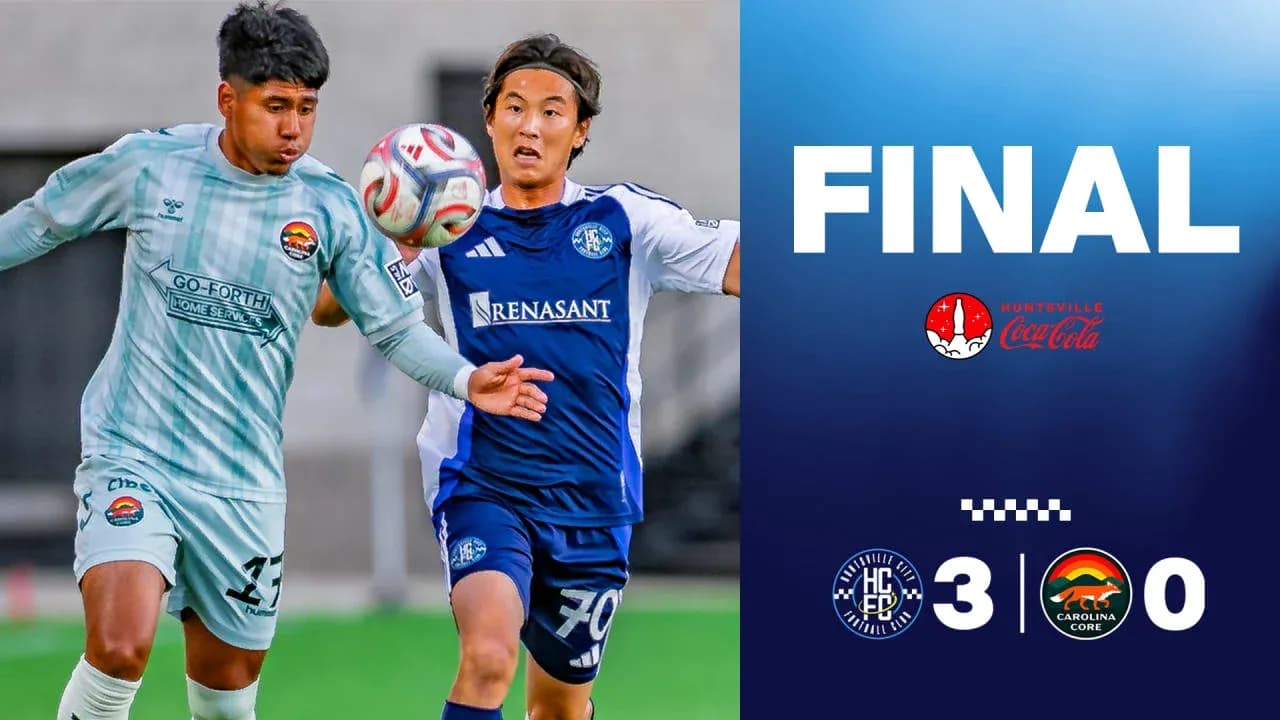
Huntsville City’s Tactical Mastery in 3–0 Win Over Carolina Core
Under the lights at Joe W. Davis Stadium, Huntsville City’s 3–0 win over Carolina Core felt less like a routine group-stage result and more like a sharp tactical statement from a side quietly hardening into a playoff contender. Following this result in the MLS Next Pro Central Division, the numbers and the patterns both underline a simple truth: one of these teams is learning how to manage games; the other is still learning how to survive them.
I. The Big Picture – contrasting trajectories
Huntsville came into this fixture with the profile of a volatile but dangerous side. Overall this campaign they had played 8 matches, winning 5 and losing 3, with 18 goals for and 17 against. That gives them a goal difference of 1, perfectly aligned with their Eastern Conference rank of 5th and a description that already links them to the MLS Next Pro play-offs (1/8-finals). The attacking DNA is obvious: an overall average of 2.3 goals scored per game, with 2.0 at home and 2.4 on their travels. The cost of that ambition has been defensive looseness, particularly away, but at home they had conceded only 3 goals in 3 games, an average of 1.0.
Carolina Core, by contrast, arrived in Huntsville with a far more fragile identity. Overall they had played 9 matches, winning just 1 and losing 8, scoring 11 and conceding 22 for a goal difference of -11. In the Central Division they sit 7th; in the Eastern Conference they are 15th, their form line “LLLLLLWLL” telling the story of a side stuck in a cycle of damage limitation. On their travels, the numbers are brutal: 5 away games, 0 wins, 0 draws, 5 defeats, 4 goals scored and 13 conceded, for an away average of just 0.8 goals for and 2.6 against.
In that context, Huntsville’s 3–0 home win fits the season-long pattern: a high-scoring host leaning into its attacking strengths, and a visiting side whose defensive structure cannot yet withstand sustained pressure.
II. Tactical voids and discipline – where the gaps opened
There were no explicit injury or suspension absences listed, so both coaches, Chris O’Neal for Huntsville and Donovan Ricketts for Carolina, appeared to have close to full squads to choose from. That made the tactical choices in the starting elevens even more revealing.
Huntsville’s lineup, with W. Mackay, J. Gaines, N. Prince and L. Christiano among the starters, suggested a balance of physicality and technical security. In midfield, the cluster of M. Molina, M. Yoshizawa, N. Pariano and M. Veliz gave O’Neal multiple ball-progressors and press triggers, while the front line of L. Eke, M. Ekk and J. Van Deventer offered vertical runs and combination play between the lines.
Carolina’s XI – anchored by N. Holliday in goal, a defensive unit featuring N. Martinez, S. Yepes Valle, N. Evers and J. Caiza, and a midfield/attack including T. Zeegers, M. Diakite, R. Aguirre, T. Raimbault, A. Tattevin and D. Diaz – leaned on energy and individual quality rather than a proven collective structure. For a side that has yet to keep a single clean sheet this campaign, that is a risky foundation.
Disciplinary trends sharpened the contrast. Heading into this game, Huntsville’s yellow cards showed a clear pattern: a late-game surge, with 27.78% of their cautions between 46–60 minutes and 22.22% in both the 76–90 and 91–105 ranges. They play aggressively after the break, but crucially they have not seen a single red card in any time window this season. Carolina, however, scatter bookings across the match, with peaks of 23.33% between 46–60 and 20.00% in both the 16–30 and 76–90 ranges. More significantly, their only red card has come in the 46–60 window, underlining a tendency to lose control just as games open up.
In a match where Huntsville were always likely to raise the tempo after half-time, Carolina’s disciplinary volatility was a structural weakness waiting to be exposed, even if no new red card arrived on this particular night.
III. Key matchups – Hunter vs Shield, and the engine room battle
Without individual scoring charts, the “Hunter vs Shield” duel is best read through collective metrics. Huntsville, as a team, are the hunter: 2.0 goals per game at home, with a home “biggest win” of 3–0 already on their record – a scoreline they matched here. Carolina’s shield on their travels is thin: 13 away goals conceded in 5 games, an average of 2.6 per match, and their heaviest away defeat being 4–1. A Huntsville attack that routinely hits 2+ at Joe W. Davis was always likely to overwhelm a defense that routinely ships more than 2 on the road.
In midfield, the “engine room” duel pitted Huntsville’s technical core – players like M. Veliz and N. Pariano – against Carolina’s central operators such as M. Diakite and T. Zeegers. The numbers say Huntsville’s midfield is used to playing on the front foot: they have failed to score in only 1 home game and 1 match overall, while Carolina have never kept a clean sheet, home or away. Over 90 minutes, that difference in baseline expectation of control and chance creation told. Huntsville could commit bodies forward, knowing their home defensive record (3 goals conceded in 3 games) and 2 clean sheets overall gave them a margin of safety. Carolina’s midfield, by contrast, had to constantly think about covering a back line that concedes 2.4 goals per game overall.
IV. Statistical prognosis – a win that fits the xG logic
We do not have explicit xG numbers, but the season-long patterns provide a strong proxy. A team averaging 2.0 home goals for and 1.0 against, facing a side averaging 0.8 away goals for and 2.6 against, naturally projects towards a multi-goal home win with a strong chance of a clean sheet. Huntsville’s record of 2 clean sheets overall, plus a home “biggest win” of 3–0, aligns almost perfectly with the outcome. Carolina’s complete absence of clean sheets, coupled with 2 matches in which they failed to score, makes a 3–0 defeat feel less like an outlier and more like the statistical center of their current reality.
Following this result, Huntsville’s attacking identity looks increasingly sustainable, especially at Joe W. Davis Stadium, where their blend of front-foot pressing and controlled aggression in the second half dovetails with a disciplined card profile and solid home defending. Carolina Core, meanwhile, remain a project in search of stability: their away form, defensive averages and disciplinary spikes all point to a side that must first learn to stop the bleeding before it can think about climbing the table.
On this night, the numbers and the narrative marched in lockstep. Huntsville City were the hunter; Carolina Core, once again, the shield that cracked under pressure.