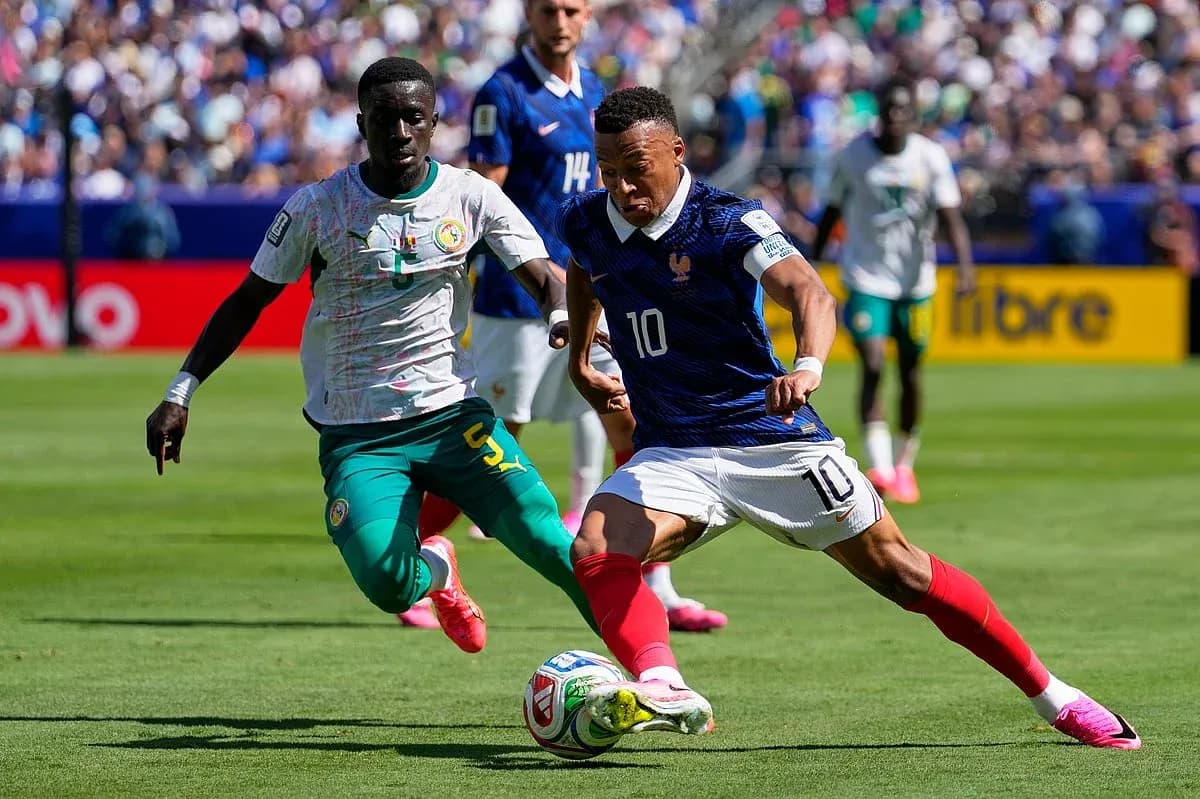
France vs Senegal: World Cup 2026 Opening Match Analysis
Under the New Jersey floodlights at MetLife Stadium, France and Senegal opened their World Cup 2026 campaigns with a contest that felt less like a tentative group-stage sparring session and more like a statement of intent from the European giants. Following this result, France sit 2nd in Group I with 3 points, a +2 goal difference (3 goals for, 1 against), and the unmistakable sense that their squad architecture is built for deep tournament runs. Senegal, 3rd with 0 points and a -2 goal difference (1 for, 3 against), leave with bruised pride but enough flashes to suggest this story is not finished.
I. The Big Picture – Structure and DNA
Both sides mirrored each other in a 4-2-3-1, but the systems were anything but symmetrical.
France’s shape, under Didier Deschamps, was classic control-with-vertical-threat. Mike Maignan in goal sat behind a back four of Jules Kounde, Dayot Upamecano, William Saliba, and Theo Hernandez. Ahead, the double pivot of Aurelien Tchouameni and Adrien Rabiot gave the platform for a fluid three of Michael Olise, Ousmane Dembele, and Desire Doue to orbit around Kylian Mbappe as the lone forward.
The numbers support the intent. Heading into this game, France’s only fixture of the tournament produced 3.0 goalsFor at home on average and 1.0 goalsAgainst at home on average, underlining a side willing to push numbers high while accepting some risk. The goal timing is revealing: 33.33% of their goals came between 61-75 minutes and 66.67% between 76-90, a late-game surge profile that speaks to depth and conditioning.
Senegal, coached by Bouna Thiaw Pape, also lined up 4-2-3-1: Edouard Mendy in goal; a back four of Krepin Diatta, Kalidou Koulibaly, Moussa Niakhate, and Mamadou Diouf; Idrissa Gueye and Pape Gueye as the double pivot; with Ismaila Sarr, Lamine Camara, and Sadio Mane supporting Nicolas Jackson.
Their statistical DNA is almost a mirror in reverse. On their travels, Senegal average 1.0 goalFor and 3.0 goalsAgainst, with 100.00% of their goals coming in the 76-90 window but also 66.67% of their goalsAgainst conceded in that same 76-90 range and 33.33% between 61-75. This is a team that lives – and currently dies – in the final quarter of games.
II. Tactical Voids and Discipline
The absences column is empty: no listed injuries, no suspensions, no questionable players. This was as close to full-strength as either coach could hope for in a World Cup opener.
Disciplinary data across the competition so far is equally clean for both. France have no recorded yellow or red cards in any time range; Senegal’s card profile is also blank. That purity of disciplinary record allowed both midfields to tackle and press without the shadow of suspension management, and it showed in the intensity of the duels between the lines.
III. Key Matchups
- Hunter vs Shield – Mbappe vs Senegal’s late-game fragility Kylian Mbappe is already shaping the tournament. With 2 goals in total from 1 appearance, an 8.2 rating, and 4 shots on target from 4 attempts, he is operating with ruthless efficiency. His 93% passing accuracy from 16 passes underlines that he is not just a finisher but also a secure possession link in the final third.
- The Engine Room – Tchouameni & Rabiot vs Idrissa Gueye & Pape Gueye The true hinge of this fixture lay in midfield. France’s double pivot of Tchouameni and Rabiot controlled tempo, ensuring that France’s 4-2-3-1 never became stretched into a broken 4-2-4. Their job was to shield Upamecano and Saliba from transitions while feeding Olise, Dembele, and Doue between the lines.
- Impact from the Bench – Barcola and Mbaye The late-game subplot belonged to the substitutes. Bradley Barcola, already on the top scorers list with 1 goal from just 10 minutes of action, offers Deschamps a devastating change-up: direct, vertical, and efficient. His 1 shot, 1 on target, 1 goal line in limited minutes is the statistical embodiment of France’s depth-driven late surge.
IV. Statistical Prognosis
Following this result, the numbers paint a clear tactical trajectory. France’s overall profile – 3 goalsFor total, 1 goalAgainst total, no clean sheets yet but a powerful late-game scoring pattern – suggests a side whose xG curve will likely spike in second halves, particularly after the 60th minute. Their biggest home win so far is 3-1, and that is already the baseline.
Senegal’s story is more precarious. Overall they have 1 goalFor and 3 goalsAgainst, with their entire attacking and defensive drama compressed into the last 30 minutes. That volatility hints at an xG profile where they can hurt anyone late, but also collapse against any side with depth and composure.
From a tactical lens, France look built for knockout football: a stable 4-2-3-1, a lethal top scorer in Mbappe, and impact players like Barcola ready to exploit tiring defenses. Senegal, meanwhile, must tighten their structure between minutes 61-90. If they can align the creative flashes of Mane, Sarr, Camara, and Ndiaye with the emerging finishing of Mbaye, their late-game chaos could yet turn from weakness into weapon.