France's Tactical Superiority Over Senegal in 3-1 Victory
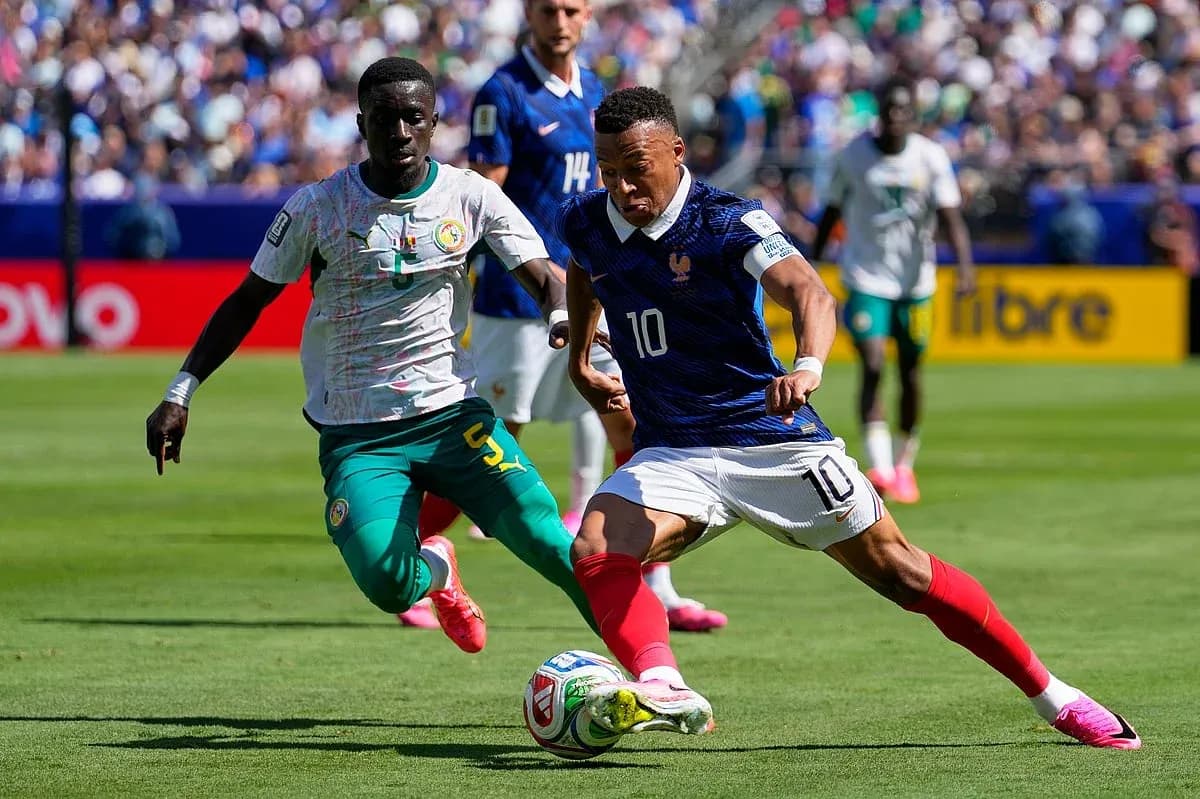
France’s 3-1 win over Senegal at MetLife Stadium was built on structural control in a mirrored 4-2-3-1 battle, where France’s superior occupation of the half-spaces, cleaner progression and more ruthless exploitation of transition moments eventually overwhelmed a disciplined but limited Senegal side. The scoreline reflects a second-half surge after a tactical arm-wrestle, rather than domination from the opening whistle.
Both coaches stayed loyal to a 4-2-3-1, but the interpretations diverged. Didier Deschamps’ France used Aurélien Tchouaméni and Adrien Rabiot as a stable double pivot behind an aggressive line of three – Michael Olise, Ousmane Dembélé and Désiré Doué – supporting Kylian Mbappé as the lone forward. The structure was clearly designed to pin Senegal’s back four and stretch their double pivot of Idrissa Gana Gueye and Pape Gueye horizontally.
France’s 53% possession and 575 passes (505 accurate, 88%) underline how they controlled tempo and circulation. The key, though, was verticality: 11 total shots with 7 inside the box show how often they managed to break Senegal’s lines and arrive in dangerous zones, rather than simply recycling the ball. Olise and Dembélé repeatedly received between full-back and centre-back, forcing Kalidou Koulibaly and Moussa Niakhaté to step out and creating channels for Mbappé’s diagonal runs.
Senegal’s 4-2-3-1 was more conservative. Krépin Diatta and El Hadji Malick Diouf formed a relatively narrow full-back pairing, protecting the half-spaces and inviting France to play wide. With 47% possession and 502 passes (430 accurate, 86%), Senegal were not overrun in pure ball control terms, but their 6 total shots – only 2 on goal – and xG of 0.53 show a lack of penetration. Much of their threat depended on Sadio Mané drifting inside from the left and Ismaïla Sarr attacking in transition, but France’s back four held an excellent line, with William Saliba and Dayot Upamecano managing depth aggressively to keep Nicolas Jackson facing away from goal.
Turning Point
The game’s turning point was the sequence around the 60th minute. A VAR intervention cancelled a potential France penalty for Mbappé at 60', but the pattern of play that led to that moment – France combining centrally, then releasing Mbappé into the box – signalled that Senegal’s block was starting to crack. Six minutes later, Mbappé finally broke through, assisted by Olise at 66', a direct reward for France’s insistence on feeding their No. 10 lane and then attacking the space behind.
From there, Deschamps doubled down on fresh attacking legs. Bradley Barcola (IN) came on for Dembélé (OUT) at 80' and immediately offered a more direct, north–south threat. His goal at 82', assisted by Rabiot, epitomised France’s second-half plan: win the ball, connect quickly through the pivot, and exploit Senegal’s increasingly stretched back line. The fact that France ended with 8 shots on goal from 11 total attempts – a very high on-target ratio – underlines how clear their shooting opportunities were once they broke the deadlock.
Senegal’s response was to lean into attacking substitutions, but the structural trade-off hurt them. Ibrahim Mbaye (IN) for Sarr (OUT) at 75', Habib Diarra (IN) for Lamine Camara (OUT) at 76', Ahmadou Bamba Dieng (IN) for Jackson (OUT) and Iliman Ndiaye (IN) for Pape Gueye (OUT) both at 83', then Pathé Ismaël Ciss (IN) for Idrissa Gana Gueye (OUT) at 88' progressively tilted the side towards offense. The downside was a loss of compactness in midfield and less protection in front of the centre-backs. France’s third goal, Mbappé again at 90+6', came in a context where Senegal were committing numbers forward and leaving large spaces for France’s transition game.
Defensive Performance
Tactically, France’s defensive performance was about control rather than last-ditch heroics. Mike Maignan (France) faced only 2 shots on goal and made 2 saves, consistent with a side that largely kept Senegal to low-quality efforts. The negative goals prevented figure in France’s statistics indicates that, relative to the xG of the shots faced, Maignan conceded slightly more than expected over a broader sample, but in this match he was scarcely tested thanks to the structure in front of him.
At the other end, Edouard Mendy (Senegal) had a far heavier workload. With France registering 8 shots on goal and Senegal’s goalkeeper credited with 5 saves, the three goals conceded reflect sustained, high-quality pressure rather than isolated lapses. Senegal’s defensive block initially managed to funnel France wide and restrict central access, but as fatigue set in and the double pivot was stretched by France’s rotations, Mendy was increasingly exposed to clean looks from inside the box.
Statistical Verdict
The statistical verdict reinforces the tactical story. France’s xG of 1.79 against Senegal’s 0.53 shows that the 3-1 scoreline slightly flatters France in terms of pure chance quality but still reflects a clear superiority in creating dangerous situations. France’s 6 corner kicks to Senegal’s 4 and a lower foul count (5 vs 9) point to a side controlling territory and tempo without needing to resort to disruptive defending. Offensively, the 7 shots inside the box versus Senegal’s 4 underline how consistently France managed to penetrate the penalty area.
Both teams shared the same goals prevented figure of -0.94 in their season-stat snapshot, but in this specific match the difference lay higher up the pitch: France’s ability to convert structural dominance into box entries and on-target shots, and Senegal’s struggle to turn reasonable possession and passing accuracy into genuine threats. In a mirrored 4-2-3-1 contest, France simply executed their principles with greater clarity and attacking precision.