England Edges Mexico 3–2 in Thrilling Round of 16 Showdown
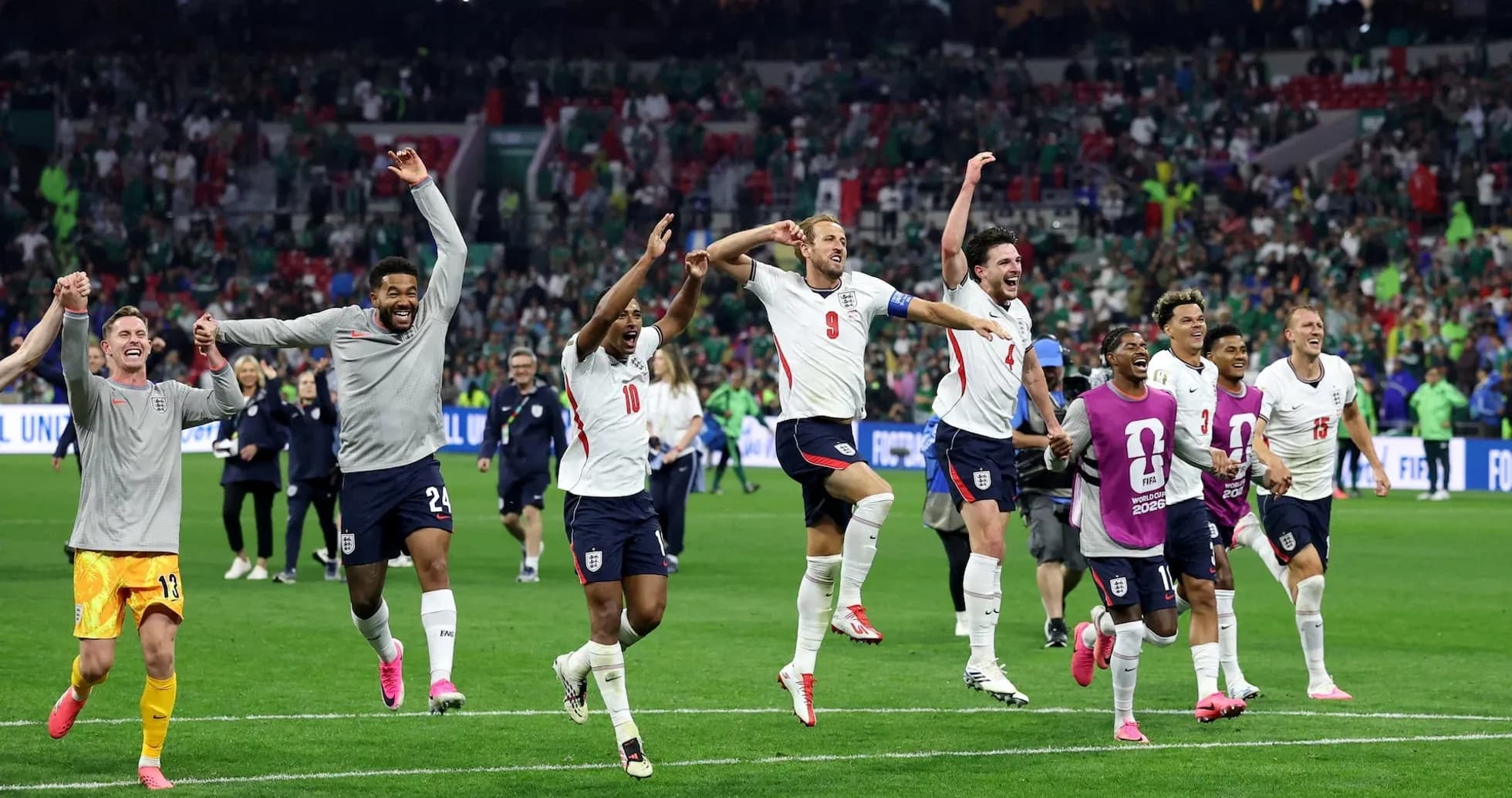
The night at Estadio Banorte ended with England edging Mexico 3–2, a Round of 16 epic that felt like a collision of two fully formed identities rather than a clash of undercooked ideas. It was a meeting between Mexico’s front‑foot, high‑tempo 4‑3‑3 and England’s more measured 4‑2‑3‑1, both sides arriving as group winners, both with the statistical profile of teams built to go deep.
Mexico's Path
Mexico came into the knockout phase as Group A leaders, with 9 points from 3 matches and a goal difference of 6, built on 6 goals scored and none conceded in the group. Across the tournament they had played 5 fixtures in total, with 4 wins and 1 defeat, scoring 10 goals overall and conceding just 3. At home in this World Cup, Mexico had played 4 times, winning 3 and losing 1, with 7 goals for and 3 against; on their travels they had a perfect away record from a single match, scoring 3 and conceding none. Their average goals for at home stood at 1.8, rising to 3.0 away and 2.0 overall, while goals against averaged 0.8 at home, 0.0 away and 0.6 overall. This was a side used to controlling games, used to clean sheets (4 in total) and never once failing to score.
England's Path
England’s path was different but just as convincing. Group L winners with 7 points, they too were unbeaten in the group, with a goal difference of 4 from 6 goals scored and 2 conceded. Over 5 matches in the tournament they had 4 wins and 1 draw, with no defeats. At home they had played 3 times, winning 2 and drawing 1, scoring 6 and conceding 3; away, they had been perfect in 2 fixtures, winning both, with 5 goals for and 2 against. Their attacking output was slightly higher than Mexico’s: 2.0 goals per home match, 2.5 away and 2.2 overall. Defensively they were more porous than Mexico, conceding an average of 1.0 goal both at home and away, and 1.0 overall, but they had still kept 2 clean sheets and failed to score only once.
Tactical Shapes
Within that statistical framing, the tactical shapes told the story of the match. Javier Aguirre’s Mexico lined up in a familiar 4‑3‑3 that has become their default, used 4 times this tournament. R. Rangel in goal sat behind a back four of J. Gallardo, J. Vasquez, C. Montes and J. Sanchez. In front, a midfield trio of L. Romo, E. Lira and G. Mora was tasked with both protecting the centre and releasing a devastating front three: J. Quiñones off the left, R. Jimenez through the middle and R. Alvarado from the right.
Opposite them, Thomas Tuchel’s England deployed the 4‑2‑3‑1 that has underpinned 4 of their 5 line‑ups. J. Pickford anchored the back line of N. O’Reilly, M. Guehi, E. Konsa and J. Quansah. Ahead of them, D. Rice and E. Anderson formed the double pivot, shielding the defence and feeding a line of three creators: A. Gordon wide left, J. Bellingham central and B. Saka on the right, all servicing H. Kane as the lone striker.
The Duel
The “Hunter vs Shield” duel was always going to be central. Kane entered the knockout tie as one of the World Cup’s most lethal forwards: 6 goals and 1 assist in 5 appearances, with 15 shots, 10 on target, and a rating of 7.6. His penalty record in this tournament was spotless, scoring 2 from 2, and his presence as a target and link player is reflected in 71 completed passes and 4 key passes. He was up against a Mexico defence that had conceded only 3 goals in 5 matches overall, and just 3 at home, with 4 clean sheets. C. Montes, despite carrying the stain of a red card earlier in the competition, had been a commanding figure: 176 passes at 90% accuracy, 2 tackles, 1 blocked shot and 2 interceptions. His reading of the game and aerial dominance were designed to blunt Kane’s penalty‑box instincts.
Yet England’s threat was never just about their number nine. J. Bellingham arrived with 4 goals and 1 assist, 11 shots (9 on target), and a tournament rating of 7.78. He had completed 161 passes at 81% accuracy, with 8 key passes and 12 tackles, embodying the “engine room” archetype: part creator, part destroyer. Across the line, B. Saka had quietly become one of the tournament’s most productive providers, with 3 assists in just 192 minutes, 56 passes at 82% accuracy and 8 dribble attempts with 4 successful. The chemistry between Bellingham’s vertical surges and Saka’s wide menace created constant stress for Mexico’s full‑backs.
Mexico’s Offensive Balance
Mexico’s own offensive balance was equally impressive. J. Quiñones, notionally listed as a midfielder but operating as an advanced wide forward, had 4 goals and 1 assist, with 11 shots (6 on target) and a 7.76 rating. His 135 passes at 82% accuracy and 10 key passes underlined his dual role as scorer and creator. R. Alvarado, one of the top assist providers in the competition, matched Saka’s output with 3 assists, adding 191 passes at 83% accuracy and 13 key passes, plus 8 dribbles with 7 successful. Between them, they supplied R. Jimenez, who had 3 goals from 14 shots (7 on target), winning half of his 36 duels and converting 1 penalty from 1 attempt.
Discipline and Card Profiles
Discipline and card profiles formed a subtle but important backdrop. Mexico’s yellow cards were clustered in the 16–30 minute window (25.00% of their cautions) and especially between 61–75 minutes (50.00%), hinting at an aggressive press that can boil over as fatigue bites. They had also seen a red card shown between 91–105 minutes, a reminder that late‑game emotional control can slip. England, by contrast, spread their yellows more evenly, with 14.29% in each of the 0–15, 16–30, 31–45 and 46–60 minute segments, and a spike to 28.57% between 61–75 minutes. Critically, they had already suffered one red card between 46–60 minutes, shown to J. Quansah in this tournament, underlining the risk baked into Tuchel’s insistence on aggressive front‑foot defending from his full‑backs.
Tactical Intent
In this match, those disciplinary patterns intersected with tactical intent. Mexico’s midfield three pressed high to disrupt Rice and Anderson, but England’s structure, with Bellingham dropping into pockets and Saka and Gordon stretching the pitch, repeatedly dragged the Mexican block into awkward shapes. Romo and Lira had to decide whether to track Bellingham’s half‑space movements or hold position to protect Montes and Vasquez from Kane’s runs. Each time they stepped out, Saka or Gordon could dart into the vacated channels; each time they sat, Bellingham had time to turn and feed his striker.
Conversely, Mexico’s best moments came when Alvarado and Quiñones isolated England’s full‑backs. N. O’Reilly and J. Quansah, both tasked with pushing high to support the press, were vulnerable to balls played into the space behind them. With Mexico averaging 3.0 goals on their travels and 2.0 overall, their confidence in committing numbers forward was justified. England’s concession rate of 1.0 goal per match suggested that chances would come if Mexico could transition quickly enough.
Conclusion
Set against the statistical backdrop of two sides both scoring more than 2 goals per game and conceding around or below 1, the 3–2 scoreline felt almost inevitable. England’s slight edge in attacking variety, powered by the Kane–Bellingham axis and Saka’s delivery, ultimately tilted the balance. Mexico’s resilience, built on a defence that had previously conceded just 3 goals in 5 matches and a frontline where Quiñones, Alvarado and Jimenez all carried genuine end product, ensured the contest remained alive until the final whistle.
Following this result, the numbers that had defined both campaigns were bent but not broken. Mexico’s proud defensive record was finally punctured in earnest, while England’s tendency to concede but outscore opponents was reinforced. In tactical terms, this Round of 16 tie will be remembered as a showcase of how modern tournament football is increasingly decided not by a single star, but by the interconnectedness of structures: the double pivot against the pressing trio, the creative tens against disciplined holding midfielders, and the constant, simmering tension between ambition and control.