Mexico vs England Tactical Analysis: A 3-2 Defeat at Estadio Azteca
Mexico’s 3-2 defeat to England at Estadio Azteca was a tactical paradox: territorial dominance and control of the ball from Mexico against England’s ruthless efficiency and game-state management, even after going down to ten men. Across 90 minutes, Mexico’s 67% possession and 20 shots could not overturn England’s early two-goal cushion and their calm exploitation of transitional moments.
Javier Aguirre set Mexico up in a 4-3-3 that was clearly designed to suffocate England’s build-up and keep the game played in English territory. Thomas Tuchel’s England, in a 4-2-3-1, accepted a deep and compact posture, trusting the front four to convert the limited attacking phases into goals. That trade-off defined the match.
Mexico’s structure with the ball was aggressive and high. The back four of Jorge Sánchez, César Montes, Johan Vásquez and Jesús Gallardo frequently stepped into England’s half, with Erik Lira as the single pivot and Luis Romo plus Gilberto Mora (later replaced by Santiago Giménez) pushing high between the lines. The front three of Roberto Alvarado, Raúl Jiménez and Julián Quiñones played very narrow, almost as three central forwards at times, which helped Mexico flood the box — reflected in 12 shots inside the box and 7 blocked efforts — but also congested their own attacking lanes.
This front-loading created a clear pattern: Mexico recycled possession patiently, racking up 455 passes with 420 accurate (92%), but too many attacks ended in crowded central zones where England’s centre-backs and double pivot could collapse around the ball. The volume of shots (20 total) did not translate into clear-cut chances, mirrored by an xG of 1.87. Mexico’s penalty from Raúl Jiménez was earned pressure, but open-play penetration was less efficient than the shot count suggests.
England’s 4-2-3-1 was built on vertical clarity. Declan Rice and Elliot Anderson formed a disciplined double pivot, rarely both advancing at the same time, allowing the back four to stay compact. With only 244 passes (195 accurate, 80%), England did not try to contest the midfield carousel; instead, they focused on first and second balls and quick vertical progressions to Jude Bellingham, Anthony Gordon and Bukayo Saka behind Harry Kane.
That approach was brutally effective in the first half. Despite only 6 total shots (4 inside the box), England matched Mexico’s 5 shots on target and generated 1.55 xG. Their attacking phases were shorter but cleaner: Bellingham’s two goals, one assisted by Saka and one by Kane, came from well-timed runs into the half-spaces that Mexico’s midfield three struggled to track. With Lira often isolated and Romo stepping high, the distances between Mexico’s lines became exploitable whenever possession was lost.
The defensive contrast is stark in the numbers. Mexico committed 14 fouls to England’s 7, and although both sides finished with the same number of shots on target (5), the context differs. Mexico’s 7 blocked shots underline how often England’s low block got bodies in the way, while England conceded territory but not many clean looks. Conversely, England needed only 6 attempts to score 3 times — an extreme level of efficiency that speaks to the quality of their shot locations and execution rather than volume.
Game-state management was decisive after Jarell Quansah’s red card for “Serious foul” at 54'. Reduced to ten men, Tuchel adjusted by sacrificing Bukayo Saka for John Stones at 57', effectively sliding into a 4-4-1/5-3-1 hybrid out of possession. Nico O’Reilly, booked for “Unsportsmanlike conduct” and later replaced by Djed Spence, tucked deeper to help protect the left flank. England’s priority became compactness in the central corridor, forcing Mexico to either cross from wide or shoot from distance.
Mexico’s response was to double down on attacking personnel. Aguirre introduced Edson Álvarez for César Montes at 46', then pushed further at 61' with Santiago Giménez for Gilberto Mora and Brian Gutiérrez for Luis Romo, turning the midfield into a more attacking unit. Later, Álvaro Fidalgo for Jorge Sánchez at 79' and Guillermo Martínez for Julián Quiñones at 81' left Mexico with a very aggressive, almost lopsided shape: multiple forwards, full-backs high, and Álvarez tasked with covering vast defensive ground.
This produced sustained pressure — 12 corner kicks to England’s 2 — and eventually the penalty converted by Jiménez. But it also left Mexico vulnerable to transitions, which is how England earned their own penalty, calmly dispatched by Kane at 60' to restore a two-goal cushion even with ten men. From that point, England’s plan was clear: compress space centrally, manage fouls, and live off clearances and counters.
Discipline and emotional control subtly favoured England despite their higher card count (4 yellows and 1 red to Mexico’s 2 yellows). Early on, Rice’s yellow for “Roughing” at 1' did not change England’s compact aggression. Later bookings for Marc Guéhi (“Unsportsmanlike conduct”) and Jordan Henderson, plus O’Reilly’s card, were the by-product of a team willing to foul to break rhythm but structurally sound enough not to be disorganized by it. Mexico’s bookings for Sánchez and Vásquez, both “Unsportsmanlike conduct”, came as they chased the game, reflecting frustration as much as tactical necessity.
In goal, Raúl Rangel (Mexico) made 2 saves with a goals prevented figure of -0.15, indicating England’s finishing slightly outstripped the underlying shot quality. Jordan Pickford (England) produced 3 saves with the same -0.15 goals prevented, suggesting Mexico’s finishing was also marginally above expectation but not enough to erase the early deficit.
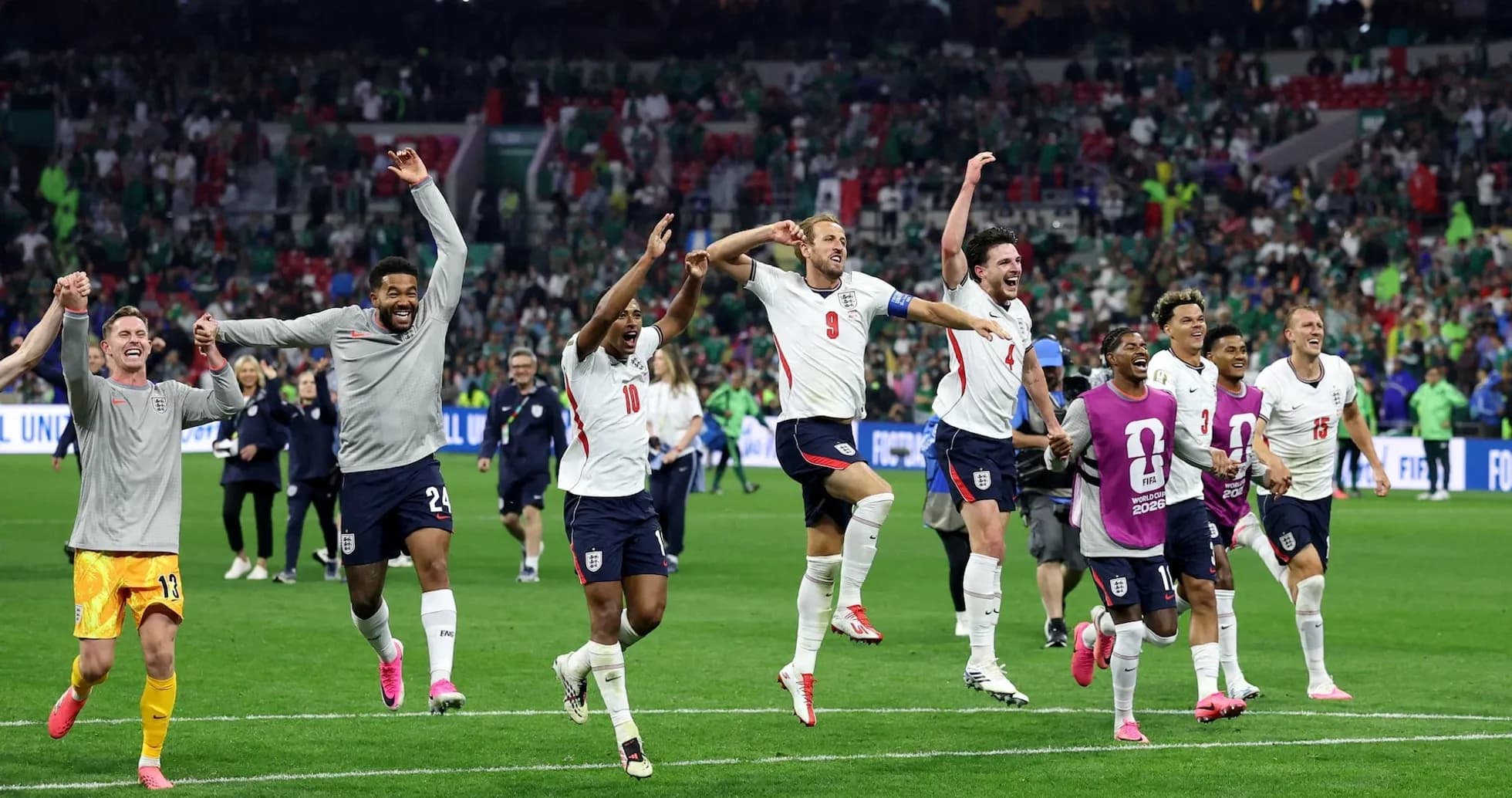
Ultimately, this Round of 16 tie was decided by England’s clinical exploitation of Mexico’s structural risks and their ability to recalibrate into a resilient, low-possession game once ahead and a man down. Mexico controlled the ball, England controlled the scoreboard — and at tournament level, the latter remains the sharper weapon.