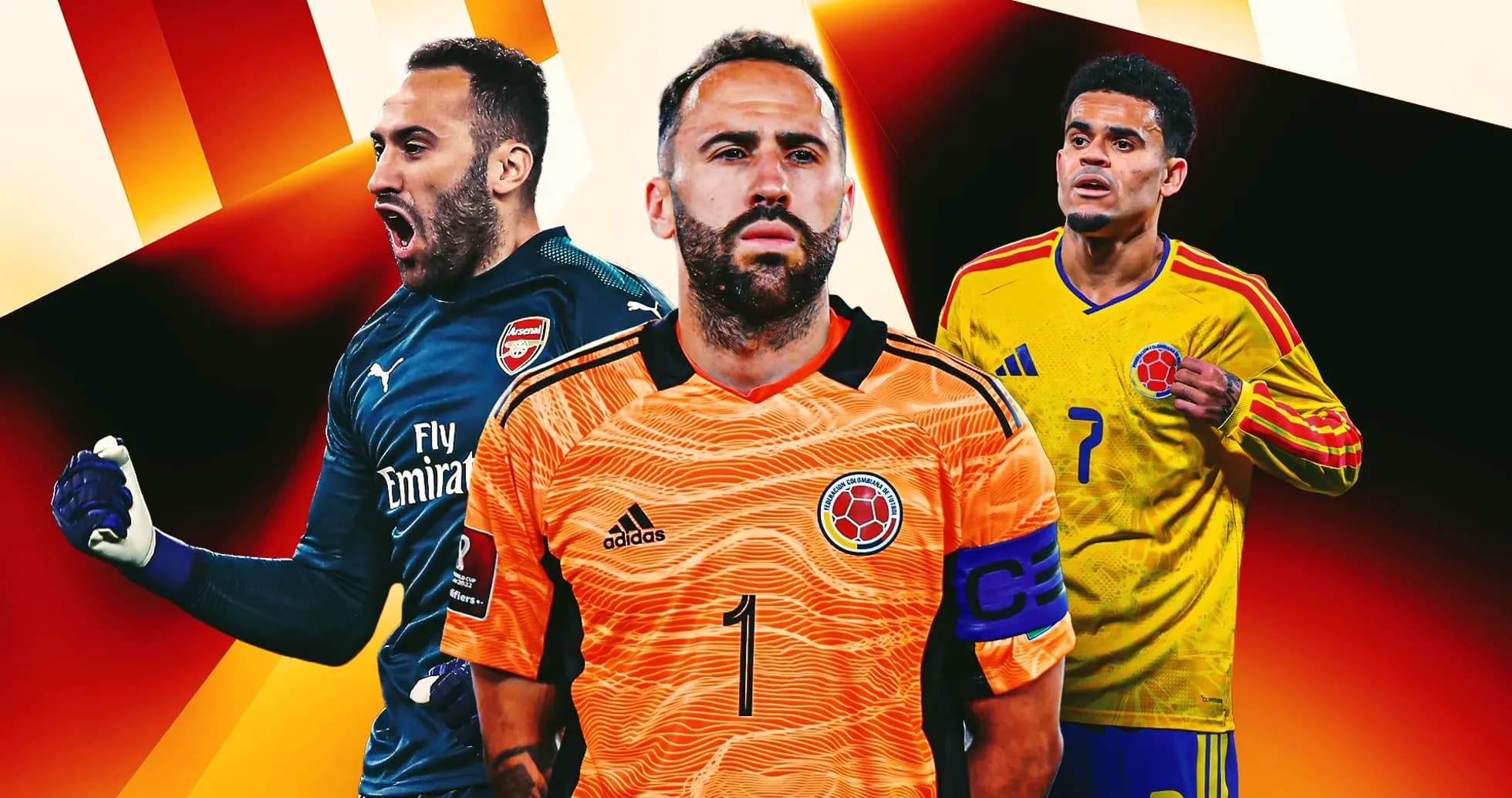
David Ospina: A Goalkeeper's Journey to the World Cup
David Ospina was never supposed to last this long.
He is 37 now, nudging 38 by the time the next World Cup closes its doors. Goalkeepers rarely break out on that stage. Even fewer stretch that spotlight into another decade of relevance. Yet here he is, still talking about new generations, new demands, new expectations.
It has never been a straight line.
Back in 2013-14, Nice were clinging to Ligue 1 status, a big club in name flirting with a small club problem. They scored just 30 goals in 38 games. That should drag you down. Ospina refused to let it. Thirteen clean sheets, a string of defiant performances and, by the end, a fanbase looking at their goalkeeper as the thin line between survival and disaster.
That spring in France bled into a summer on the world stage. Colombia arrived at the World Cup with flair; Ospina added the steel. Four goals conceded in 450 minutes. Enough tape, enough saves, enough calm under the lights to convince a Premier League giant he could anchor a new chapter.
Arsenal called. He said yes.
“Having belonged to a team like Arsenal was a dream come true. Living that experience was something magnificent in my career,” he said.
He walked into North London at a strange, creaking moment. Arsene Wenger’s Arsenal still played beautiful football, still filled the Emirates, still believed in their way. But the money elsewhere had shifted, the arms race had escalated, and the title felt further away every season. For a goalkeeper, it was an odd crossroads too.
The evolution of the position is often oversimplified. It did not happen overnight. But by the time Ospina pulled on an Arsenal shirt, the ground had clearly moved. Goalkeepers were no longer simply shot-stoppers; they were the first playmakers, the extra outfield player, the risk at the back that allowed risk at the front.
“I’ve had the opportunity to witness all the transitions across different generations. Today, our position has taken on a much more significant role, largely because we are now expected to be far more involved with our feet - something that wasn't nearly as necessary in the past,” he said.
Does he embrace it? He accepts it. Football reinvents itself. Systems change, angles shift, the goalkeeper’s job description gets longer.
“Possessing technical proficiency is crucial, as it allows us to initiate attacking sequences right from the back. The goalkeeper has truly become an integral part of the starting eleven - no longer merely the player who prevents goals, but also the one capable of orchestrating a transition quickly and precisely,” he said.
The problem was that his Arsenal career never quite matched the promise. Injuries cut into his rhythm. Then Petr Cech walked through the door from Chelsea, bringing with him trophies, aura, and the sort of status that squeezes opportunities for anyone standing behind him.
Ospina still took something vital from those years. Wenger, the mentor. The training ground, the standards. And a close-up view of a teammate who would later redefine the club from the dugout.
“I had the opportunity to have him as a teammate when I first arrived at Arsenal. Even back then, he demonstrated his leadership and showed what he could contribute to the game over the course of his career,” Ospina said of Mikel Arteta.
No one around London Colney is surprised that Arteta now runs the club. The question hangs over him instead: can he finally drag Arsenal over the line, beyond the second-place finishes and near-misses?
“They have a massive opportunity to win the Premier League, led by an excellent manager and featuring young players who are performing exceptionally well. So, let's hope they can achieve that milestone. It would make me very happy to see Arsenal win the Premier League title,” Ospina said.
He watches it unfold from a distance. The noise of the Emirates, the tension of a title chase, all of it filtered through a television screen. Ospina is back where it began, at Atletico Nacional, the club that shaped him in Colombia. The chaos of North London has given way to something quieter, something closer to home.
That distance brings focus. The national team has his full attention.
Colombia’s current group feels like the crest of a wave. James Rodriguez now plays his club football with Minnesota United in Major League Soccer, a long way from the Bernabeu but still a central figure in yellow. Around him, the supporting cast is stronger than ever.
Luis Diaz is in the form of his life, revitalised under Vincent Kompany at Bayern Munich. Luis Suarez has started fast for Sporting CP in Portugal. The talent is spread across Europe, across roles, across ages.
“We have players at major clubs in Europe, such as Lucho Suarez and Luis Diaz, who are incredibly important figures. We also count on a player like James Rodriguez, with his experience and quality, as well as Davinson Sanchez, who has been playing in top-tier leagues for quite some time now,” Ospina said.
And that’s only half the story. The new names matter just as much. Richard Rios, Juan Cabal, Daniel Munoz, perhaps Jhon Duran if bridges are rebuilt. Colombia, a nation once reliant on a handful of stars, now boasts depth in every department.
“We have players with a great deal of experience, as well as young players who are eager to do things right. There are others among us, those with a bit more experience, who can make very positive contributions to the national team,” Ospina said.
Colombia will not arrive at the World Cup as outright favourites. They sit a rung below that, dangerous but not dominant, expected to fight for top spot in their group and then see where the draw takes them. A kind path, a surge of form, and a semi-final is entirely within reach.
It comes down to energy, rhythm, belief. Few understand tournament momentum better than a goalkeeper who has lived it.
Brands have noticed his status as the veteran at the heart of a rising side. Modelo chose him as one of the faces of their World Cup campaign, hitching themselves to a player who has become a symbol of Colombian resilience.
“Modelo brings people together, allowing them to experience unique moments anywhere in the world - even right from their own homes- and to share those moments with friends and family,” he said.
For Ospina, 2026 feels like the last great swing at history. His CV is full of deep runs and near-misses, campaigns that promised more than they delivered. The gap is obvious: no defining national-team trophy, no moment that turns solid achievement into legend.
This tournament might be his final chance to change that, whether he starts in goal or guides the group from just behind the frontline.
“The expectations are very high,” he said. “Both for what we ourselves aim to achieve, and for what we hope to accomplish for our country.”
If Colombia’s golden generation is ever going to cash in, it will be with their elder statesman watching every second, waiting for one last shot at immortality.