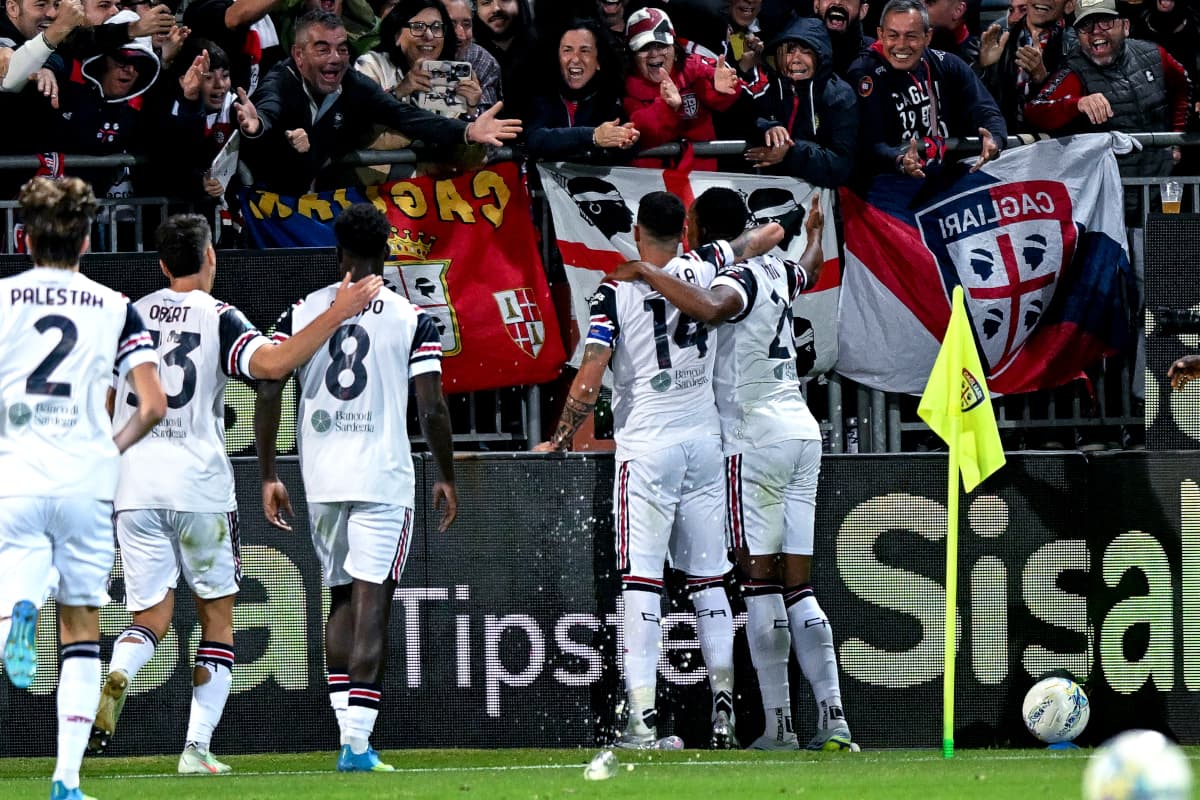
Cagliari's Tactical Mastery in 2–1 Victory Over Torino
Under the low Sardinian sun at Unipol Domus, Cagliari’s 2–1 win over Torino felt less like a routine end‑season fixture and more like a statement of survival identity. Following this result in Serie A’s Regular Season – 37, the table still paints them as a bottom‑third side – Cagliari 16th on 40 points, Torino 12th on 44 – but the way Fabio Pisacane’s men bent the game to their structure suggests a squad that has finally understood its own limitations and weapons.
Pisacane’s choice of a 4‑3‑2‑1 was pragmatic and tailored to his squad’s seasonal DNA. Heading into this game, Cagliari had been a split personality: at home they averaged 1.2 goals for and 1.2 against, away just 0.9 for and 1.6 against. Unipol Domus is where they become competitive, and the shape reflected that: a back four shielded by a compact three, with two narrow attacking midfielders knitting play to a lone striker.
E. Caprile, behind a line of G. Zappa, Y. Mina, A. Dossena and A. Obert, had the familiar brief: protect a team whose overall goal difference of -14 (38 scored, 52 conceded) shows how thin the margins are. Obert, the league’s sixth‑most booked player with 9 yellows and 1 yellow‑red, embodies Cagliari’s edge. His 65 tackles, 18 blocked shots and 40 interceptions this season underline why Pisacane trusts him as the left‑side anchor; he is the defender who steps out to meet danger early, even at the risk of cards.
Ahead of them, the midfield triangle of M. Adopo, G. Gaetano and A. Deiola was built to close the central lane Torino’s 3‑4‑2‑1 depends on. Wide of them, M. Palestra and S. Esposito floated as dual “tens” behind P. Mendy. It is Esposito who gives this structure its brain. With 7 goals and 5 assists in total, 954 passes and 67 key passes, he is Cagliari’s primary creative outlet and press trigger. His 298 duels (141 won) and 52 tackles show he is not a luxury piece; he is the first line of resistance when possession is lost.
This tactical clarity is all the more impressive given the absences. Cagliari were stripped of attacking depth: M. Felici, R. Idrissi, J. Liteta, L. Mazzitelli and L. Pavoletti were all ruled out, while J. Pedro served a suspension for yellow cards. That removed a traditional penalty‑box presence and a key second‑line finisher. Pisacane responded by leaning into mobility rather than brute force, trusting Mendy’s channels runs and Esposito’s timing instead of aerial bombardment.
Torino arrived with their own scars. Their overall goal difference of -19 (42 scored, 61 conceded) is brutal for a mid‑table side, and on their travels they had conceded 34 while scoring just 17. Leonardo Colucci nevertheless doubled down on the club’s season‑long structural identity: a 3‑4‑2‑1 with A. Paleari behind a back three of L. Marianucci, S. Coco and E. Ebosse, wing‑backs M. Pedersen and R. Obrador, and a central pair of E. Ilkhan and M. Prati.
The front line had pedigree: N. Vlasic and G. Simeone tucked in behind D. Zapata. Simeone, with 11 league goals, 58 shots (28 on target) and 22 key passes, is Torino’s “hunter” – an attacker who thrives on quick, vertical service and broken‑play chaos. Yet that strength collided with Torino’s structural flaw: the team’s reliance on a high back line that has been repeatedly exposed away from home, where they concede an average of 1.8 goals.
The “Hunter vs Shield” duel was clear: Simeone’s penalty‑area instincts against a Cagliari defence that, at home, concedes 1.2 per match and has kept 6 clean sheets. Mina and Dossena were tasked with tracking Zapata’s physical presence, leaving Obert and Zappa to manage the half‑spaces where Simeone loves to arrive late. Obert’s willingness to step out and block shots – 18 blocks this campaign – was crucial in narrowing Simeone’s angles.
In midfield, the “Engine Room” battle set the rhythm. On one side, Esposito and Gaetano, combining creativity with aggression; on the other, Ilkhan and Prati, more functional, tasked with screening central spaces and feeding early passes to the front three. Torino’s season‑long card profile hinted at how this might play out: they pick up a growing share of yellows late, with 20.00% between 76‑90' and 21.43% from 91‑105'. Cagliari, too, skew late – 27.85% of their yellows between 76‑90' – but their red‑card profile is more dramatic, with both reds arriving in that same 76‑90' window.
This overlap in late‑game volatility framed the closing stages. Torino’s need to chase, coupled with their away fragility, often pushes them into risky challenges after the hour mark; Cagliari’s tendency to defend deeper and more desperately at home at the same time increases the likelihood of last‑ditch interventions. In a match that finished 2–1 after a 2–1 half‑time scoreline, the real tactical story was how Cagliari managed the second half: compressing central zones, shortening distances between lines, and trusting Esposito to carry them upfield in short, controlled bursts rather than extended transitions.
From a statistical prognosis standpoint, this result sits comfortably within the season’s patterns. Heading into this game, Cagliari’s home attack (1.2 goals per match) was facing a Torino away defence conceding 1.8; a two‑goal return for the hosts fits the underlying trend. Conversely, Torino’s away attack, averaging 0.9, found the net once against a Cagliari home defence that allows 1.2 – again, almost exactly on script.
What elevates the performance beyond the numbers is the way the squad roles clicked. Caprile’s authority behind a disciplined back four, Obert’s controlled aggression rather than reckless lunges, Esposito’s dual role as creator and disruptor, and Mendy’s willingness to run selflessly into the channels all pointed to a group that has internalised the demands of this system.
Following this result, Cagliari remain a flawed side – their overall averages of 1.0 goals for and 1.4 against tell that story plainly – but they now look like a coherent one. Torino, for all Simeone’s cutting edge and the structural familiarity of their 3‑4‑2‑1, continue to be betrayed by their away‑day softness. The tactical preview for any future meeting between these two is already written in this 90‑minute script: Cagliari’s compact, late‑game‑volatile block against a Torino side that creates enough to score, but not enough to escape its own defensive gravity.