Bournemouth's Tactical Clarity Shines in 2-1 Victory Over Newcastle
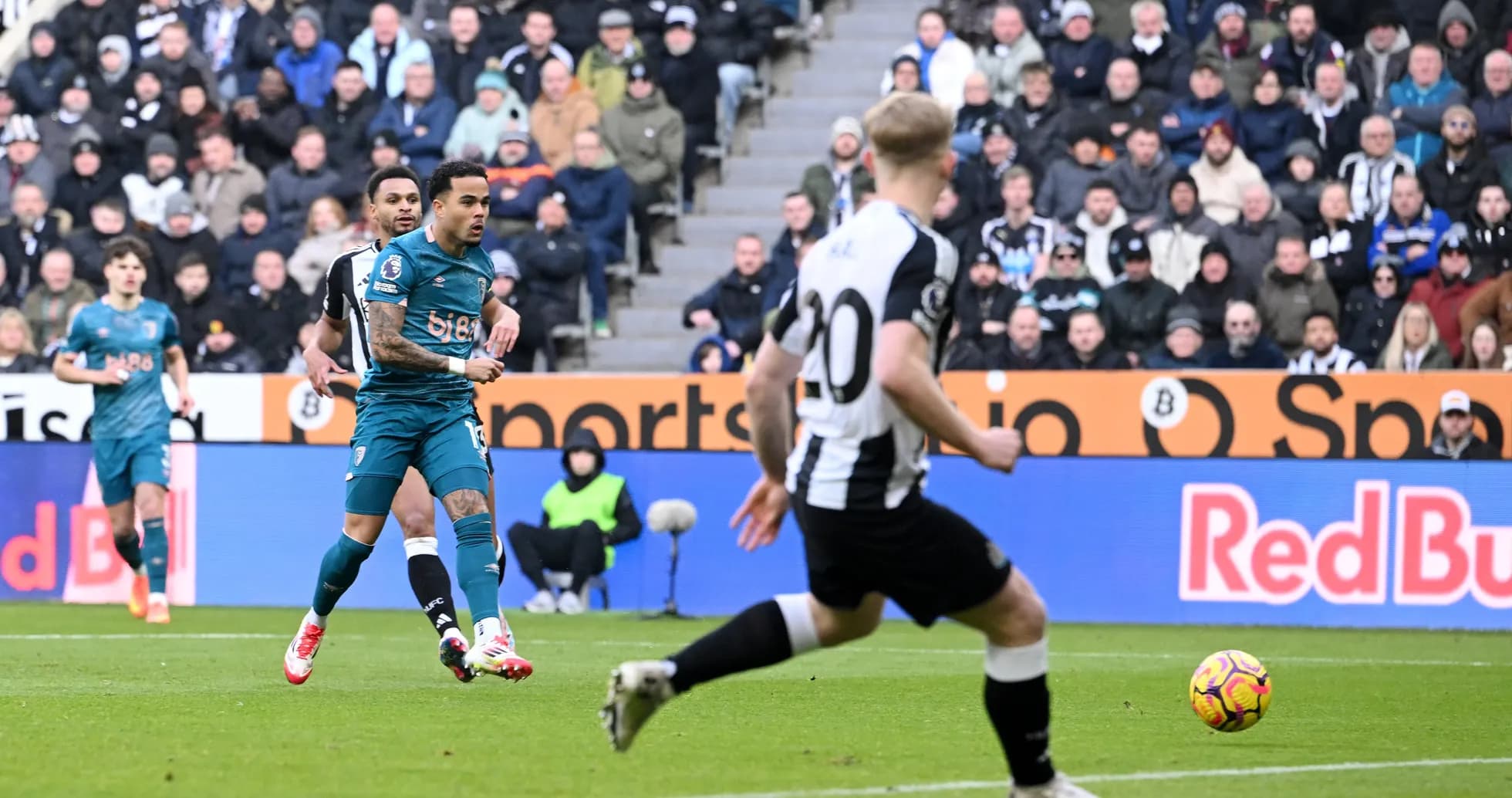
St. James’ Park had the feel of a crossroads rather than a coronation. Newcastle, 14th in the Premier League and fighting to reassert their identity, met a Bournemouth side quietly assembling a European push from 8th. By full time, the 2-1 away win underlined a simple truth: Bournemouth are structurally clearer, Newcastle are still searching.
Heading into this game, the numbers already hinted at the tension. Newcastle’s overall record of 12 wins, 6 draws and 15 defeats from 33 matches painted a side oscillating between power and fragility. Their goal difference of -3 (46 scored, 49 conceded) captured that duality perfectly. At home, though, they had been more assertive: 8 wins from 17, with 30 goals scored at an average of 1.8 per match and 28 conceded at 1.6. St. James’ Park remained a weapon, if an imperfect one.
Bournemouth arrived with a different profile: 11 wins, 15 draws and just 7 defeats overall, a stubborn, hard‑to‑beat unit with a perfectly balanced goal difference of 0 (50 for, 50 against). On their travels they were unpredictable but dangerous: 5 away wins, 7 draws, 5 defeats, scoring 27 and conceding 33 at an average of 1.6 goals for and 1.9 against. They rarely died wondering.
I. The Big Picture – Structures and Intent
Eddie Howe leaned into familiarity, sending Newcastle out in a 4-3-3 that has been his most-used shape this season (27 league matches in that system). A. Ramsdale anchored the side, shielded by a back four of V. Livramento, M. Thiaw, S. Botman and L. Hall. Ahead of them, S. Tonali, L. Miley and J. Ramsey formed a young, technical midfield three, while A. Elanga, W. Osula and H. Barnes stretched the pitch as a narrow, aggressive front line.
The structure spoke of verticality and pressing. With Newcastle’s overall scoring average of 1.4 goals per match and a relatively high home output, the plan was clear: use the energy of Miley and Ramsey to break lines, Tonali to dictate, and the front three to isolate Bournemouth’s full-backs in space.
Andoni Iraola answered with Bournemouth’s trademark 4-2-3-1, the formation they have used in 31 league matches. D. Petrovic stood in goal behind a back four of Álex Jiménez, J. Hill, M. Senesi and A. Truffert. A double pivot of A. Scott and R. Christie underpinned an attacking trio of Rayan, E. J. Kroupi and M. Tavernier, all servicing lone forward Evanilson.
This was a structure built for controlled chaos: Scott and Christie to compress the middle, full-backs to surge, and the three behind Evanilson to rotate, press and exploit transition moments. Bournemouth’s overall scoring rate of 1.5 goals per match, combined with their 9 clean sheets, suggested a team comfortable living on the knife-edge between front-foot aggression and last-ditch defending.
II. Tactical Voids – Absences and Discipline
The absences carved out the game’s fault lines. Newcastle were without Joelinton, suspended for yellow cards, and defenders E. Krafth and F. Schar through injury. Joelinton’s 10 yellow cards this season and his 261 duels (133 won) illustrate what Howe was missing: a disruptive, combative presence who turns midfield battles into attritional wars. Without him, Newcastle’s midfield three skewed more technical than physical, more about circulation than confrontation.
At the back, Schar’s absence removed a progressive passer from defence, forcing more responsibility onto Botman and Thiaw in buildup. The result was a Newcastle side that could still play through thirds, but with less bite in the counter-press and fewer risk-taking passes from deep.
Bournemouth were also shorn of key pieces: L. Cook and J. Soler through hamstring injuries, and J. Kluivert with a knee problem. Cook’s absence weakened their capacity to control rhythm in midfield, while Kluivert’s loss reduced their one‑v‑one threat in the final third. Yet Iraola’s system, with its clear 4-2-3-1 spine, absorbed those blows more smoothly than Newcastle’s did.
Disciplinary trends added another layer. Heading into this game, Newcastle’s yellow cards peaked late, with 27.12% of bookings arriving between 76-90 minutes and another 18.64% between 91-105. Bournemouth mirrored that late volatility: 29.49% of their yellows also came in the 76-90 window, with 20.51% in added time. This was always likely to become a match that frayed around the edges as legs tired and spaces opened.
III. Key Matchups – Hunter vs Shield, Engine Room vs Enforcer
The “Hunter vs Shield” narrative sat firmly with Bournemouth’s attacking cohort against Newcastle’s reshaped back line. While top scorer A. Semenyo did not feature in this fixture’s squads, his season profile framed Bournemouth’s attacking DNA: 10 goals, 3 assists, 42 shots (27 on target), and a willingness to shoot early and often. That mentality was mirrored by E. J. Kroupi, also on 10 league goals, whose 25 shots and 19 key passes mark him as both finisher and connector.
Up against them, Botman and Thiaw had to compensate for Newcastle’s season-long defensive wobble: 49 goals conceded overall at an average of 1.5 per match, and 28 conceded at home at 1.6. Without Schar, the onus fell on Botman’s positioning and Thiaw’s athleticism. Their task was not only to win duels but to manage Bournemouth’s rotational overloads in the half-spaces, particularly with Tavernier and Kroupi drifting inside.
In the “Engine Room”, the theoretical battle was between creativity and control. Newcastle’s most influential midfielder this season, Bruno Guimarães, started on the bench but loomed large over the tactical picture. His 9 goals, 4 assists, 40 key passes and 52 tackles define him as both playmaker and ball-winner. When introduced, Bruno Guimarães was always likely to raise Newcastle’s tempo, threading passes into Osula and Barnes while trying to pin Bournemouth’s double pivot deeper.
For Bournemouth, A. Scott and R. Christie were the quiet enforcers. Scott’s role in screening transitions and Christie’s capacity to shuttle and press were central to protecting a back line that, on their travels, had conceded 33 goals at 1.9 per match. Behind them, M. Senesi’s season numbers told the story of a defender built for this kind of siege: 56 tackles, 41 blocked shots, 49 interceptions and 8 yellow cards. Senesi is both organiser and emergency brake; his ability to step out and block lanes was crucial against Newcastle’s wide forwards.
Álex Jiménez added another layer on the right. His 63 tackles, 11 blocked shots and 25 interceptions, coupled with 65 dribble attempts, showed a full-back who defends on the front foot and then drives play forward. Against H. Barnes and the overlapping Hall, his duel success (127 duels won from 250) was a pivotal battleground.
IV. Statistical Prognosis – Why the Game Tilted
Following this result, the numbers feel less like theory and more like confirmation. Bournemouth’s away profile—1.6 goals scored, 1.9 conceded—always suggested they would create and concede in equal measure. Newcastle’s home pattern—1.8 scored, 1.6 conceded—hinted at a match of traded blows rather than control.
Newcastle’s clean sheet count of just 3 at home, against Bournemouth’s 4 away, underlined the defensive fragility that eventually cost Howe’s side. Bournemouth’s 15 draws overall this season also spoke of a team comfortable in long, tense contests, managing momentum and moments rather than chasing chaos.
In xG terms, the tactical balance pointed towards Bournemouth carving out higher-quality chances in transition, while Newcastle would rely on volume and territory. Without a true enforcer in Joelinton and without Schar’s progression, Newcastle’s structure was always one step from being stretched. Bournemouth, drilled in their 4-2-3-1 and backed by the ruthlessness of players like Kroupi and the all‑round work of Evanilson, were better placed to turn those moments into goals.
The 2-1 away win felt less like an upset and more like the logical outcome of two season-long trajectories: a Newcastle side still trying to reconcile ambition with balance, and a Bournemouth team whose clarity of shape and resilience continue to nudge them towards the top half’s upper reaches.