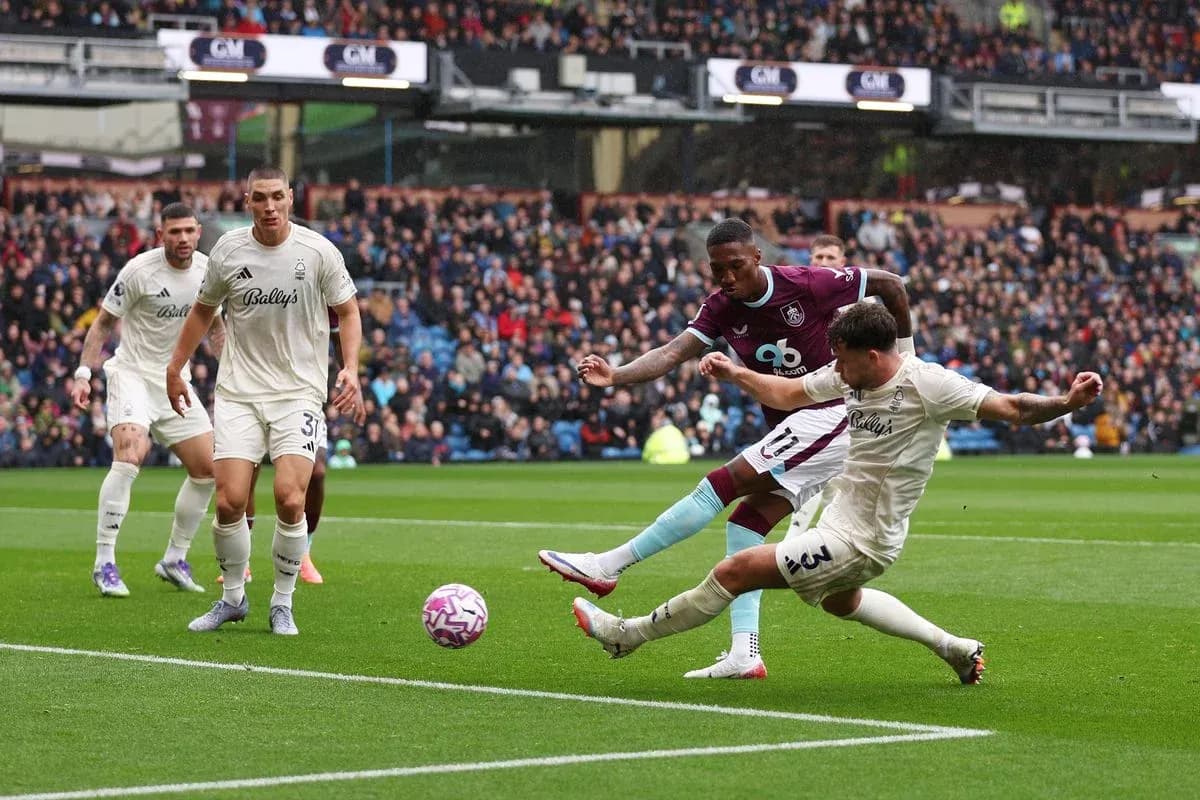
Nottingham Forest Overcomes Burnley with 4-1 Comeback Victory
Nottingham Forest overturned a 0-1 half-time deficit to beat Burnley 4-1 at the City Ground in Premier League Round 33, a result built less on sheer volume of chances than on ruthless second-half execution. Both sides lined up in a 4-2-3-1 and split possession almost evenly (51% Forest, 49% Burnley), but Forest’s attacking structure after the break, and in particular the centrality of M. Gibbs-White between the lines, completely flipped the match’s tactical balance.
Burnley initially controlled the key moments. Their 4-2-3-1 used J. Ward-Prowse and Florentino as a double pivot to circulate under Forest’s first line, with Z. Flemming dropping off the front to overload central spaces. The visitors’ only first-half breakthrough came right on 45', when Flemming finished a move created from the left by Q. Hartman, whose advanced full-back positioning gave Burnley width against Forest’s narrow defensive block. That goal crystallised Burnley’s early plan: limited shot volume (just four total all game) but a focus on high-quality central entries.
Forest’s first major adjustment was forced but significant. At 42', Murillo (OUT) left the pitch for Cunha (IN), a like-for-like change that nonetheless altered the build-up angles in the back line. Cunha, as a left-sided centre-back, was more aggressive in stepping into midfield, helping Forest compress Burnley’s attacking midfield trio and setting the platform for the second-half turnaround.
The restart brought a decisive structural shift from Vitor Pereira. At 46', D. Bakwa (OUT) made way for Igor Jesus (IN). Functionally, Forest moved from a classic 4-2-3-1 with wide creators to something closer to a dual-forward dynamic in possession: C. Wood pinning the centre-backs and Igor Jesus operating as a second striker or narrow left forward. This created constant central occupation of Burnley’s two centre-backs and disrupted their ability to step into midfield.
With Igor Jesus higher and narrower, O. Hutchinson on the right and M. Gibbs-White as the 10 could now receive more frequently between the lines. The first Forest goal at 62' was emblematic: Gibbs-White found space in the central pocket, exploiting the gap between Burnley’s pivot and centre-backs, and finished without an assist. The lack of a recorded assist underlines how much this was an individual exploitation of Burnley’s compact but passive mid-block.
Burnley’s response at 64' aimed to restore attacking threat: M. Edwards (OUT) was replaced by L. Foster (IN). Rather than changing shape, Scott Parker tried to refresh the right side of the three behind Flemming, but Burnley never rebuilt their first-half control. Forest’s press, led by Gibbs-White and the two forwards, increasingly forced Burnley to play longer, disconnecting Ward-Prowse and Florentino from the front line.
Forest’s second goal at 69' showed the growing synergy on the right. Hutchinson, still operating from the nominal right-midfield slot, delivered the assist for Gibbs-White’s second. Forest’s right side—N. Williams underlapping from full-back, Hutchinson wide, Gibbs-White drifting to support—repeatedly isolated Burnley’s left-back Hartman, who had been an attacking asset earlier but now struggled to defend multiple lanes.
Burnley’s discipline began to fray as Forest took control. At 75', Florentino Luís received a yellow card for a foul, a direct product of being overrun centrally by Forest’s more aggressive rotations. Three minutes later, Forest doubled down on midfield control: C. Wood (OUT) was replaced by R. Yates (IN) at 76'. The change pushed Forest towards a more stable double pivot (Sangare and Yates), with Gibbs-White effectively leading the line as a false nine and Igor Jesus continuing as a high runner. Almost immediately, at 76', Burnley altered their own midfield: L. Ugochukwu (OUT) came off for J. Bruun Larsen (IN), shifting the visitors towards a more attacking, less balanced midfield structure.
Forest punished that loosened structure straight away. At 77', Gibbs-White completed his hat-trick, assisted by R. Yates. The sequence underlined the impact of Yates’ introduction: his forward timing from midfield added a new runner into the box, while Gibbs-White’s freedom to drift and finish highlighted Burnley’s inability to track late arrivals once their double pivot was broken.
By now, Burnley were chasing. At 80', Kyle Walker collected a yellow card for argument, an indication of growing frustration as Forest controlled territory and tempo. Parker then made a triple attacking adjustment between 83' and 84': J. Anthony (OUT) for L. Tchaouna (IN) at 83', Florentino (OUT) for J. Laurent (IN) also at 83', and Z. Flemming (OUT) for A. Broja (IN) at 84'. These changes tilted Burnley towards a more direct, front-loaded approach, but with their structure already stretched, they generated no meaningful increase in shot volume.
Pereira’s late-game management focused on energy and defensive stability. At 88', O. Hutchinson (OUT) was replaced by Morato (IN), adding defensive security on the flank. At 89', the hat-trick hero Gibbs-White (OUT) made way for N. Dominguez (IN), further reinforcing central control. Even with these more conservative moves, Forest still found a fourth goal: at 90', Igor Jesus scored, assisted by Dominguez. The pattern fit Forest’s second-half narrative—fresh legs from the bench, attacking with vertical precision rather than high volume.
From a goalkeeping and defensive standpoint, both sides underperformed their expected metrics but in very different contexts. Forest allowed only four shots (three on target) and M. Sels made two saves. Burnley’s expected goals of 0.36 against a single actual goal suggests they scored from a relatively low-probability situation and created little else; Sels’ “goals prevented” figure of -2 indicates that, on balance, the model expected him to concede fewer than he did, but Burnley simply did not test him often enough to turn that into a structural issue. Forest’s Defensive Index in this match—judged by shot suppression and chance quality allowed—was strong despite the single concession.
At the other end, Burnley’s defensive performance collapsed under limited but high-quality pressure. Forest generated an xG of 1.18 from just 10 shots (four on target), yet scored four times. M. Dubravka recorded only one save and a goals-prevented value of -2, highlighting that Forest’s finishing and Burnley’s goalkeeping combined to produce a scoreline far above the expected model. Statistically, both teams completed passes at 82% accuracy (Forest 389/475, Burnley 373/454), underscoring how this was not a game of chaotic turnovers but of who better exploited advanced spaces. Forest committed fewer fouls (8 vs 12) and received no cards, while Burnley finished with two yellows (Florentino Luís for a foul, Kyle Walker for argument). In synthesis, Forest’s overall form on the day was defined by superior in-game adjustments and clinical execution, while Burnley’s defensive structure and discipline unraveled under sustained, intelligent pressure after half-time.