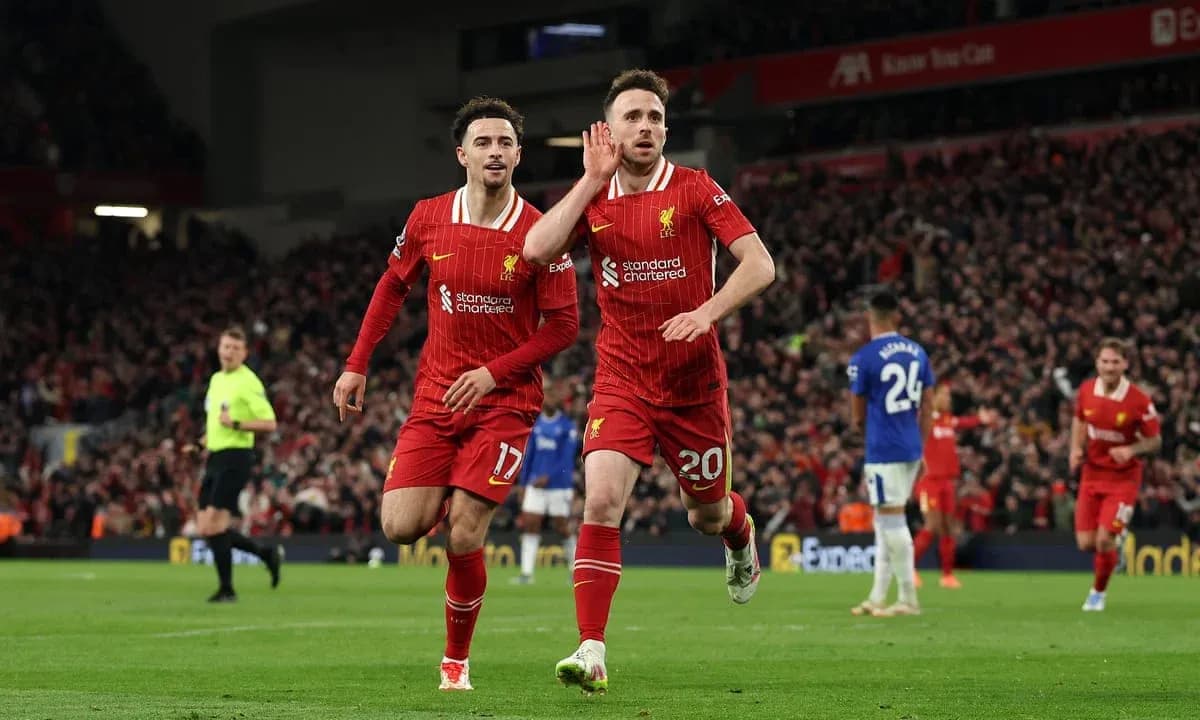
Liverpool Edges Everton in Premier League Derby 2–1
Everton and Liverpool produced a tight, attritional derby at Hill Dickinson Stadium, with Liverpool edging a 2–1 away win in Premier League Round 33. Liverpool’s superiority in possession (56%) and shot volume (14 total shots to Everton’s 10) eventually told, but the game’s texture was defined by Everton’s compactness, direct transitions, and a series of fine margins at both ends. The halftime scoreline of 0–1 to Liverpool reflected their cleaner structure between the lines, while the late 1–2 final came from sustained territorial control and set-piece pressure rather than open-play dominance.
First Half
The first half revolved around Liverpool’s 4-2-3-1 trying to unpick Everton’s deeper block. With G. Mamardashvili starting behind a back four of C. Jones, I. Konate, V. van Dijk and A. Robertson, Liverpool built with a broad base and double pivot of D. Szoboszlai and R. Gravenberch. Everton, lacking a declared formation in the data but clearly organised with a back four (J. O’Brien, J. Tarkowski, J. Branthwaite, V. Mykolenko) and a hard‑working midfield unit of I. Gueye, James Garner, D. McNeil, K. Dewsbury-Hall and I. Ndiaye behind Beto, prioritised density in central areas.
The early yellow card for Jordan Pickford on 22' for argument hinted at the emotional temperature and also at how often Everton were forced into emergency defending and disputes around their box. A pivotal moment came at 28', when Jake O’Brien thought he had given Everton the lead, only for VAR to cancel the goal. That intervention underlined the knife‑edge nature of Everton’s set‑piece and aerial threat, but also preserved Liverpool’s structural advantage at a moment when the hosts could have flipped the game state in their favour.
Within a minute of that cancellation, Liverpool punished Everton’s loosened shape. On 29', M. Salah struck the opener, assisted by C. Gakpo. The pattern reflected Liverpool’s attacking design: Salah starting from the right of the three behind A. Isak, Gakpo from the left, and F. Wirtz central, all rotating into half-spaces. The goal sequence suggests Liverpool exploiting the transitional disorganisation after the VAR decision, with Gakpo finding Salah in a channel where Everton’s midfield screen had momentarily fractured. From there to halftime, Liverpool controlled the tempo through possession, using their 491 total passes (84% accuracy) to circulate Everton side to side, but without overwhelming shot volume; Everton’s compactness limited clear entries into the box.
Equaliser and Tactical Changes
Everton’s equaliser on 54' through Beto, assisted by K. Dewsbury-Hall, was the purest expression of their game plan. With only 44% possession overall and 370 passes at 76% accuracy, Everton leaned on direct progression and second balls. Dewsbury-Hall, one of their more progressive midfielders, supplied Beto in a situation that likely originated from a quick transition or a targeted ball into the striker’s zone. The finish, contributing to Everton’s 0.8 xG total, showed how efficiently they converted their limited, but high‑value, entries into the box (7 shots inside the area, matching Liverpool’s 7).
The subsequent substitution vector from Liverpool at 58' was revealing: F. Woodman (IN) came on for G. Mamardashvili (OUT). With Mamardashvili having made part of Liverpool’s 3 total saves before departing, this was a significant alteration in the last line. It did not reflect in the goals-prevented metric (0 for Liverpool), but from a tactical standpoint it introduced a new goalkeeper’s distribution profile into Liverpool’s build-up and rest-defence organisation.
On 72', R. Ngumoha (IN) came on for A. Isak (OUT), shifting Liverpool’s attacking reference. Isak had provided a central focal point for link play and pinning Everton’s centre-backs; Ngumoha’s introduction likely tilted Liverpool towards more fluid, mobile interchanges and potentially more threat attacking space in behind, rather than a traditional target profile.
Everton’s own substitutions were reactive and structurally coherent. On 73', T. Barry (IN) came on for Beto (OUT), swapping a classic reference No. 9 for a more mobile forward. This suggested a desire to threaten Liverpool’s back line in transition with fresher legs and diagonal runs rather than hold-up play. On 80', T. George (IN) replaced D. McNeil (OUT), refreshing wide energy and perhaps adding more direct running on the flanks to exploit Liverpool’s full-backs, especially as Liverpool pushed to reassert control.
Late Game Adjustments
Liverpool’s decisive tactical reshaping came between 84' and 86' with a triple defensive and midfield adjustment. At 84', A. Mac Allister (IN) came on for F. Wirtz (OUT), and J. Frimpong (IN) for C. Gakpo (OUT). Mac Allister’s introduction into the double pivot or as a deeper playmaker increased Liverpool’s control of central circulation and rest-defence structure, giving them a more stable platform to sustain attacks and manage Everton counters. Frimpong, nominally a defender but with strong attacking instincts, likely operated high on the right, adding width and overlapping thrust to pin back V. Mykolenko and disrupt Everton’s left side.
At 86', M. Kerkez (IN) replaced A. Robertson (OUT). This maintained Liverpool’s aggressive left-back profile, ensuring fresh legs to continue overlapping and counter-pressing on that flank. Collectively, these changes pushed Liverpool into a late-game structure closer to a 2-3-5 in possession, with full-backs and Frimpong high, and Mac Allister and Szoboszlai orchestrating from deep.
Everton’s final substitution at 87' — M. Keane (IN) for J. Branthwaite (OUT) — was a like-for-like central defensive change, probably enforced by fatigue or minor issues, but it also meant a fresh aerial presence for the closing set-piece phase. That set-piece phase, however, ultimately favoured Liverpool. On 90', V. van Dijk scored the winner, assisted by D. Szoboszlai. Given Liverpool’s 6 corners to Everton’s 1 and Van Dijk’s profile, it is consistent with a rehearsed dead-ball routine: Szoboszlai’s delivery and Van Dijk’s timing in the box against an Everton back line that had just been reshuffled.
Disciplinary Management
Disciplinary management also shaped the tone. Everton collected both yellow cards: Jordan Pickford’s on 22' for argument, and James Garner’s on 90+12' for a foul, the latter arriving as Everton chased an equaliser in a stretched, emotionally charged final phase. Liverpool, by contrast, finished without a booking, reflecting a more controlled defensive approach despite committing more fouls (12 to Everton’s 8).
Statistically, Liverpool’s 1.45 xG to Everton’s 0.8 xG aligns with the 2–1 scoreline and the territorial pattern. Both goalkeepers ended with 3 saves each, underscoring that while Liverpool had more shots (14–10) and more blocked attempts (4–1), Everton’s low block and compactness forced Liverpool into less efficient shooting zones for long stretches. Everton’s Overall Form in this match — combative, vertically direct, and reliant on set-pieces and transitions — was consistent with a side ceding possession but seeking high‑impact moments. Their Defensive Index was solid in open play, limiting Liverpool to 7 shots inside the box and leaning heavily on central compactness, but it faltered in two key phases: the post‑VAR transition on 29' and the late set-piece sequence on 90'.
Liverpool’s Overall Form was that of a possession-dominant, structurally coherent side, using a 4-2-3-1 to maintain control and then intelligently adjusting personnel to increase central stability and wide thrust in the final quarter. Their Defensive Index benefited from strong central defending by Konate and Van Dijk and effective control of Everton’s wide supply lines, restricting Everton to 1 corner and relatively few sustained attacks. In the end, the match was decided by Liverpool’s superior set-piece execution and in-game tactical flexibility, against an Everton side whose disciplined defensive work could not quite withstand the cumulative pressure.