Australia's Tactical Mastery in 2-0 Win Over Türkiye
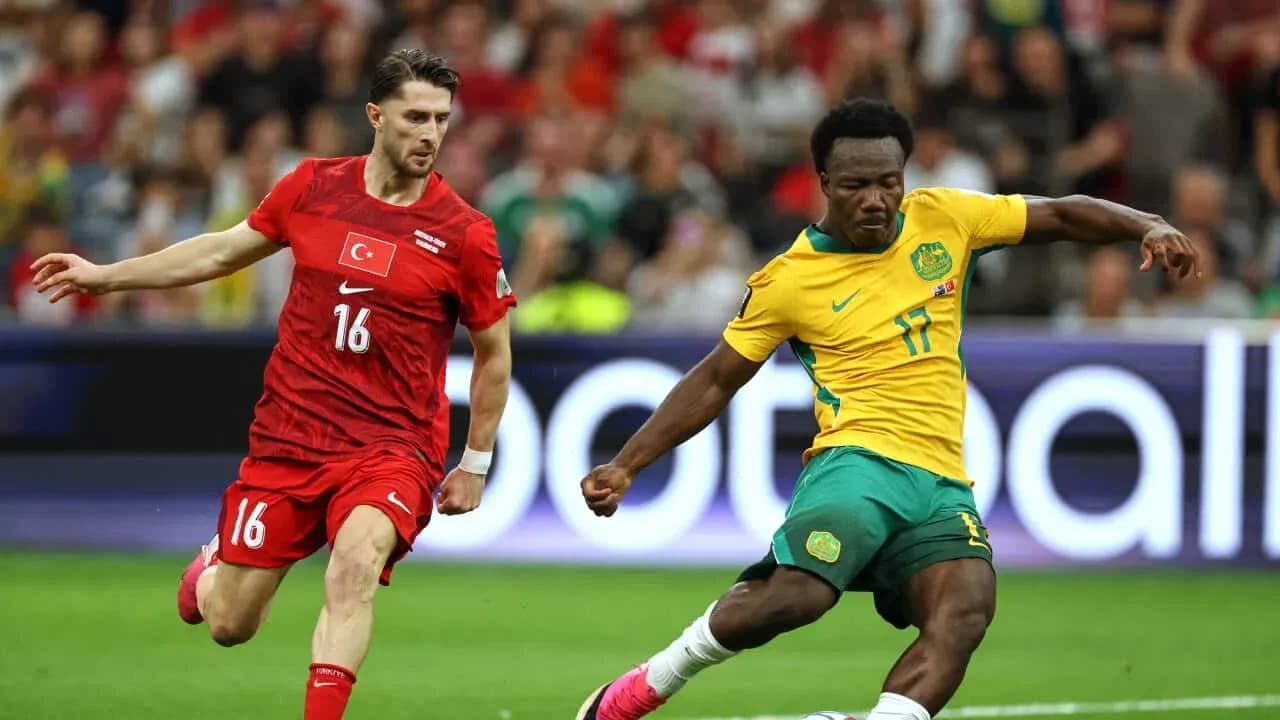
Australia’s 2-0 win over Türkiye at BC Place was a classic example of an underdog executing a low-possession, structurally disciplined game plan almost to perfection. In a World Cup group opener where Türkiye controlled 72% of the ball and fired 30 shots, Australia leaned on a compact 5-4-1, ruthless transition moments, and an outstanding display from debutant goalkeeper Patrick Beach to convert just 28% possession into a two-goal cushion and three points.
Executive Summary
Australia’s 5-4-1 under Tony Popovic was designed to absorb and spring, ceding territory but protecting central zones. Türkiye’s 4-2-3-1 under Vincenzo Montella dominated the ball and territory but repeatedly ran into a crowded penalty area and an in-form goalkeeper. First-half control without penetration from Türkiye was punished by Nestory Irankunda’s 27' opener in transition. In the second half, as Türkiye chased and opened up, Connor Metcalfe struck at 75' to seal a win that was tactically conservative but brutally efficient relative to the shot and xG balance.
Scoring Sequence & Disciplinary Log
- 27' Nestory Irankunda (Australia) — assisted by Paul Okon-Engstler. A classic counter-attacking moment: Australia broke from deep, Irankunda attacking the space left by Türkiye’s advanced full-backs. Okon-Engstler provided the decisive forward pass, and Irankunda finished to give Australia a 1-0 lead against the run of play.
- 75' Connor Metcalfe (Australia) — (no assist). With Türkiye committing numbers forward, Metcalfe arrived from midfield to finish a second-phase attack, doubling Australia’s lead to 2-0 and effectively ending the contest.
Disciplinary log (chronological):
- 86' Yunus Akgün (Türkiye) — Roughing. The only card of the match came late, reflecting Türkiye’s frustration as they pushed desperately to find a way back. The “Roughing” incident underlined how Australia had successfully dragged the game into a more physical, stop-start rhythm in the closing stages.
Total cards: Australia: 0, Türkiye: 1, Total: 1.
Tactical Breakdown & Personnel
Popovic’s 5-4-1 was built on a deep, narrow block. The back five of Jacob Italiano, Alessandro Circati, Harry Souttar, Cameron Burgess, and Jordan Bos stayed extremely compact horizontally, forcing Türkiye into wide areas and long-range attempts. In front, a hard-working midfield line of Nestory Irankunda, Paul Okon-Engstler, Aiden O'Neill, and Connor Metcalfe shielded the half-spaces and dropped to form almost a 5-2-3/5-2-1-2 in deep phases, with Mohamed Touré as the lone outlet.
The defensive plan hinged on three principles:
- Central denial: With Türkiye’s creative hub of Hakan Çalhanoğlu, Orkun Kökçü, and Arda Güler, Australia prioritised closing the central lane. O'Neill and Metcalfe stayed tight to the pivot and No.10 zones, while Souttar and Circati aggressively stepped out when passes did pierce the first line.
- Box saturation: Türkiye registered 30 total shots, with 14 inside the box, but Australia’s “Blocked Shots” figure (1) highlights that rather than lunging in, they focused on positional defending and forcing rushed finishes under pressure rather than last-ditch blocks. The sheer volume of Turkish shots was met by layered coverage rather than reckless interventions.
- Transition punch: Australia’s 9 total shots (6 inside the box) from only 28% possession shows how they prioritised high-value attacks. The first goal encapsulated this: quick progression through Okon-Engstler into Irankunda’s pace channel. The second came as Türkiye’s structure stretched, with Metcalfe timing his forward run from midfield.
In goal, Patrick Beach (Australia) was decisive. Australia’s statistics show 8 “Goalkeeper Saves” and a “goals prevented” figure of -0.95, indicating that while he made a high number of stops, the underlying model judged that, on average, he conceded fewer difficult chances than the volume might suggest. Still, 8 saves against 8 Turkish shots on target is the backbone of the clean sheet; his handling and positioning under sustained pressure were crucial.
For Türkiye, Uğurcan Çakır (Türkiye) had a quieter but less forgiving night. With Australia producing 4 shots on goal, he recorded 2 “Goalkeeper Saves”, conceding twice. The “goals prevented” value of -0.95 on Türkiye’s side underscores that the goals he conceded were, in model terms, slightly more preventable, hinting at finishes that were good but not unstoppable and perhaps a small underperformance relative to xG.
Montella’s 4-2-3-1 was aggressive: full-backs Zeki Çelik and Ferdi Kadıoğlu pushed high, with İsmail Yüksek and Hakan Çalhanoğlu orchestrating from deep and Arda Güler plus Orkun Kökçü between the lines. Yet Australia’s back five consistently outnumbered the front line, and Türkiye’s possession often stalled around the edge of the box, leading to 16 shots from outside the box and a reliance on volume rather than clear-cut chances.
Substitutions reflected the tactical arms race. At 46', Barış Alper Yılmaz (OUT) for Kenan Yıldız (IN) added another dribbler to attack Australia’s flanks. Later, Salih Özcan and Mert Müldür were introduced for İsmail Yüksek and Zeki Çelik to refresh the press and add crossing threat. Popovic responded by replacing Irankunda with Nishan Velupillay and Touré with Tete Yengi, preserving vertical outlets, and later shoring up the flanks with Jason Geria and Aziz Behich for Italiano and Bos. Jackson Irvine for Okon-Engstler added fresh legs and aerial presence in the closing stages to see out the lead.
The Statistical Verdict
The numbers paint a stark contrast between control and efficiency. Türkiye led 72% to 28% in possession, completed 707 passes to Australia’s 270, and posted a 90% pass accuracy (638 accurate) against Australia’s 75% (202 accurate). In terms of chance creation, Türkiye’s 30 total shots (8 on goal, 12 blocked) dwarfed Australia’s 9 (4 on goal, 1 blocked). Yet the xG split — 1.33 for Türkiye vs 0.77 for Australia — shows that while Türkiye created more, the quality gap was not as wide as the shot count suggests.
Australia’s defensive index on the night was defined by structure and goalkeeping rather than sheer volume of interventions. Fouls were 12 for Australia and only 4 for Türkiye, indicating that Australia were willing to break rhythm and disrupt Turkish tempo when needed. Corner Kicks (8-5 to Türkiye) further underline territorial dominance, but Australia’s box management ensured those set-pieces did not translate into goals.
Ultimately, this match will be filed as a textbook low-possession victory: Australia maximised a modest xG, protected their box intelligently, and relied on Patrick Beach (Australia) to absorb Türkiye’s volume. Türkiye, despite territorial and statistical superiority, lacked the incisive movements and finishing to convert control into points in this World Cup group opener.