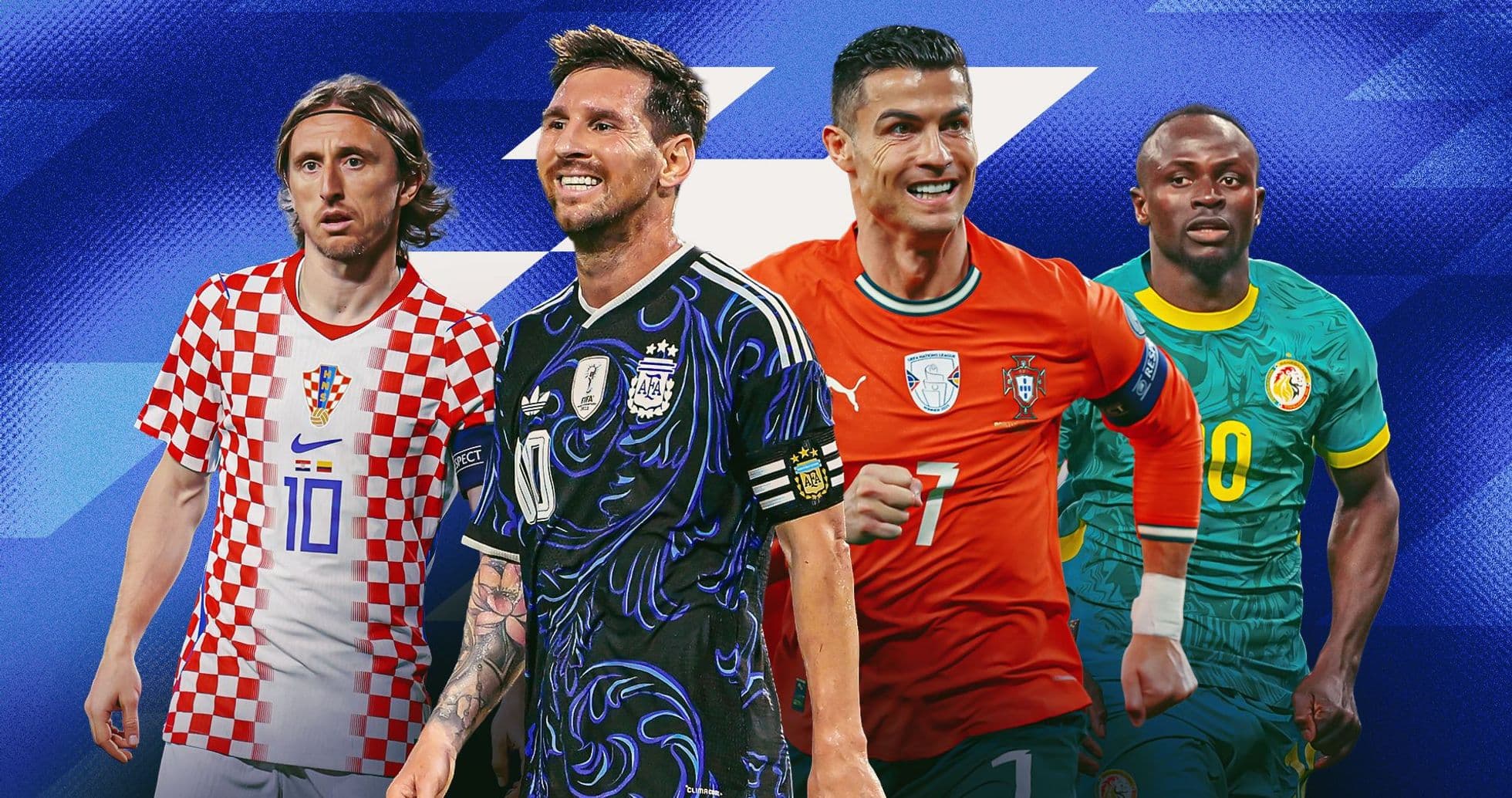
World Cup 2026: The Last Dance for Football Legends
The World Cup has always loved a farewell. In 2026, it might be overwhelmed by them.
Across North America, legends will arrive knowing this is the last dance, the final shot, the final chapter. Some have already conquered the tournament. Others are still chasing the one piece missing from their careers. All of them are fighting time.
Messi, Ronaldo and Ochoa: Six and out
Lionel Messi will turn 39 during the tournament and still walk into a sixth World Cup as Argentina’s guiding light. He finally lifted the trophy in 2022, completing the story that had haunted him for over a decade. He has since traded Europe for Inter Miami, managing his body in MLS, picking his moments rather than living in the relentless churn of the Champions League.
Yet every time he pulls on the Argentina shirt, the old magic returns. He still scores, still creates, still sees passes and spaces players half his age can’t even imagine. Doubts linger about how he will cope with an expanded format and suffocating summer heat across the United States, Mexico and Canada. But nobody truly believes he’ll go quietly. Messi has never done quiet.
Cristiano Ronaldo arrives from a very different place. At 41, if he captains Portugal to the trophy, he becomes the oldest World Cup-winning player in history. He has never scored in the knockout rounds of the competition, never come close to matching his club dominance on this particular stage. For a five-time Ballon d’Or winner, his World Cup record sits awkwardly against his legend.
Yet he refuses to fade. He keeps scoring heavily for Al-Nassr in Saudi Arabia and keeps insisting retirement is nowhere near. Portugal no longer depend on him in the way they once did – Rafael Leao, Pedro Neto and Goncalo Ramos are ready to take the baton – but Roberto Martinez still builds the team with Ronaldo at its centre. This is also his sixth World Cup. It has to be his last shot at the one trophy he has never held.
Guillermo Ochoa will join them in that exclusive six-tournament club, even though his presence looked unlikely just months ago. The Mexican icon, now 40 and with more than 150 caps, had barely featured for El Tri since the CONCACAF Nations League finals in March 2024. His international story seemed to be over.
Then Angel Malagon tore his Achilles. The door swung open again. Ochoa, the man who has popped up every four years with gravity-defying saves and a headband that feels as permanent as the posts, steps back into the World Cup as co-hosts Mexico’s veteran guardian. After a career that has taken him through Spain, Italy, France, Portugal, Belgium and most recently AEL Limassol in Cyprus, he has hinted this will be his last stand. For two decades, Ochoa has been part of the tournament’s furniture. Now he gets one more tournament to decorate.
Neuer, Modric, Dzeko: Old masters, last missions
Germany have their own blast from the past. Manuel Neuer, 40, was supposed to be done with international football after Euro 2024 on home soil. He said goodbye, the curtain came down. But as Marc-Andre ter Stegen’s injuries dragged on and doubts grew around Oliver Baumann, Julian Nagelsmann picked up the phone.
Neuer answered. Again.
After another strong season with Bayern Munich, he heads to a fifth World Cup with the No.1 shirt already promised to him. Germany, scarred by back-to-back group-stage exits, turn back to the man who redefined goalkeeping at this level. One more rodeo. One more attempt to drag Die Mannschaft out of their malaise.
Luka Modric is 40 and still trying to bend time to his will. The Croatian playmaker, who took his country to the final in 2018 and third place in 2022, now prepares for a fifth World Cup. He joined AC Milan last summer after leaving Real Madrid, a move designed to keep his legs fresh and minutes manageable rather than chase another European peak.
On the international stage, though, he remains Croatia’s heartbeat. He sits on 197 caps, just behind Messi’s 198, and both are about to crash through the 200 barrier. Only three players in history have done that before. Modric will likely be the fourth, but he will not get many more chances to add to his World Cup story.
Edin Dzeko probably thought his chances were gone altogether. Bosnia and Herzegovina had not been back to the World Cup since their 2014 debut, and qualification campaigns kept ending in disappointment. Then came one last surge. A playoff run. A win over Italy. Suddenly, at 40, Dzeko will walk out in North America for a second World Cup.
He is closing in on 150 caps and already has more than 70 international goals. A January move to Schalke reignited his club form, his goals helping drive the German club back into the Bundesliga. For a striker who has spent his career at Manchester City, Roma and Inter, his international tournament tally has never matched his talent. Now he finally gets another shot at the biggest stage before he says goodbye.
Asia and Africa’s icons at the crossroads
Some farewells will be more subtle. Son Heung-min may not frame this as a last World Cup, but the possibility hangs in the air. He turns 34 in July. He has already left Tottenham and European football for LAFC in MLS. He remains the face of South Korean football, the captain and the symbol, the man expected to carry a nation obsessed with the game.
That weight is heavy. By the time 2030 rolls around, Son may decide he has done enough. For now, he leads Korea into another World Cup with the same relentless work rate and sharp finishing, but this could be the final time he shoulders everything on this particular stage.
Mohamed Salah lives a similar reality for Egypt. Just a few days older than Son, he has dragged the Pharaohs forward almost single-handedly for years. This time he has a little more help – led by Manchester City’s Omar Marmoush – yet the team still looks to Salah for the decisive moment, the goal, the spark.
His form for Liverpool has dipped sharply over the last year. His only previous World Cup, in 2018, was compromised by the shoulder injury he suffered in the Champions League final. For a player of his stature, that is not enough. He needs a World Cup memory to match his club exploits.
With his Liverpool chapter closed and a move to Saudi Arabia looming, the end of his peak years is in sight. Expecting him to keep grinding through international breaks and long qualifying campaigns deep into the next cycle feels optimistic. This summer may be his last real chance to leave a mark on the tournament that has so far eluded him.
Sadio Mane, 34, has already delivered Senegal’s greatest moment, scoring the decisive penalty to win the 2021 Africa Cup of Nations. He then led them back to the World Cup, only to miss the 2022 tournament through injury. That absence hurt. It still does.
Now he gets another crack. His move to Al-Nassr has taken him out of the European spotlight, but his importance to Senegal has not dimmed. He still wears the armband. He still sets the tone. Around him, Ismaila Sarr and Illiman Ndiaye are growing into stars, giving Senegal more weapons than ever. With that blend of emerging talent and Mane’s experience, this could be the best – and last – chance for the Lions of Teranga to make a deep run.
Riyad Mahrez completes the African trio of Champions League and Premier League winners. At 35, the Algerian winger still possesses that velvet first touch, that glide past defenders that seems to ignore physics. He, too, is winding down in Saudi Arabia with Al-Ahli, but on his day he remains unplayable.
Amazingly, Mahrez has only one World Cup appearance to his name, all the way back in 2014. Algeria have not qualified since. This summer finally gives him another shot at the tournament his talent always deserved. For a player who has lit up England and Europe, this is a late chance to put his international career on the global stage it has lacked.
Europe’s fading giants: De Bruyne, Van Dijk, James
Kevin De Bruyne arrives in North America under a cloud. His first season at Napoli has been shredded by injuries. As his 35th birthday approaches, the fear is simple: is his body starting to say no?
When he is fit, there are few like him. De Bruyne can split a defence with a single pass, score from distance, dictate an entire match’s rhythm. He remains Belgium’s conductor, even as the so-called Golden Generation breaks apart around him. Rudi Garcia’s squad is in transition, younger, less star-studded. Yet if De Bruyne can stay on the pitch, Belgium instantly become a dangerous outsider again. His margin for error – and for fitness – has never been slimmer.
Virgil van Dijk, who turns 35 during the tournament, faces his own questions. For years he has been the rock on which Liverpool built one of the most feared sides in Europe, a defender so dominant that some forwards openly tried to avoid duels with him. The aura was real.
The past season has chipped away at that aura. On Merseyside, there are whispers that he has lost a yard of pace, that his anticipation is not quite as sharp. For the Netherlands, though, he remains the captain, the leader, the defensive pillar. This will likely be his second and final World Cup. Dutch supporters will hope the old Van Dijk, the one who made the game look slow and simple, turns up for one more month.
James Rodriguez knows what the World Cup can do for a career. In 2014, he lit up Brazil with a tournament for the ages, winning the Golden Boot and earning a move to Real Madrid. Since then, his club journey has been fractured by injuries and short stints, most recently at Minnesota United in MLS, as he tries to stay sharp enough for international duty.
He turns 35 in July. For Colombia, his presence still matters. He remains their creative reference point, the player who can see a picture nobody else spots. His body has betrayed him often, but his talent has not. A final World Cup, in the country where he once again tried to rebuild himself, feels like a fitting closing chapter for one of the competition’s most recognisable faces.
Neymar, Kane and England’s shifting core
Neymar’s relationship with the World Cup has been chaotic, brilliant, heartbreaking. Now it is fragile. Brazil’s all-time leading scorer tore his ACL in October 2023 and has not played for his country since. With Carlo Ancelotti taking charge in September and initially looking elsewhere, the idea of Neymar at one last World Cup seemed to be slipping away.
Then injuries struck Brazil’s forward line. Ancelotti turned back to the 34-year-old Santos attacker, naming him in his 26-man squad and sparking wild celebrations. Yet the story immediately twisted again: another injury, just days after the call-up. His role in North America is unclear, his fitness a constant worry.
What is clear is that his body is running out of time. The notion of Neymar reaching 2030 in shape for another World Cup is pure fantasy. This is it. One final chance to chase the sixth star Brazil craves, one last opportunity to rewrite a World Cup legacy that has never quite matched his talent.
Harry Kane, by contrast, arrives at 32 looking as sharp as ever. More than 60 goals for Bayern Munich this past season, a record as England’s all-time leading scorer, and the sense that he is right in the middle of his peak. He could, in theory, go again in 2030. England fans will cling to that idea.
But the calendar tells a different story. England will co-host the European Championship in 2028. For a player like Kane, that home tournament offers a natural endpoint: one last roar in front of his own crowd, one final embrace of the Wembley lights before stepping away from international football. If that proves to be his farewell, then 2026 becomes his last World Cup.
He will not be alone in that. Jordan Pickford, John Stones, perhaps even Marcus Rashford may look at a home Euros as the perfect stage on which to bow out. The spine of this England era could be heading into its final World Cup together, knowing that whatever happens in North America, the real goodbye might come two years later on English soil.
Across continents, the pattern repeats. Legends clinging on for one more month. Bodies creaking, minds still sharp, eyes fixed on a trophy that might never come again. The World Cup has always been about the future – the new star, the next generation.
In 2026, it might belong, just for a moment, to those who refuse to let go.