World Cup 2023: U.S. Men Make History with 4-1 Opener
LOS ANGELES — For months, the noise around this World Cup had little to do with football. Politics, ticket prices, immigration snarls, transit chaos — the buildup across Mexico, Canada and the United States felt more like a summit than a sporting festival.
Then the whistle blew.
The tournament has erupted into life, and nowhere has the energy crackled more than in Los Angeles, where the U.S. men delivered a statement performance that will echo far beyond the city limits.
A U.S. Opener for the History Books
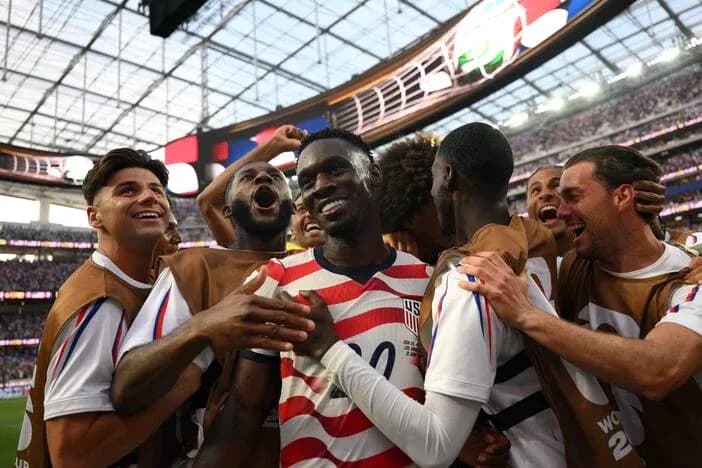
The U.S. didn’t just beat Paraguay on Friday night at Los Angeles Stadium. It tore into the World Cup with a 4-1 win that ranks among the finest displays the American men have produced on this stage.
Four goals — the most the U.S. men have ever scored in a World Cup match.
Folarin Balogun grabbed the spotlight, striking twice and writing his name alongside a sliver of history. No U.S. player had scored multiple goals in a World Cup game since the inaugural tournament in 1930. Ninety-four years later, the drought ended.
Behind him, the foundation was just as impressive. Chris Richards, back in the lineup after missing both pre-tournament warm-ups through injury, turned in a masterclass from the back. He completed all 83 of his passes — every single one — the highest total recorded by any player in a World Cup match since 1966. For a defender returning from the treatment table, it was a commanding answer to any doubts.
There was one cloud. Christian Pulisic, the team’s marquee attacker, exited at halftime with a calf issue. He walked gingerly to the team bus afterward, his status uncertain. For a side that just announced itself so loudly, the health of its biggest star now hangs over the week.
Still, from front to back, the U.S. sparkled. The tempo, the aggression, the ruthlessness in front of goal — it all pointed to a team intent on doing more than just making up the numbers.
One game, though, never defines a World Cup. It only sets the stakes for the next one.
Australia Crash the Party in Group D
On Saturday, the U.S. got an early look at its Group D landscape, and it shifted in a hurry.
Turkey arrived with pedigree and big-club power. Arda Güler of Real Madrid. Kenan Yildiz of Juventus. A squad stacked with players from Europe’s top leagues. On paper, the group’s heavyweight.
Australia ripped that script to shreds.
With disciplined defending and sharp counterattacks, the underdogs stunned Turkey 2-0, flipping the group dynamic and injecting real jeopardy into every remaining match. That result turns next Friday’s USA–Australia clash into a pivotal early test. If the Americans win, they seize control of Group D and stride toward the knockout rounds with authority. Drop points, and the margin for error tightens fast.
The World Cup rarely waits long to complicate things.
Scotland’s Surprise and Brazil’s Early Stumble
Elsewhere, another storyline surged from an unexpected corner.
Scotland, back on the World Cup stage for the first time in 28 years, opened its campaign with a win over Haiti and now sits atop Group C. The significance lies in the company they keep. Sharing the group with Brazil — the five-time champions, football’s eternal aristocrats — and a formidable Morocco side, Scotland was expected to scrap for survival.
Instead, it is looking down on both.
Brazil and Morocco, the two presumed qualifiers, fought to a 1-1 draw. It’s only the first round of games, but that single point each has allowed Scotland to claim an early, unlikely lead. For now, the group’s balance has shifted, and the pressure on the giants has already ticked up a notch.
Qatar’s First Point, Heavyweights Trade Blows
The weekend offered smaller but meaningful milestones, too.
Qatar, playing in just its second World Cup, drew 1-1 with Switzerland on Saturday. That result gave the Gulf nation its first-ever World Cup point, after losing all three matches at the 2022 tournament it hosted. A modest step, but a historic one.
In Group F, the Netherlands and Japan delivered the kind of contest that justifies the “heavyweight” label. Their 2-2 draw swung back and forth, a reminder that both sides carry enough quality to go deep into the tournament. Neither blinked. Neither backed down.
Curaçao’s Seventeen Minutes of Belief
Then came one of those World Cup scenes that live in the memory long after the scoreline fades.
Curaçao, population 158,000, the smallest country ever to appear at a World Cup, walked out against Germany on Sunday and refused to be overawed. Germany struck first, as expected. Curaçao answered, unexpectedly. At 1-1, for 17 glorious minutes, the Caribbean debutant stood level with a four-time world champion.
Dreams rarely last long against a machine like Germany. Once the favorites shifted through the gears, the flood followed, and they ran out 7-1 winners — a scoreline with familiar resonance in German World Cup history.
For Curaçao, the scoreboard was harsh. The memory of that equalizer, and those 17 minutes of parity, will endure far longer.
Iran, New Zealand and a Different Kind of Tension
The football drama this week will share space with geopolitics.
On Monday, Iran opens its World Cup against New Zealand at Los Angeles Stadium under extraordinary circumstances. After the U.S. and Israel attacked Iran in February, questions lingered over whether the team would even participate. Plans to base their training camp in Tucson, Arizona, were scrapped, with Iran relocating to Tijuana, Mexico, citing security concerns and ongoing hostilities.
The U.S. government has imposed strict conditions: the Iranian squad may only enter the country the day before each of its three group matches. It is a logistical and emotional strain layered on top of the usual World Cup pressure.
How that tension translates on the pitch will be one of Monday’s central storylines.
Mbappé, Messi and the Champions Step In
By Tuesday, the tournament’s star power takes center stage.
France, powered by Kylian Mbappé, launches its campaign against Senegal in a marquee Group I clash. Mbappé arrives as one of the defining figures of modern football, and every touch he takes will be dissected. Senegal, with its own rich talent pool and competitive edge, will not roll over. This is no gentle warm-up for the French.
On the same day, the defending champions step into the light.
Argentina, led by Lionel Messi, begins its bid for back-to-back titles against Algeria in Group J. Only Italy in 1938 and Brazil in 1962 have ever successfully defended a World Cup crown. That’s the scale of the challenge in front of Messi and company, even after their cathartic triumph last time out.
The path to history starts with Algeria. Any wobble, any hint of vulnerability, and the narrative around their repeat bid changes instantly.
The politics, the logistics, the noise will keep humming in the background across North America. But the games have taken over now, and the next week offers a clear message: this World Cup is not easing its way into the calendar. It’s sprinting.