Germany’s Tactical Masterclass in 7-1 Victory Over Curaçao
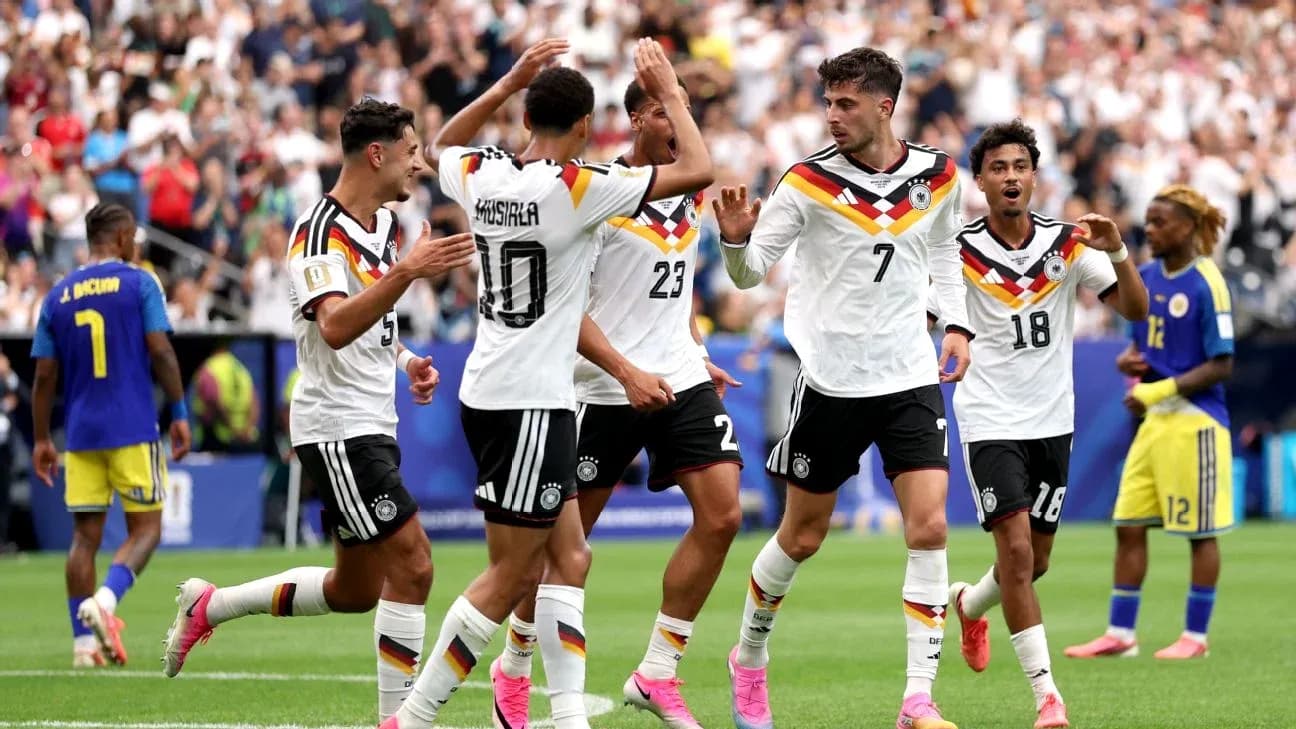
Germany’s 7-1 demolition of Curaçao at NRG Stadium was a tactical rout built on structural superiority, relentless occupation of the final third, and a clear exploitation of individual mismatches across the pitch. Julian Nagelsmann’s 4-2-3-1 established territorial control from the first whistle, while Dick Advocaat’s 4-3-1-2 never found a stable defensive reference against Germany’s fluid attacking midfield.
Germany’s possession share of 65% was not sterile circulation but a deliberate, high-tempo positional game. The double pivot of Felix Nmecha and Aleksandar Pavlović gave Germany a stable rest-defense platform and constant vertical access. With 633 total passes and 550 accurate (87%), Germany used the ball to stretch Curaçao’s compact central block, repeatedly shifting play to isolate fullbacks and half-spaces.
Structurally, the back four of Joshua Kimmich, Jonathan Tah, Nico Schlotterbeck and Nathaniel Brown held an aggressive line, compressing the field and keeping Curaçao’s front two, Jürgen Locadia and Sontje Hansen, far from Manuel Neuer’s penalty area. Curaçao completed 336 passes (276 accurate, 82%), but most of that possession came in deeper zones, under pressure, and without the capacity to break lines consistently.
First Goal
The first goal on 6 minutes encapsulated Germany’s plan: early central occupation by the No. 10 line, quick combinations around the box, and late arrivals from midfield. Felix Nmecha’s opener, assisted by Florian Wirtz, came from Germany’s ability to overload the interior channels, pulling Curaçao’s midfield three out of shape and opening a lane for a decisive final pass.
Curaçao’s Equaliser
Curaçao’s equaliser on 21 minutes through Livano Comenencia was more of an isolated moment than a pattern. With only 2 shots on goal from 8 total attempts, their attacking threat was sporadic. Germany’s rest-defense, anchored by Schlotterbeck and Tah, limited Curaçao to 4 shots inside the box and 4 from outside, showing how rarely they could access premium zones.
Germany’s Dominance
Germany’s dominance in chance creation is underlined by 27 total shots, 12 on goal and 22 from inside the box. The 8 blocked shots highlight how often they were shooting from central, dangerous areas, forcing last-ditch interventions. The xG figure of 3.91 reflects a steady stream of high-quality chances; scoring 7 from that platform shows both clinical finishing and Curaçao’s defensive collapse, rather than unsustainable long-range conversion.
The second and third German goals before half-time were a direct consequence of structural superiority on set and wide attacks. Schlotterbeck’s 38th-minute goal, assisted by Nathaniel Brown, came from Germany’s capacity to commit defenders into advanced positions without losing balance, knowing Curaçao lacked the pace and structure to counter effectively. Kai Havertz’s penalty at 45+5’ confirmed the territorial siege: Curaçao’s back line was repeatedly forced into last-ditch defending inside the box.
In Possession
In possession, Germany’s 4-2-3-1 often morphed into a 2-3-5. Kimmich pushed high and wide on the right, Brown advanced on the left, and Nmecha or Pavlović dropped between the centre-backs to initiate build-up. Wirtz, Jamal Musiala and Leroy Sané rotated constantly behind Havertz, dragging Curaçao’s defensive line and midfield triangle into impossible decisions: follow between the lines and leave space in behind, or hold the line and concede free receptions in the pocket.
Curaçao’s Struggles
Curaçao’s 4-3-1-2 struggled most in defensive reference points. With a narrow front three (Chong as the link behind Locadia and Hansen), their wide midfielders were constantly outnumbered. Kimmich’s repeated involvement in advanced phases is reflected in his double-assist impact: he set up Musiala’s 47th-minute goal and later provided the cross or cutback for Deniz Undav’s strike on 78 minutes. Germany consistently created 2v1s on the flanks, then attacked the box with five lanes occupied.
Substitutions did not alter Germany’s structure; they refreshed the intensity. Deniz Undav (IN) came on for Jamal Musiala (OUT) at 64’, adding a second central reference in some phases and attacking the space between Curaçao’s centre-backs. His assist for Brown’s 68th-minute goal and his own finish on 78 minutes, again from Kimmich’s service, underlined how Germany’s system generated chances for whichever forward occupied those zones. David Raum (IN) for Nathaniel Brown (OUT), Antonio Rüdiger (IN) for Jonathan Tah (OUT), and Leon Goretzka (IN) for Felix Nmecha (OUT) at 73’ allowed Nagelsmann to maintain the same tactical template with fresh legs and slightly different profiles, without sacrificing control.
Advocaat’s Changes
On the opposite side, Advocaat’s changes were largely reactive. Jeremy Antonisse (IN) for Sontje Hansen (OUT) at 46’ aimed to add depth in transition, but with Germany pinning Curaçao so deep, there were few moments to exploit space behind. Later, Jearl Margaritha (IN) for Jürgen Locadia (OUT) on 64’ and Gervane Kastaneer (IN) for Tahith Chong (OUT) on 83’ freshened the front line but did not change the structural problem: Curaçao rarely progressed through Germany’s compact midfield screen.
Defensive Intensity
Defensively, Germany’s intensity is reflected in 18 fouls to Curaçao’s 11, a sign of proactive counter-pressing rather than ill-discipline, especially given the absence of recorded cards. Their immediate pressure after loss prevented Curaçao from launching clear counters, forcing rushed clearances and low-percentage long balls. With only 1 recorded goalkeeper save for Manuel Neuer (Germany), most of Curaçao’s efforts either missed the target or were blocked before reaching the goal, confirming how well Germany controlled shot quality against.
At the other end, Eloy Room (Curaçao) made 4 saves, but the negative goals prevented value of -2.47, combined with Germany’s 3.91 xG, indicates that Curaçao’s defensive structure and goalkeeping performance both underperformed expectation. Germany consistently generated clear looks from central areas, often inside the six-yard box or unpressured in the penalty area, making the task almost impossible for the visiting goalkeeper.
Statistical Verdict
The statistical verdict is emphatic: Germany’s 65% possession, 27-8 shot advantage, and 22 shots inside the box illustrate a complete territorial and qualitative dominance. Their passing volume and 87% accuracy allowed them to sustain pressure and recycle attacks, while Curaçao’s 35% possession and 0.4 xG show an attack limited to isolated moments rather than sustained patterns.
Tactically, this was a blueprint performance for Nagelsmann’s Germany: aggressive high line, fluid 4-2-3-1 morphing into a 2-3-5 in possession, strong rest-defense, and heavy occupation of the half-spaces. Curaçao’s 4-3-1-2, by contrast, was exposed in width and between the lines, unable to cope with the constant rotations of Wirtz, Musiala, Sané and Havertz, and later Undav. The 7-1 scoreline matches the underlying data: a lopsided contest where structure, intensity and individual quality all tilted decisively in Germany’s favour.