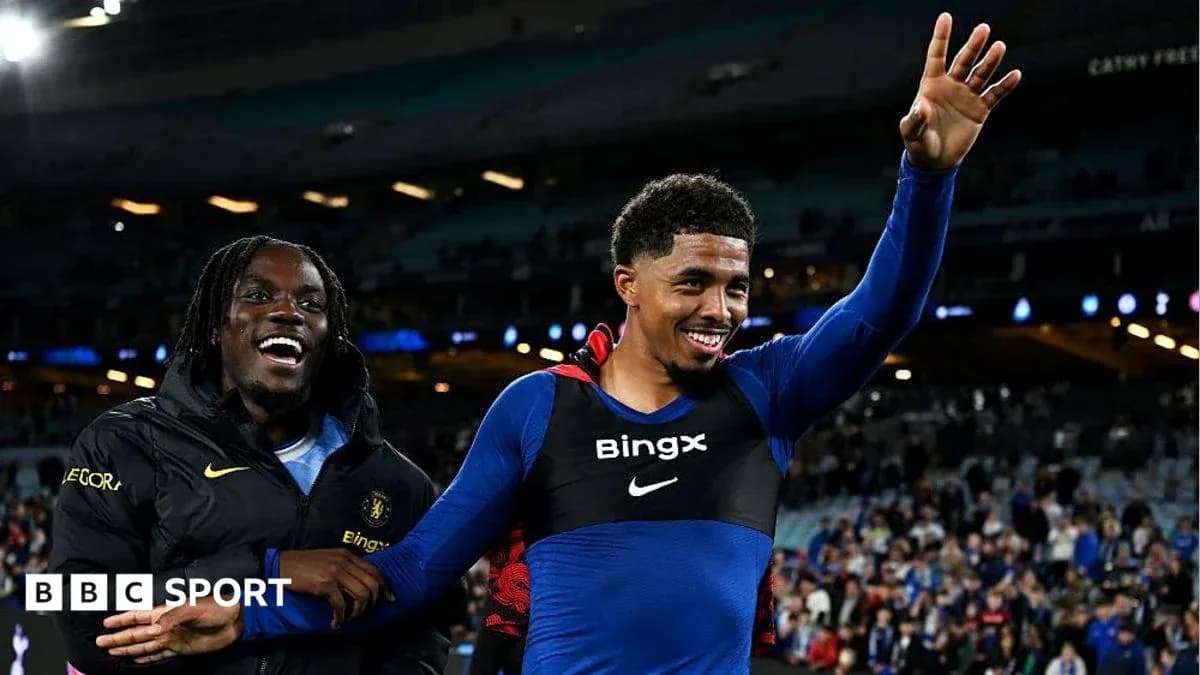
Wesley Fofana's Journey: From Struggles to Chelsea's Future
Wesley Fofana has cried, been mocked for laughing and opened his inbox to racist abuse. Now he is talking about stability. And about an “amazing” Chelsea future.
It sounds optimistic. He knows that. He also thinks he has earned the right to say it.
Two years on from his £75m move from Leicester City, the 25-year-old centre-back has become a lightning rod at Stamford Bridge. He has been injured, criticised, singled out. Yet he is still there. In fact, he is almost alone.
Of the big-money 2022 intake, Fofana is the last one standing. With Marc Cucurella gone to Real Madrid, only academy captain Reece James has been at the club longer.
“Football is like this. It moves fast, but it is a good stat,” Fofana says. “For me, some years were difficult, but now I'm back. I'm playing, I'm fit.”
He pauses. Then corrects himself with a grin.
“Thanks, Filip,” he adds, nodding to goalkeeper Filip Jorgensen, who punched him during an aerial challenge last season and ruined the idea of a completely clean bill of health.
From broken leg to belief
Fofana’s optimism is not blind. It is built on scar tissue.
A broken leg at Leicester. An ACL injury at Chelsea. Hamstring surgery. Months and months of rehab rooms and gym sessions while his new club lurched from one crisis to another.
“Last season the most important thing was to be fit, just to remove this from my head – the injuries and other things,” he explains. Small details, he says, have kept him on the pitch. Routine. Discipline. Repetition.
Under new manager Xabi Alonso in pre-season, those efforts have started to show. Fofana has featured heavily, trusted in what has looked close to Alonso’s strongest XI in three of five friendlies. Young, mobile, aggressive in the press – this is the version of Fofana Chelsea thought they were buying.
It matters to him more than most. Chelsea were not just a big move. They were the dream.
Growing up in Marseille, he idolised Didier Drogba and fell for the blue shirt. When the call finally came, he saw it as the culmination of childhood fantasy and hard graft.
The reality has been harsher.
Chelsea finished 10th in the Premier League last season and ended without a trophy. Performances dipped, managers changed, and someone had to carry the blame.
Often, it was Fofana.
The laugh that went viral
His lowest moment in the public eye came in March, during a heavy Champions League defeat by Paris St-Germain. Cameras caught him laughing on the bench. The clip flew around social media. For many, it became a symbol of everything wrong with Chelsea’s season.
Inside the club, he insists, the reaction was very different.
He says those who work with him “know my mentality” and that the incident was not the insult it was made out to be. But he understands how football works.
“When the team is not doing well, we need to find someone [to blame]. I can accept that,” he says. “The club bought me for a very big transfer [fee]. I came with the ambition to be the best in my position and to help the team. So, when things go badly, I accept being the guy [people blame].”
He could easily have pointed upwards instead.
Enzo Maresca left after a breakdown with the hierarchy. Liam Rosenior replaced him, went five games without a goal, lost the dressing room and was gone within four months. Tactical changes, shifting messages, constant noise.
“Of course we can use this as an excuse, but I think it's the players,” Fofana says, refusing the easy out. “We didn't give everything. We lost some games, we produced some poor performances and we missed a lot of things.
“Of course you can't bring that into the new season, but I think everyone knows what was wrong last season. Everyone looked at themselves in the mirror.”
Drawing the line on abuse
Some criticism, he accepts. Some, he never will.
Fofana is a Muslim, with a father from Ivory Coast, and last season he was racially abused on Instagram. He highlighted more abuse again in March 2025. The messages cut deep, but he refuses to stay silent.
“It is not a big thing to expose people who do that,” he says. “For me, it is very important. For me and other players, we need to show what people are saying.
“We need to educate people. I think the people behind Instagram need to work on that. I exposed this on Instagram and Twitter [now called X] because I think they need to be more aware and more conscious of this problem.
“It is not only football. I think the world is a little bit like this and it is too easy to say some things.”
The contradiction he sees is stark. One game, monkey emojis and slurs. The next, if he scores, the same accounts send praise.
“Sometimes I receive messages and I don't think these people are racist,” he says. “They send monkey emojis because they are unhappy with the result and then, if I score in the next game, the same people support me.
“We need to educate people because it is not normal to talk like this. I understand that if I get a red card, you can be disappointed, but you cannot say these things.”
Younger team-mates have shown him similar messages after matches and chosen to ignore them. Fofana has been dealing with this since he was a teenager. He is not prepared to look away, even if speaking up leads to criticism of his character.
Fighting for his place
On the pitch, another battle waits.
Alonso has made Fofana a key part of his pre-season plans, but Chelsea’s centre-back department is overflowing. Maxence Lacroix has arrived, and there are nine central defenders on the books.
Inside the club, a group of players has been labelled “untouchable”, effectively off the market. Fofana is not in that group.
He shrugs when this is put to him.
“Yes we have a lot, I think there are nine or 10,” he says. “Everyone needs to be good, to train well and after the manager takes the decision. It's like this for everyone.
“Maybe some guys will leave, others will come again. For myself, it is about training well, trying to be fit and we will see what the manager does. If the club tells me they don't need me anymore, it is like this. Of course I will be sad but this is football. You can't say 'I have my place and I am sure to play'.”
Privately and publicly, though, he wants to stay. He believes the project is changing shape.
Senior signings Jordan Henderson, 36, and Danny Welbeck, 35, have arrived with medals, scars and the authority of players who have lived through title races and cup finals. Fofana is convinced their presence can change standards.
He says they “know how to win big games”, will be “important in training sessions” and hints that one or two younger players might get “a kicking” if they switch off.
That, he feels, is exactly what this squad has lacked.
Betting on stability
The bigger shift, in his eyes, sits on the touchline.
Alonso’s appointment has been framed as a reset, a move away from short-term fixes and rapid-fire sackings. For Fofana, who has already seen managers come and go, the message from the top this summer has been different.
“I think everyone knows we need stability,” he says. “We talked last season with the directors and they said the same thing. They think the same way as the players. We need stability.”
He has lived the chaos. He has felt the backlash. He has read the abuse.
Now he is betting that, with a fit body, a settled manager and a dressing room bolstered by hardened winners, the version of Chelsea he dreamed of as a boy in Marseille might finally start to appear.
If it does, the tears, the criticism and the noise will fade. What remains is the question that will define his time at Stamford Bridge: is this the season Wesley Fofana stops surviving at Chelsea and starts leading it?