Washington Spirit's 2-1 Win Over Seattle Reign: A Statement of Ambition
Audi Field under the Washington lights has become a measuring stick for NWSL ambitions, and this 2–1 win for Washington Spirit W over Seattle Reign FC W felt like a statement of where these two projects are heading.
Following this result, the table snapshots diverge sharply. Washington sit 4th with 21 points from 11 matches, their overall goal difference of 9 built on 18 goals for and only 9 against. On their travels and at home they have been balanced, but Audi Field has turned into a controlled fortress: at home they average 1.6 goals scored and only 0.6 conceded. Seattle, by contrast, leave Washington 10th with 14 points from 11, their overall goal difference at -3 (10 scored, 13 conceded). They are competitive away, averaging 1.0 goal for and 1.2 against on their travels, but lack the attacking volume to consistently tilt tight games.
I. The Big Picture – Two 4-2-3-1s, two very different identities
Both coaches doubled down on a 4-2-3-1, but the shapes carried very different personalities.
Adrian Gonzalez’s Spirit lined up with Sandy MacIver in goal behind a back four of Lucia Di Guglielmo, Tara McKeown, Elisabeth Tse and Gabrielle Carle. In front, Hal Hershfelt and Rebeca Bernal formed the double pivot, with an aggressive three of Trinity Rodman (right), Leicy Santos (central) and Rosemonde Kouassi (left) supporting Sofia Cantore as the lone forward.
The structure mirrored Washington’s season-long identity: a team that can play on the front foot without losing defensive discipline. Heading into this game, they had kept 5 clean sheets overall, and failed to score in only 2 league matches. The 4-2-3-1 is not just a default; it is their single, trusted league formation, used in all 11 matches.
Seattle, under Laura Harvey, mirrored the shape on paper. Claudia Dickey started in goal, with a back four of Madison Curry, Jordyn Bugg, Phoebe McClernon and Sofia Huerta. The double pivot of Angharad James-Turner and Ainsley McCammon sat behind a line of Holly Ward, Sally Marie Menti and Maddie Dahlien, with Maddie Mercado up top.
Yet their season tells of a more unsettled identity. They have alternated between 4-2-3-1 (8 times) and 4-3-3 (3 times), reflecting a search for balance between solidity and attacking thrust. The numbers underline the struggle: overall they average only 0.9 goals for per match and concede 1.2. Six times they have failed to score, an alarm bell for a side trying to play with a lone striker.
II. Tactical Voids – Discipline and the invisible absentees
There were no listed injuries or suspensions in the data, so the “voids” here are structural rather than personnel-based.
For Washington, the main risk is emotional rather than numerical. Their yellow-card profile is spread across the game, but with three distinct spikes: 22.22% of their yellows arrive in 0–15 minutes, another 22.22% in 46–60, and a final 22.22% in 76–90. That pattern hints at a side that starts aggressively, re-energizes the press right after half-time, and then defends its lead with a combative edge late on. It is controlled risk, but risk nonetheless.
Seattle’s disciplinary map is more jagged. Their yellows cluster heavily in the second half and early added time: 21.43% in 46–60, 21.43% in 76–90, and another 21.43% between 91–105. That late-game surge of cards suggests a team often chasing the game, stretching their structure and forced into recovery fouls. In a match where Washington’s game management is a strength, that pattern matters.
Neither side has seen a red card in the league, so the tactical voids are not about missing leaders but about how aggression is timed and channeled.
III. Key Matchups – Hunter vs Shield, Engine Room vs Enforcer
Hunter vs Shield: Leicy Santos and Trinity Rodman against Seattle’s away defence
Leicy Santos arrived as one of the league’s most efficient attacking midfielders: 4 goals and 2 assists overall, from 16 shots (10 on target). She is a high-volume passer too, with 446 total passes at 78% accuracy and 13 key passes, the creative metronome in the “10” slot.
Alongside her, Trinity Rodman is both scorer and supplier: 3 goals and 3 assists overall, with 26 shots (13 on target) and 13 key passes. She is also a duel machine, contesting 96 duels and winning 43, plus 12 tackles and 7 interceptions. She does not just finish moves; she starts them and wins them back.
Together, they attack a Seattle away unit that concedes 1.2 goals per match on their travels and has kept only 1 clean sheet away. Overall, Seattle have allowed 13 goals in 11 matches; the -3 goal difference is the product of a back line that is competent but repeatedly exposed by a misfiring attack.
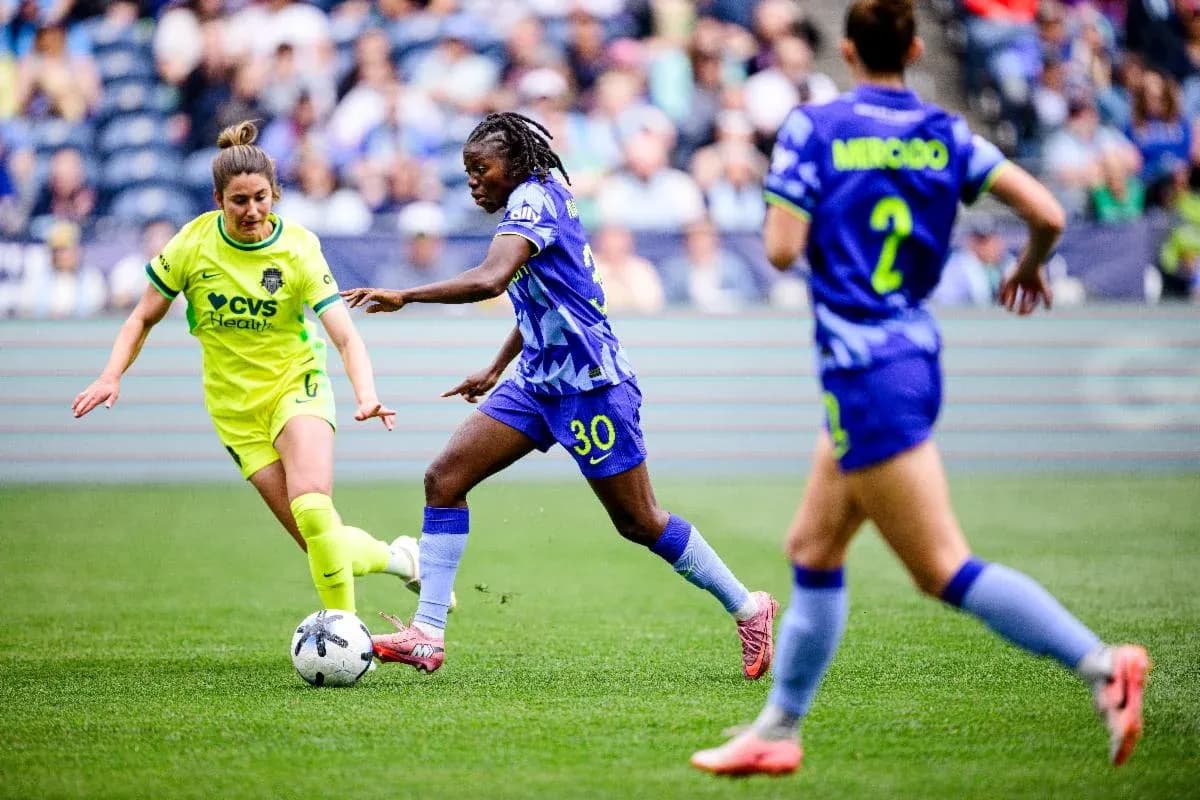
In this match, that dynamic played out as expected. Washington’s front four found pockets between James-Turner and the centre-backs, with Santos drifting to combine and Rodman attacking the half-spaces. Seattle’s defensive line, built on McClernon and Bugg centrally, held reasonably well in phases, but with their attack offering only 10 goals overall this season, every concession feels fatal.
Engine Room: Rebeca Bernal and Hal Hershfelt vs Angharad James-Turner and Ainsley McCammon
Washington’s double pivot has been central to their defensive record: only 9 goals conceded overall, an average of 0.8 per match. At home that drops to 0.6, a figure that speaks to the screening job in front of MacIver. Bernal, listed as a midfielder, plays like a hybrid centre-back in possession, dropping to form a three and freeing Di Guglielmo and Carle to push high. Hershfelt balances that by stepping into midfield lines, connecting to Santos and Kouassi.
Seattle’s pivot of James-Turner and McCammon has a heavier defensive load. With the team conceding 1.2 goals per match overall and scoring only 0.8 at home and 1.0 away, their midfield often defends in transition rather than from a settled block. James-Turner’s role as enforcer is clear: break up play, protect the young back four, and give Menti and Dahlien a platform. But the lack of consistent attacking output means they are frequently pinned back.
In Washington, that asymmetry was stark. The Spirit’s pivot could step higher, compressing the field and turning Seattle’s lone forward Mercado into an isolated outlet. For the Reign, every turnover became a sprint backwards.
IV. Statistical Prognosis – xG logic and defensive solidity
Even without explicit xG numbers, the season data sketches the expected goals landscape. Washington’s overall scoring average of 1.6, combined with only 0.8 conceded, implies that in a typical match they generate more and higher-quality chances than they allow. Their 5 clean sheets overall and only 2 total losses from 11 underline that they rarely lose control of the chance battle.
Seattle’s profile suggests the opposite: 0.9 goals for and 1.2 against overall, plus 6 matches without scoring, point to an attack that struggles to create clear chances and a defence that spends long stretches under pressure. Their best away win is 1–2; their worst away loss is 2–0, which fits the pattern of being competitive but outgunned.
A 2–1 scoreline at Audi Field fits the underlying math. Washington’s attack, powered by Santos, Rodman, Cantore and Kouassi, has enough variety to consistently reach a two-goal ceiling, especially at home. Seattle’s structure and work rate can keep them in matches and occasionally nick a goal, but not yet at the volume required to overturn a side with Washington’s defensive record.
Following this result, the trajectories crystallize. Washington look every inch a playoff-bound side built on a stable 4-2-3-1, a tight defensive block, and a creative axis of Santos and Rodman. Seattle, for all their young talent and tactical flexibility, remain a team searching for a sharper attacking edge to match their industry.