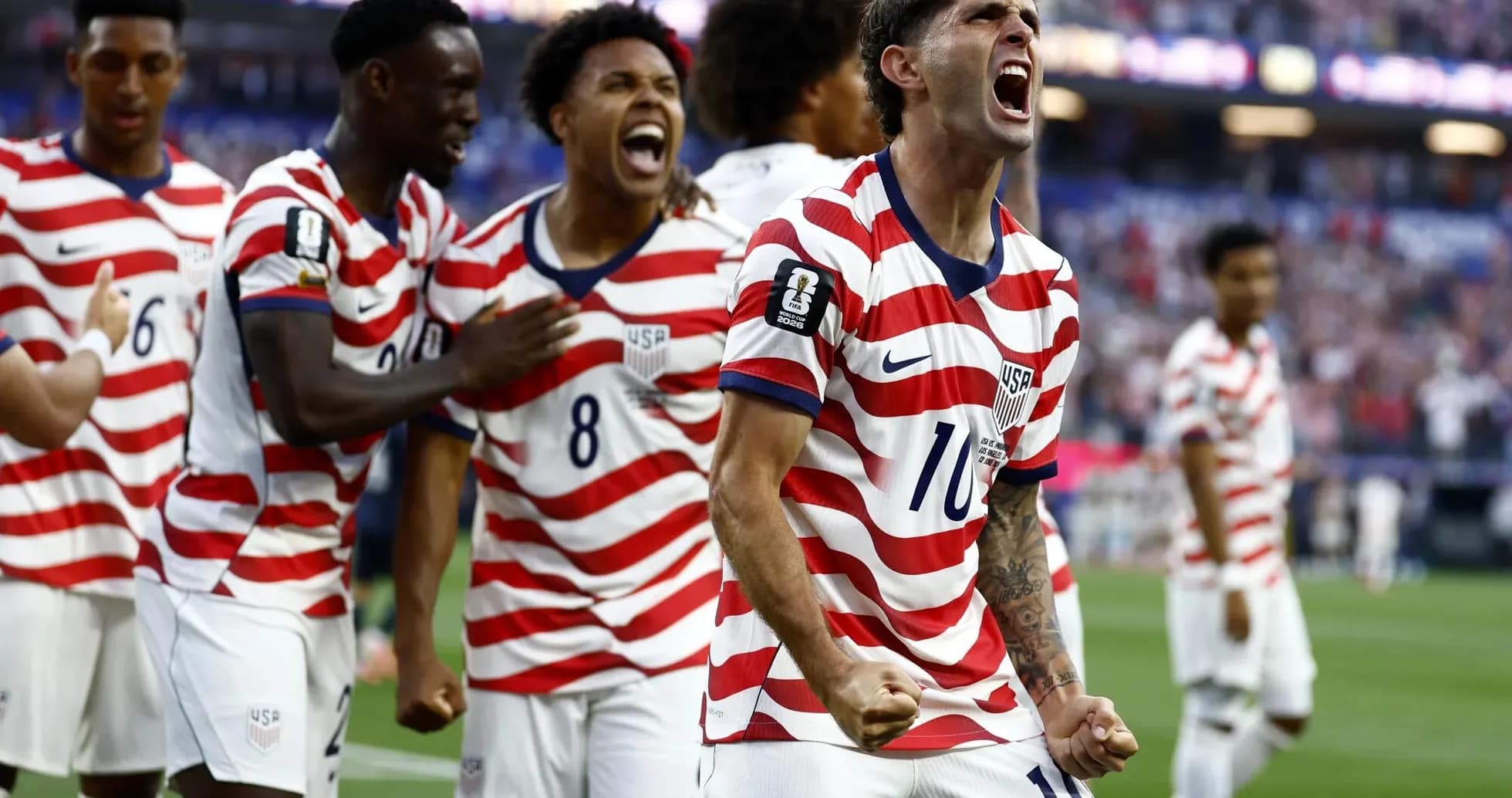
USA Dominates Paraguay 4-1 with Tactical Mastery
USA’s 4-1 win over Paraguay at SoFi Stadium was built on structural control and vertical punch. Mauricio Pochettino’s side translated a 65% share of possession, 596 passes and 16 shots into a three-goal lead by half-time, then managed the game with relative comfort despite a brief Paraguayan surge after the break. Paraguay, in Gustavo Alfaro’s 4-4-2, produced only 9 shots and 0.51 xG, relying on transition moments and set pieces but spending long stretches defending deep against USA’s 4-2-3-1 positional play.
I. Executive Summary
USA’s 4-2-3-1 was cleanly tiered: Tyler Adams and Malik Tillman as a double pivot, Christian Pulišić, Weston McKennie and Sergiño Dest as the advanced line behind Folarin Balogun. The structure created constant five-man occupation of the last line, with full-backs Antonee Robinson and Alexander Freeman providing width and depth. Paraguay’s 4-4-2, with Antonio Sanabria and Julio Enciso up front and Miguel Almirón wide, tried to press selectively but mostly dropped into a mid-to-low block, conceding territory and allowing USA to dictate tempo and shot volume (13 shots inside the box).
II. Scoring Sequence & Disciplinary Log
The early 7' own goal from Damián Bobadilla undercut Paraguay’s game plan. With USA already dominating the ball, that moment forced Alfaro’s side to defend even deeper, compressing their two banks of four around the box. USA’s second and third goals, both from Balogun (31' and 45+5'), came as logical outcomes of sustained pressure: one assisted by Pulišić, the other by Tillman, exploiting the channels between Paraguay’s full-backs and centre-backs. By half-time, the 3-0 scoreline matched the shot profile and xG edge (1.27 to 0.51).
Paraguay’s only goal, at 73', came after a structural shift. Substitutes Mauricio and Alex Arce added verticality; Mauricio’s finish from an Enciso assist was a rare instance where Paraguay broke USA’s rest defence and attacked space before the block reset. Even then, it did not materially change the tactical pattern. Gio Reyna’s 90+8' strike, assisted by Freeman, underlined USA’s ability to keep creating from organized possession deep into stoppage time.
Discipline tilted heavily towards Paraguay: 5 yellow cards to USA’s 1. The sequence reflects how much defending Paraguay had to do. Juan Cáceres was booked at 10' for “Tripping”, Miguel Almirón at 53' for “Diving”, Diego Gómez at 79' for “Holding”, Alex Arce at 88' for “Roughing” and Junior Alonso at 90+3' for “Holding”. For USA, Adams’ 59' yellow for “Roughing” was the only card, emblematic of his aggressive screening in front of the back four.
III. Tactical Breakdown & Personnel
USA’s build-up used Adams as the central reference, dropping between or beside Chris Richards and Tim Ream to form a three-man first line, with Robinson and Freeman pushing high. Tillman often stepped beyond the first Paraguayan line, creating a 3-1-5-1 in possession. This allowed Pulišić to receive between lines on the left half-space, McKennie to make late surges centrally, and Dest to invert or overlap on the right. The 596 passes at 85% accuracy (508 accurate) show a side comfortable circulating under minimal pressing pressure.
Paraguay’s 4-4-2 struggled to influence that first phase. With only Sanabria and Enciso up top, they could not consistently lock the ball to one side; the midfield four were often pinned by USA’s advanced line and full-backs. Their 320 passes at 72% accuracy underline a reactive, clearance-heavy game. When they did break, it was usually via Enciso’s direct running or Almirón carrying from the flank, but USA’s rest defence—Adams and the two centre-backs—kept the box largely protected, limiting Paraguay to just 1 shot on goal and 4 inside the box.
Out of possession, USA pressed selectively rather than constantly. The first line curved to screen central access, with Balogun shading passes into Cubas and Gómez, while Pulišić and Dest jumped onto Paraguay’s full-backs. When the press was bypassed, Adams dropped into a narrow 4-5-1 block, with McKennie and Tillman tightening central lanes. This compactness explains Paraguay’s reliance on shots from outside the box (5 attempts) and their low xG.
After the break, substitutions tweaked but did not transform the structures. Mauricio for Bobadilla at 46' and Arce for Sanabria at 62' gave Paraguay more direct presence, which produced their best spell and the 73' goal. For USA, Sebastian Berhalter for Pulišić at 46' and later Tim Weah for Dest and Ricardo Pepi for Balogun at 72' shifted the attack towards more depth runs and transition threat rather than pure positional play, but the underlying 4-2-3-1 shape remained.
In goal, Matthew Freese (USA) faced little sustained pressure, registering 1 save behind a defence that allowed only 9 shots and few clean looks. Orlando Gill (Paraguay), by contrast, made 3 saves but was exposed by volume and quality: USA’s 6 shots on target from 13 in the box constantly tested the last line. Both goalkeepers are credited with negative goals prevented (-1.16), indicating that the finishing they faced outstripped the underlying shot quality—USA clinically so, Paraguay through their single conversion.
IV. The Statistical Verdict
The numbers align tightly with the tactical story. USA’s 65% possession, 596 passes and 16 shots (13 inside the box) reflect sustained territorial dominance and a well-structured attacking scheme. Their xG of 1.27 suggests the 4 goals came from efficient finishing and the own goal, rather than sheer chance volume, but the pattern of play justified a multi-goal margin. Paraguay’s 9 shots, 1 on target and 0.51 xG capture a side limited to sporadic counters and long-range efforts.
Defensively, Paraguay’s 5 yellow cards and 17 fouls illustrate how often they were forced into last-ditch interventions to halt USA’s rotations between the lines. USA’s 13 fouls and single booking show a more controlled aggression, anchored by Adams’ screening and the back four’s positioning. With both teams recording negative goals prevented and Paraguay blocking 5 shots to USA’s 4, the key difference lay not in pure defensive effort but in structural control and attacking clarity. At SoFi Stadium, USA’s 4-2-3-1 simply imposed its rhythm on Paraguay’s 4-4-2 from first whistle to last.