UEFA Champions League Final Preview: Paris Saint Germain vs Arsenal
On 30 May 2026, under the sweeping roof of the Puskas Arena in Budapest, Paris Saint Germain and Arsenal walk out knowing there is nothing bigger left to chase: the UEFA Champions League final, one night for immortality. Paris Saint Germain arrive as a dangerous knockout force with goals spread across a star-studded attack (21 scored and 11 conceded in 8 matches), while Arsenal come in as the competition’s benchmark of consistency (23 scored and only 4 conceded in 8 games). For Paris Saint Germain, this is a chance to turn attacking brilliance into the ultimate prize; for Arsenal, it is the opportunity to crown a near-perfect Champions League campaign with the trophy itself.
Season Context
For Paris Saint Germain, the road to Budapest has been shaped by volatility wrapped in firepower. Sitting 11th in the overall Champions League table with 14 points from 8 matches, they have combined 4 wins, 2 draws and 2 defeats with a potent goal difference of +10 (21 goals scored, 11 conceded). The “Promotion - Champions League (Play Offs: 1/16-finals)” tag underlines that they have already navigated the pressure of knockout jeopardy, and their numbers show a side capable of blowing opponents away when their attack clicks.
Arsenal arrive as the competition’s standard-setters. Ranked 1st with 24 points from 8 matches, they boast a flawless record of 8 wins, 0 draws and 0 defeats, underpinned by a formidable +19 goal difference (23 scored, 4 conceded). The “Promotion - Champions League (Play Offs: 1/8-finals)” description reflects how early they secured their path through the competition. Their balance between ruthlessness in front of goal and defensive control has made them the most complete side in this Champions League campaign.
Form & Momentum
Paris Saint Germain’s recent form line reads “DLDWL”, a sequence that captures both their threat and their inconsistency. The goal numbers still intimidate: 21 goals in 8 games mean they average more than two and a half per match (21 goals for in 8 games), but the 11 goals conceded in that same span underline why they can feel vulnerable when games become stretched (11 goals against in 8 games). They are the archetypal high-ceiling side: capable of overpowering anyone on their day, but occasionally leaving just enough space for doubt.
Arsenal’s form, by contrast, is immaculate: “WWWWW” tells the story of a team in relentless rhythm. With 23 goals scored and only 4 conceded across 8 Champions League games, they combine efficiency with control at both ends (23 goals for and 4 against in 8 games). That defensive record is especially imposing, translating to just half a goal conceded per match (4 goals against in 8 games), and it gives their attacking players the platform to win ties without needing to chase chaos.
Head-to-Head Patterns
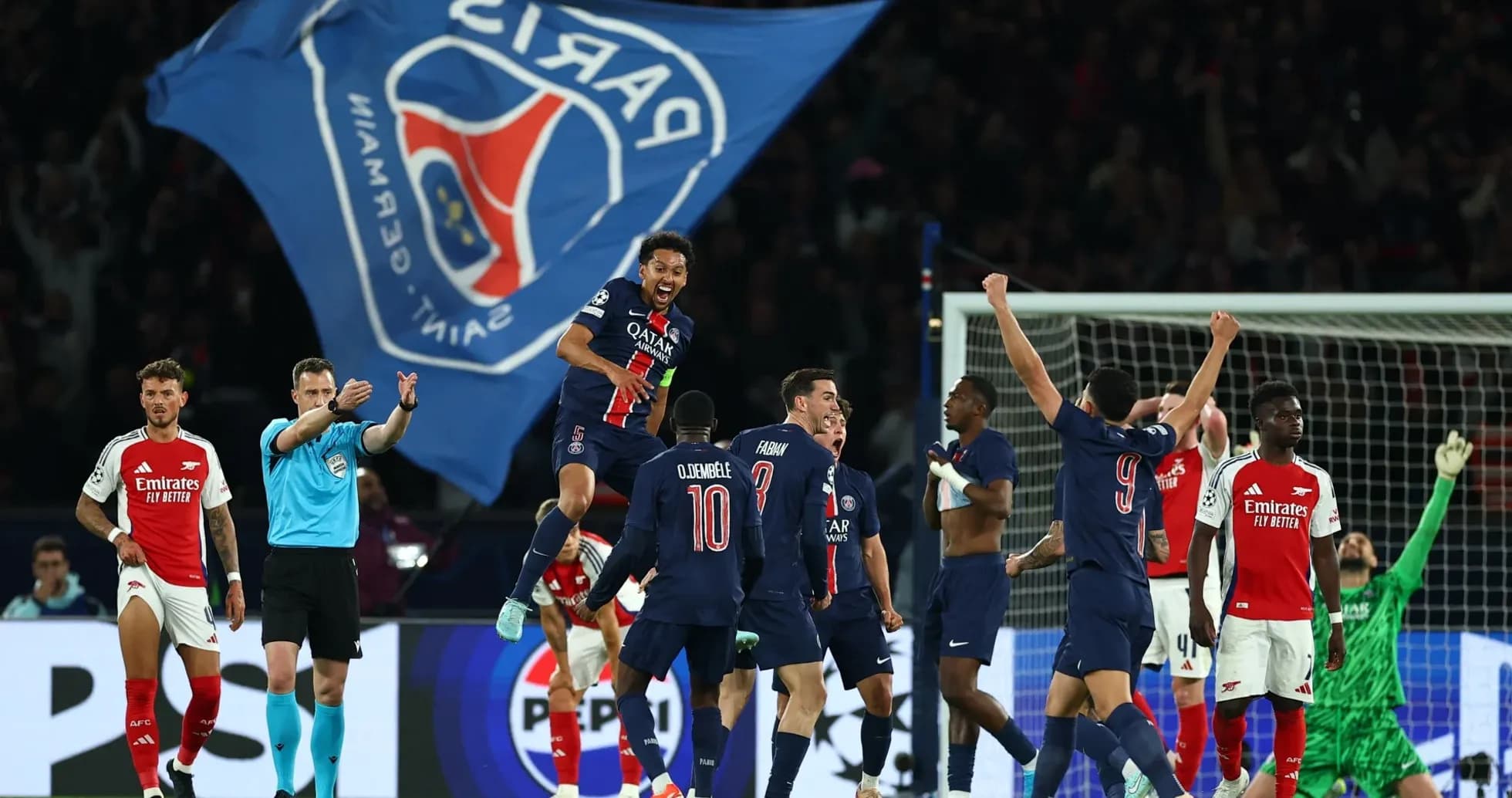
Recent history between these clubs in the UEFA Champions League has been finely poised and emotionally charged. In the most immediate clash, Paris Saint Germain edged Arsenal 2-1 at Parc des Princes (UEFA Champions League, season 2024, May 2025), a semi-final second leg where the French side’s home advantage told in a tight contest. Just days earlier, Arsenal had hosted Paris Saint Germain at Emirates Stadium and were undone 0-1 (UEFA Champions League, season 2024, April 2025), a night defined by Paris Saint Germain’s compact shape and clinical edge. Go back to the League Stage in the same campaign and the balance shifts: Arsenal beat Paris Saint Germain 2-0 at Emirates Stadium (UEFA Champions League, season 2024, October 2024), a controlled home performance that showcased their ability to shut down Paris Saint Germain’s attack completely.
Tactical Preview
Paris Saint Germain are expected to lean again on their 4-3-3 structure, a system they have used throughout this Champions League run (4-3-3 played 16 times in the data sample). That shape is designed to unleash the creative and scoring talents of K. Kvaratskhelia, O. Dembélé and D. Doué. K. Kvaratskhelia has been the headline figure, with 10 goals and 6 assists in the competition, backed by 30 shots and 18 on target, plus 51 dribble attempts with 29 successful; those numbers underline why Paris Saint Germain’s attack feels explosive (10 goals and 6 assists for K. Kvaratskhelia). O. Dembélé adds directness and end-product from the flank (7 goals and 2 assists, with 24 shots and 13 on target), while D. Doué brings a blend of creativity and work-rate (5 goals and 4 assists, 50 dribble attempts with 23 successes). Vitinha, operating from midfield, knits it all together with control and progression (6 goals, 1 assist, 1553 completed passes at 93% accuracy), helping Paris Saint Germain turn possession into sustained pressure.
Defensively, Paris Saint Germain have a harder edge but also a hint of risk. I. Zabarnyi has picked up one red card, and L. Hernández also has one red card, highlighting how their aggressive defending can occasionally spill over (one red card each for I. Zabarnyi and L. Hernández). With 11 goals conceded in 8 Champions League games, they are solid but not watertight, and their back line will be tested by Arsenal’s varied attacking threats.
Arsenal’s tactical identity blends flexibility with structure. They oscillate primarily between 4-3-3 and 4-2-3-1 (4-3-3 used 9 times, 4-2-3-1 used 5 times in the data sample), systems that allow them to control midfield and release wide forwards into space. Gabriel Martinelli has been a key attacking outlet, with 6 goals and 2 assists in the competition, supported by 17 shots (8 on target) and 38 dribble attempts with 17 successes, which makes him a constant threat when isolating full-backs. Behind him, MartÍn Zubimendi provides the steel and balance in midfield; his 4 yellow cards, 14 tackles and 10 interceptions show how he anchors Arsenal’s defensive structure while still contributing 2 assists going forward (4 yellow cards, 14 tackles and 10 interceptions for MartÍn Zubimendi).
Arsenal’s defensive platform is their great strength: just 6 goals conceded across 14 matches in the broader statistics sample, and only 4 conceded in the 8 games captured by the standings. That resilience allows them to commit numbers forward in their preferred shapes without losing compactness. In Budapest, the key battle will be Arsenal’s disciplined back line and screening midfield against the fluid front three and advanced midfielders of Paris Saint Germain; if Arsenal’s structure holds, their more controlled attacking patterns could gradually tilt the final in their favour.
Statistical Snapshot
- Competition: UEFA Champions League, season 2025 — 30 May 2026.
- Venue: Puskas Arena, Budapest.
- Prediction: Win or draw — Double chance : draw or Arsenal.
- Win Probabilities: Home 10% / Draw 45% / Away 45%.
- Model: Paris Saint Germain 42.0% — Arsenal 58.2%.
Betting Verdict
The prediction model leans towards Arsenal avoiding defeat, with the advice clearly pointing to “Double chance : draw or Arsenal” and win probabilities giving the away side and the draw a combined 90% (45% each for draw and Arsenal). Arsenal’s flawless run (8 wins from 8 with 23 goals scored and 4 conceded) and their defensive resilience against elite attacks make them a logical side to trust on a “win or draw” angle. Paris Saint Germain’s firepower and recent head-to-head success in the 2-1 and 1-0 semi-final wins suggest they can threaten, but their more volatile form (“DLDWL”) adds risk. With home-win odds clustered roughly around 2.30–2.40, the draw near 3.20–3.35 and Arsenal around 3.00–3.30 across major bookmakers, the value aligns with backing the more stable, defensively secure Arsenal on the double-chance market rather than taking a straight result on this finely balanced final.