Arsenal vs Atletico Madrid: Champions League Semi-Final Insights
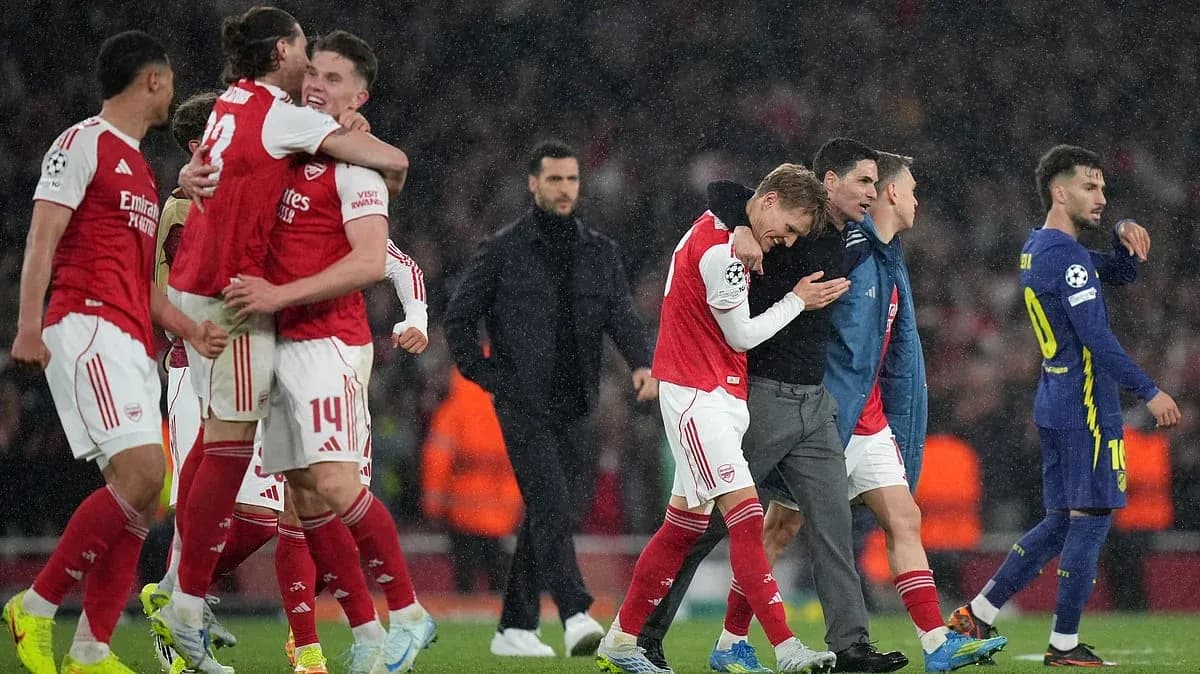
Under the lights of Emirates Stadium, this UEFA Champions League semi-final first leg finished with the narrow, controlled brutality of a knife fight. Arsenal 1–0 Atletico Madrid is a scoreline that flatters neither side and yet perfectly reflects their seasonal DNA: Arsenal, the competition’s most complete machine; Atletico, a volatile puncher who lived on the edge and, this time, fell just short.
Heading into this game, the numbers already hinted at a clash of identities. Arsenal sat 1st in the Champions League standings with 24 points from 8 matches, a flawless record of 8 wins, 23 goals for and just 4 against. Overall this campaign, they had played 14 Champions League fixtures without a single defeat, winning 11 and drawing 3. At home they averaged 2.1 goals for and only 0.4 against, with 5 clean sheets in 7. Atletico, by contrast, arrived as the 14th-ranked side, far more chaotic: 16 matches played, 7 wins, 3 draws, 6 defeats, with 35 goals for and 28 conceded overall. On their travels they were dangerous but porous, averaging 1.6 goals for and 2.1 against away from home.
I. The Big Picture: Structure and Stagecraft
Mikel Arteta leaned into control. His 4-2-3-1 was a subtly tweaked version of Arsenal’s more common 4-3-3: David Raya behind a back four of Ben White, William Saliba, Gabriel and Riccardo Calafiori; Declan Rice and Myles Lewis-Skelly as the double pivot; Bukayo Saka, Eberechi Eze and Leandro Trossard floating behind Viktor Gyökeres. It was a shape designed to suffocate transitions while still giving licence to the three creators between the lines.
Diego Simeone answered with orthodoxy: a 4-4-2 that was, in practice, a 4-4-1-1. Jan Oblak marshalled a back line of Marc Pubill, Robin Le Normand, Dávid Hancko and Matteo Ruggeri. In midfield, Giovanni Simeone and Marcos Llorente patrolled the right half-space, Koke anchored centrally, and Ademola Lookman offered the outlet on the left. Ahead of them, Antoine Griezmann drifted in the pockets behind Julián Álvarez, Atletico’s talisman and the Champions League’s fourth-ranked attacking performer, with 10 goals and 4 assists across 15 appearances.
The 1–0 full-time score, after a 1–0 half-time lead, tells of Arsenal’s territorial siege and Atletico’s stubborn but limited resistance. With no extra time or penalties required, the tie remains alive—but the balance of power has shifted.
II. Tactical Voids: Absences and Discipline
Both managers were forced to redraw parts of their blueprint. Arsenal were without Mikel Merino (foot injury) and Jurrien Timber (ankle injury). Merino’s absence removed a high-volume, press-resistant midfielder who could have partnered Rice or rotated into the left interior role; instead, Arteta trusted the youthful Lewis-Skelly to provide energy and simple progression. Timber’s injury again denied Arsenal a hybrid full-back/centre-back who might have inverted into midfield; in his place, Calafiori’s left-footed distribution became crucial for beating Atletico’s first press.
Atletico’s own voids were equally structural. Pablo Barrios and Nico Gonzalez, both out with muscle injuries, stripped Simeone of two midfielders capable of adding vertical thrust and press resistance. Without them, Koke’s burden increased: he had to dictate tempo, screen the back four, and connect to the front two. It forced Atletico’s block a few metres deeper, inviting more Arsenal possession than Simeone would ideally tolerate.
In disciplinary terms, the underlying season data framed a potential fault line. Arsenal’s yellow cards peaked in the 61–75 minute window at 31.82%, often reflecting late surges of aggression to protect leads. Atletico’s bookings were most common between 46–60 minutes (25.93%), a sign of how they often emerge from half-time with ferocity that can tip into recklessness. In this semi-final, that pattern underpinned the game’s rhythm: Arsenal tightening the vice after the break, Atletico walking the line between disruption and self-destruction.
III. Key Matchups: Hunter vs Shield, Engine Room vs Enforcer
The headline duel was always going to be Julián Álvarez versus Arsenal’s defensive core. Álvarez arrived with 10 Champions League goals, 37 shots (22 on target) and 34 key passes, a forward who can both finish and create. Yet he ran into a defence that, overall this season, had conceded only 6 goals in 14 matches, with a total average of 0.4 goals against per game and 9 clean sheets. Saliba and Gabriel, protected by Rice, formed a triangle designed to deny Álvarez the half-turn in Zone 14. Every time Atletico tried to spring him early, Rice’s reading of the game and Arsenal’s compact rest defence smothered the lane.
Further back, Pubill’s battle with Arsenal’s right flank was a subplot with teeth. The Atletico right-back is one of the Champions League’s more combative defenders: 18 tackles, 6 successful blocks and 6 interceptions in his campaign, alongside 4 yellow cards. Up against Trossard drifting inside and Calafiori overlapping, Pubill had to choose between tracking runners and holding the line. His aggression helped Atletico survive long spells, but it also locked them deeper, reducing his ability to support transitions.
In midfield, the “engine room” confrontation pitted Koke and Marcos Llorente against Rice and Lewis-Skelly. Rice, the enforcer, anchored Arsenal’s structure, recycling possession and closing counters at source. Llorente’s surges and Koke’s angles of pass were intended to break Arsenal’s first press, but without Barrios or Gonzalez, Atletico often lacked the extra body to create true overloads. Eze, floating as a No. 10, repeatedly found pockets behind Koke, forcing Atletico’s back line to step out and stretch.
On the flanks, Saka versus Ruggeri and Lookman versus White formed the game’s transition channels. Saka’s inside-out movements pinned Ruggeri back, preventing Atletico from using him as an overlapping outlet. Conversely, Lookman was Atletico’s most viable out-ball, but White’s conservative positioning ensured that Arsenal rarely allowed the one-v-one isolation Simeone craved.
IV. Statistical Prognosis: What This Result Sets Up
Following this result, the tie tilts towards Arsenal, but the numbers warn against complacency. Arsenal’s overall attacking average of 2.1 goals per game and their home record of 12 goals for and 3 against in 4 Champions League fixtures underline how under par a mere 1–0 feels by their standards. Yet it also reinforces their defensive authority: across both the season snapshot and the standings, they have allowed just 6 goals in 14 matches, with no defeats.
Atletico, however, are built for volatility. Overall, they have scored 35 and conceded 28, a goal difference of 7 that reflects both firepower and fragility. At home they average 2.8 goals for, and while they keep no clean sheets there in this competition, they can turn a second leg into a shootout. With Álvarez’s 10 goals and 4 assists, plus the bench threat of A. Sørloth (6 goals in 14 appearances), Simeone still has weapons to reshape the narrative in Madrid.
xG data is not provided, but the structural indicators are clear. Arsenal’s chance creation patterns, supported by their 2.1 total goals-for average and deep creative pool (with Gabriel Martinelli contributing 6 goals and 2 assists across the campaign), suggest they will generate enough opportunities in the second leg. Atletico’s defensive average of 1.8 goals against per match overall, and 2.1 away, implies that another Arsenal goal is more likely than not.
Tactically, the second leg becomes a test of nerve. Arsenal can lean on their defensive solidity, their clean-sheet habit, and the control of Rice and Eze between the lines. Atletico must embrace the chaos their numbers describe: pressing higher, trusting Álvarez and Griezmann to destabilise Arsenal’s build-up, and accepting the defensive risk that comes with chasing the tie.
The first act at Emirates Stadium has established the hierarchy: Arsenal, the structured juggernaut; Atletico, the dangerous but flawed challenger. The margins remain thin, but the underlying metrics, the tactical matchups, and the weight of the season so far all point to one conclusion: unless Atletico can drag this tie into their preferred storm, Arsenal’s balance of control and cutting edge should carry them over the line and into the Champions League final.