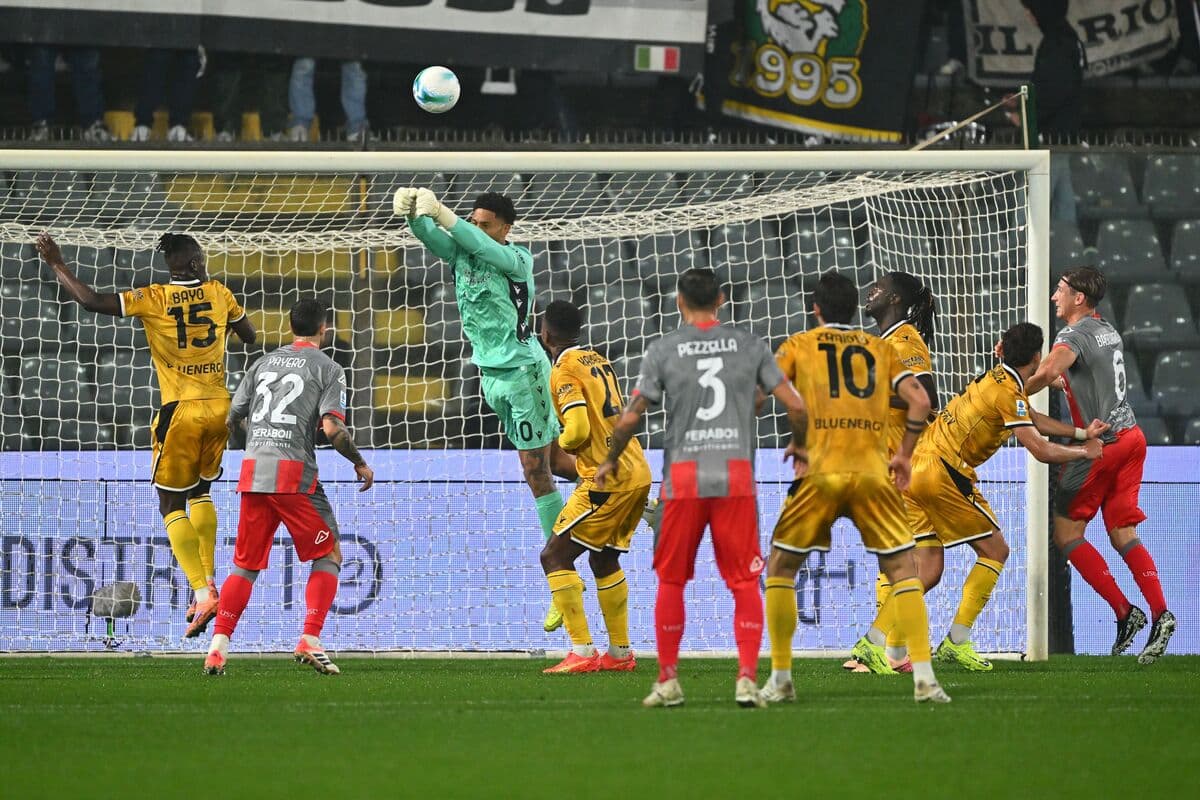
Udinese's Narrow Defeat to Cremonese: A Tactical Analysis
Under the lights of the Bluenergy Stadium – Stadio Friuli, a narrow 1–0 defeat to Cremonese closed a tense, tactical chapter in Udinese’s Serie A campaign. Following this result, the table tells a story of contrast: Udinese sit 10th with 50 points, a mid-table side whose overall goal difference of -2 (45 scored, 47 conceded) reflects a season of fine margins. Cremonese, 18th on 34 points with a goal difference of -22 (31 for, 53 against), remain trapped in the relegation zone, yet here they delivered the kind of disciplined away performance that has kept their survival hopes flickering.
Both managers doubled down on their seasonal identities. Kosta Runjaic returned to the 3-5-2 that has been his most-used shape, a structure Udinese have deployed in 19 league matches. Marco Giampaolo mirrored that with his own 3-5-2, a system Cremonese have leaned on in 25 fixtures. The symmetry on paper, however, hid very different intentions.
Runjaic’s back three of O. Solet, C. Kabasele and T. Kristensen was tasked with building from deep, protected by a broad midfield band. J. Karlstrom sat as the pivot, with L. Miller and A. Atta offering vertical runs and second-ball aggression. Out wide, J. Arizala and H. Kamara were asked to be both full-backs and wingers, stretching Cremonese horizontally to create channels for the front two, A. Buksa and K. Davis.
Cremonese’s line, anchored by M. Bianchetti between S. Luperto and F. Terracciano, was more conservative. The wing-backs, T. Barbieri and G. Pezzella, folded into a compact five when out of possession. In front, M. Thorsby and Y. Maleh worked as shuttlers around A. Grassi, whose job was to screen central spaces and dictate the first pass into transition. Up front, the pairing of F. Bonazzoli and J. Vardy gave Giampaolo a blend of hold-up play and depth-running.
The absences shaped the tone. Udinese were without K. Ehizibue (suspension), and three creative or ball-carrying options in J. Ekkelenkamp, N. Zaniolo and A. Zanoli, all injured. Zaniolo’s absence was particularly glaring: his 6 assists and 5 goals in 32 appearances have often been the spark between midfield and attack, and his dribbling presence (94 attempts, 33 successful) usually forces defensive imbalances. Without him, Udinese’s 3-5-2 felt more functional than imaginative.
Cremonese were also shorn of key depth and defensive stability. F. Baschirotto, F. Ceccherini, W. Bondo and F. Moumbagna were all missing, stripping Giampaolo of rotation options in the back line and midfield. That made the reliance on Pezzella and Thorsby even more acute; Pezzella, who has accumulated 8 yellow cards and 1 red this season, walked a tightrope between necessary aggression and disciplinary risk.
Season Statistics
Heading into this game, Udinese’s season-long numbers at home painted a picture of controlled but low-yield football. They averaged 0.9 goals for at home and 1.1 goals against, with 6 home clean sheets but 7 matches where they failed to score. Their total attacking average of 1.2 goals per match contrasted with a cautious approach in Friuli, where risk-taking in the final third has often been limited. Cremonese, by contrast, came in as an away side used to suffering: on their travels they averaged 0.7 goals for and 1.5 conceded, with 5 away clean sheets but 10 total matches where they failed to score.
The disciplinary profiles of both teams added an edge. Udinese’s yellow-card timing shows a pronounced late-game spike: 27.94% of their yellows come between 61–75 minutes, and 22.06% between 76–90, evidence of a side that often becomes stretched or frustrated as matches tighten. Cremonese’s own late surge is even starker, with 26.09% of their yellows in the 76–90 range and an additional 11.59% between 91–105. This shared tendency toward late fouls and cards framed the second half as a likely battlefield of attrition.
Key Matchups
Within that landscape, the “Hunter vs Shield” duel was clearly defined. For Udinese, K. Davis entered as the primary finisher: 10 goals and 4 assists in 29 appearances, with 25 of 38 shots on target and a robust duel profile (310 contests, 146 won). His ability to both receive under pressure and spin into space is central to Udinese’s attack, particularly given their 1.5 away goals average but more constrained 0.9 at home. Against him stood a Cremonese defence that, overall, concedes 1.4 goals per match and 1.5 away, but here compressed the box, forcing Davis into traffic and limiting clean shooting angles.
On the other side, F. Bonazzoli carried Cremonese’s scoring burden with 9 goals and 1 assist in 34 appearances. His 55 shots (31 on target) and 125 duels won from 242 underlined a forward comfortable in contact, able to pin centre-backs and bring midfield runners into play. Up against Kabasele and Solet, he was the reference point in transition, while Vardy’s movement tried to pull Udinese’s line apart.
Engine Room Confrontation
The “Engine Room” confrontation revolved around creativity and control. Udinese, deprived of Zaniolo’s 53 key passes, had to lean on Karlstrom’s distribution and Miller’s forward surges to find Davis and Buksa early. For Cremonese, J. Vandeputte, even starting from the bench, loomed as the chief playmaker: 5 assists, 53 key passes and 893 total passes at 77% accuracy in the league. His introduction was always likely to tilt the rhythm, offering better service into Bonazzoli and the half-spaces where Pezzella and Maleh operate.
From a statistical prognosis standpoint, the match was always likely to be tight and low-scoring. Udinese’s home attack (0.9 goals) versus Cremonese’s away defence (1.5 conceded) suggested that any xG model would lean toward a marginal Udinese edge in volume, but not necessarily in conversion, especially without Zaniolo. Cremonese’s modest away attack (0.7 goals) against Udinese’s 1.1 home goals against implied that Giampaolo’s side would need efficiency rather than volume.
In the end, Cremonese delivered precisely that: a compact block, selective pressing triggers, and ruthless exploitation of their limited attacking moments. Udinese, structurally sound and territorially dominant for stretches, lacked the incision to turn possession into high-quality chances. Following this result, the numbers remain consistent with the narrative: a mid-table Udinese side still searching for a sharper attacking edge at home, and a relegation-threatened Cremonese who, on their travels, can still summon the kind of disciplined, opportunistic performance that keeps the story of their season alive.