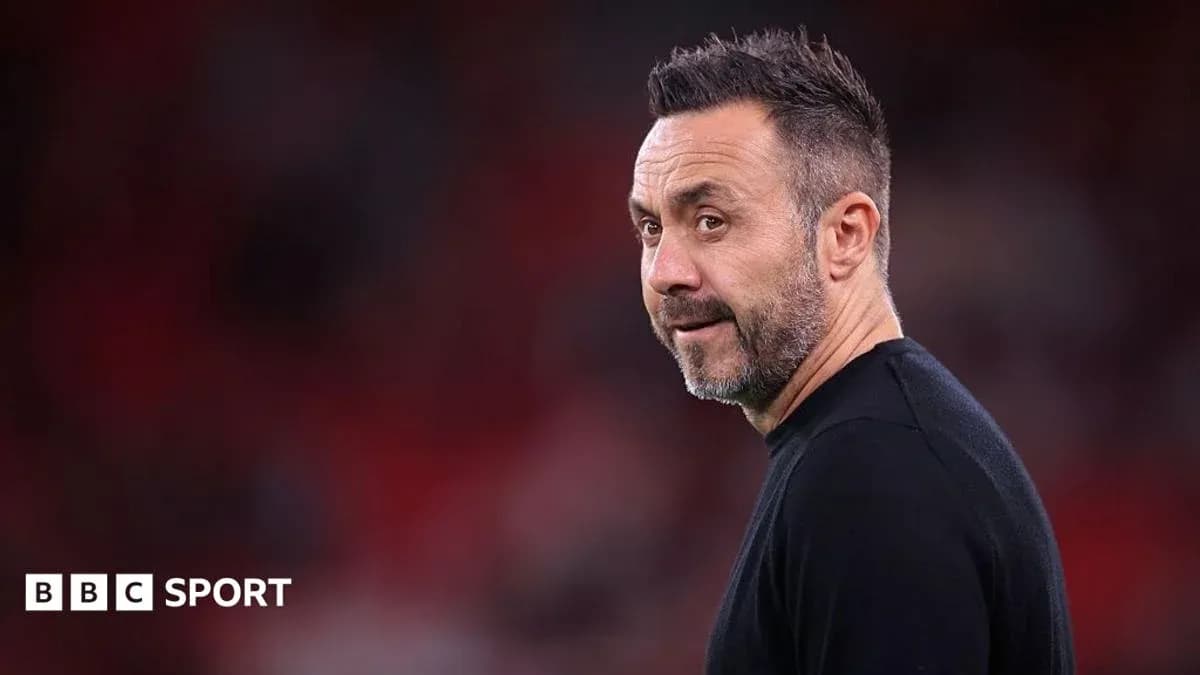
Tottenham's Struggles Under De Zerbi: A New Era Begins
Tottenham’s new era under Roberto De Zerbi has begun with an uncomfortable statistic: four league games, zero goals. Only Coventry City share that barren return. For a club that has poured around £320m into the squad, much of it on attacking talent, the question hangs over north London: what exactly is going wrong?
The short answer is that the ideas are there. The execution is not. Not yet.
De Zerbi’s Spurs: Risk by Design
De Zerbi has not arrived in England to blend in. His football is confrontational, almost provocative. He wants opponents to press. He invites it.
Spurs slow the game down, roll passes backwards, tempt the opposition to step up. Once the trap is sprung, they look to accelerate brutally, slicing into the spaces behind the press with direct passes or powerful ball-carrying.
He has been open about this philosophy for years. At a coaching seminar in 2020, he summed it up: the stronger the pressure, the more vertical the response. Fewer defenders behind the ball, more room to go and score.
We have already seen Tottenham’s forwards receiving in big, open spaces, facing fewer defenders. The structure is doing its job up to a point. The problem is what comes next.
The 2-3-2-3 and the Learning Curve
On the ball, Spurs often resemble a 2-3-2-3. Two centre-backs at the base. Ahead of them, a line of three with Rodrigo Bentancur typically anchoring in front of the defence. That central trio tends to stay relatively fixed, offering a platform.
Around them, the picture is more fluid. Wingers, full-backs and central midfielders rotate, trading zones to keep the shape intact. If one vacates an area, another fills it. The system is built on these positional exchanges and on a set of clear principles De Zerbi drills into his players.
This approach lit up his spell at Marseille between 2024 and 2026, when his side averaged 2.3 goals per game. The blueprint has not changed much. The league has. The squad certainly has. But the Italian is trying to adapt without losing his core identity.
Right now, Tottenham are stuck between understanding and instinct. The patterns are visible. The final product is not.
Playing Through the Middle: High Reward, High Risk
A key pillar of De Zerbi’s game is playing into the heart of the pitch under pressure. That is where moves either catch fire or fall apart.
For those passes into central zones to work, several things must line up. The receiver has to be comfortable with an opponent on their back, able to turn or find the next pass in tight spaces. Some players naturally thrive there. Others need help.
Sandro Tonali, for example, is more dangerous when he can face the play in bigger spaces. De Zerbi has responded by rotating him with Archie Gray, who nominally starts at right-back. It is a smart adjustment. Gray, just 20, has coped admirably in congested central pockets and seems to grasp what his manager wants.
The return of James Maddison, back from a shoulder injury in the Carabao Cup tie at Liverpool, could be crucial. Maddison is built for those tight, central zones, able to receive on the half-turn and thread passes under pressure. His presence should help Spurs reach attacking areas more frequently and with more control.
But this is not only about individuals. It is about habits.
Under Thomas Frank at the start of last season, Spurs largely bypassed the centre in build-up, funnelling attacks down the flanks to minimise the danger of losing the ball in the middle. De Zerbi is ripping up that script. He wants his players to be brave, to accept the risk of turnovers in exchange for the reward of cleaner chances.
Unlearning old instructions takes time. And it shows.
From Promising Breaks to Wasted Openings
Tottenham are already getting into promising positions. Their build-up often draws a press, they play through it, and suddenly they are behind the opposition midfield with grass to attack.
That is where the attacks are stalling.
Three things need to come together at that point: recognising the best pass, making the right runs ahead of the ball, and then executing the pass cleanly. So far, the main blockage has come in that first step. Too often, Spurs players either do not see the through ball or decide against playing it.
Omar Marmoush’s movement has generally been sharp. He has made the runs. The ball has not always arrived. Gray has tried to slide passes down the line, but centrally Spurs have been far more hesitant.
The return of Pedro Porro could change that dynamic. For Spain in the summer, during their World Cup win, he operated more centrally in possession and showed how dangerous he can be at creating chances from those areas. His natural instinct to punch passes through lines fits De Zerbi’s model perfectly. If he brings that aggression into Tottenham’s build-up, the volume and quality of chances should rise.
That is the theory. The evidence is still forming.
Width, Crosses and Missed Connections
The left flank has offered another glimpse of what might be coming. In the Carabao Cup at Anfield, Destiny Udogie repeatedly surged into threatening positions as the game opened up. His strength and timing allowed him to exploit space when Liverpool’s shape stretched and frayed.
Andy Robertson has been solid for Spurs this season, but Udogie brings a different kind of physical presence. When Tottenham sped up, Liverpool dropped, and the Italian full-back found room to deliver from wide areas against a retreating, disorganised back line.
That pattern matters. When an attacking team suddenly quickens the tempo, defenders instinctively fall towards their own goal. As they do, space appears just in front of the back four – ideal for late-arriving midfielders or strikers who peel off and then step into that gap.
Marmoush has tried to exploit that zone several times, drifting away from the line of defenders and then dropping into the pocket. He has not consistently been picked out.
On the opposite side, Savio’s profile adds another wrinkle. The left-footed right-winger is excellent at getting to the byline, but pulling the ball back across goal on his weaker foot is less natural. Udogie and Robertson, both left-footed on the left, have produced clearer chances with their crosses.
At Marseille, De Zerbi had a different balance. The right winger and right full-back were both comfortable cutting the ball back on their right foot. Those deliveries were tailor-made for the sharp penalty-box movement of Pierre-Emerick Aubameyang, who, even at 37, feasted on space and timing inside the area.
Tottenham do not yet have that same fluency between crosser and finisher. The movements are there in flashes. The final ball is not consistent enough.
Close, But Not Close Enough – Yet
Look closely at Spurs’ attacking sequences and you can see what De Zerbi is building. The triggers are clear. The rotations are deliberate. The team regularly reaches positions from which good sides usually score.
They are, in many ways, almost there.
No one at the club will pretend this will click overnight. Tactics like these demand precision and courage, and they lean heavily on the quality of the forwards. At Marseille, De Zerbi worked with ruthless finishers who loved space and needed only a glimpse to punish opponents.
Tottenham’s forwards now face the same invitation. The structure is giving them moments. The small details – the timing of a pass, the angle of a run, the decision to play forward instead of safe – will decide whether this early drought becomes a worrying trend or just the awkward opening chapter of a far more dangerous attacking side.
How long can a club built to attack wait for the goals to catch up with the ideas?