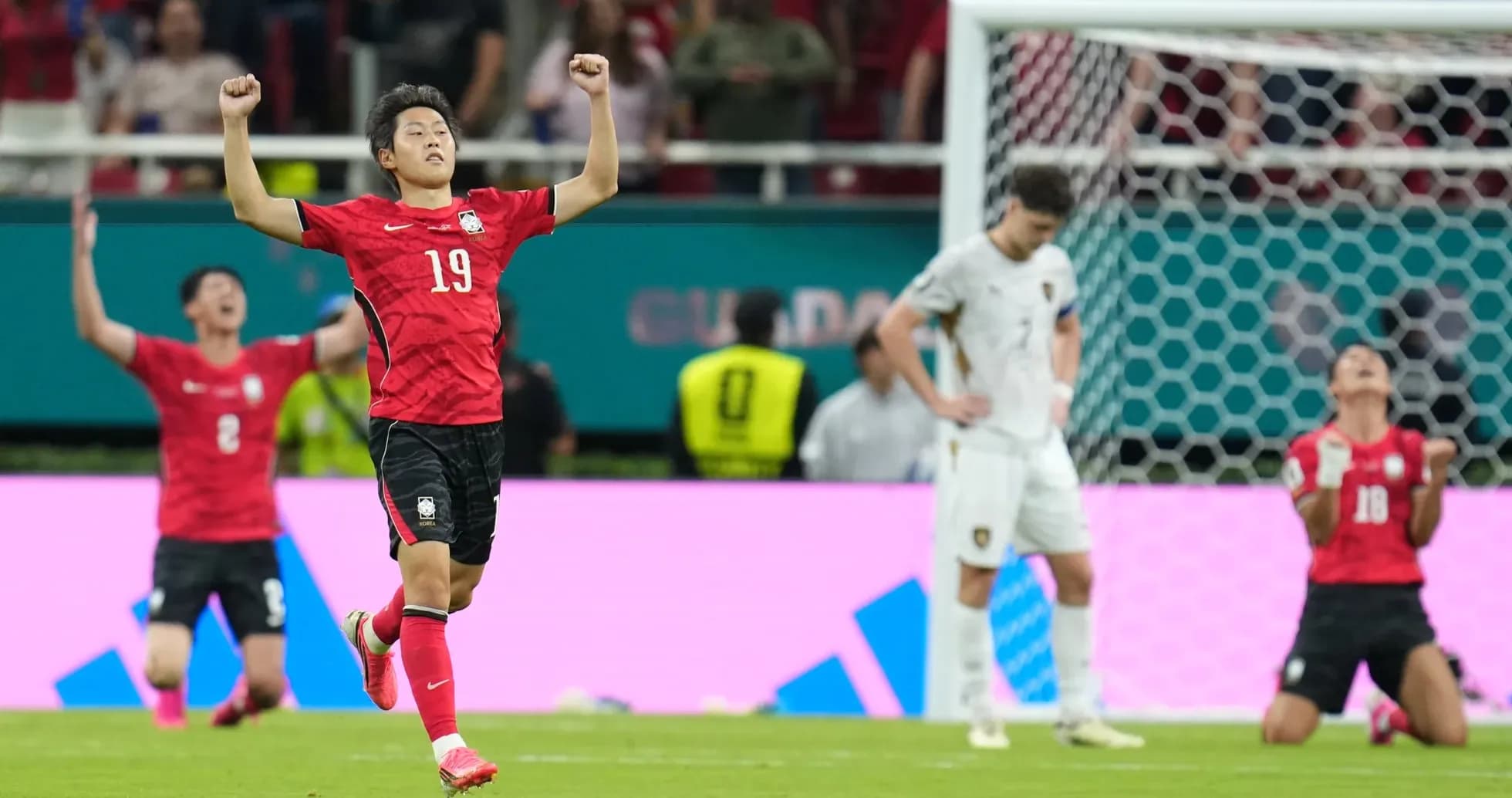
South Korea's Tactical Mastery in 2-1 Victory Over Czech Republic
South Korea’s 2-1 comeback win over Czech Republic at Estadio Akron was defined by structural clarity and superior control of space. Both sides lined up in a 3-4-2-1, but the same base shape produced very different behaviours: South Korea used it as a platform for ball-dominant positional play, while Czech Republic leaned into direct, vertical transitions and set-piece threat.
In possession, South Korea’s 62% share of the ball was not sterile circulation; it was underpinned by a clear occupation of all five vertical lanes. The back three of Gi-Hyuk Lee, Kim Min-jae and Han-Beom Lee provided a wide, stable first line, allowing Young-woo Seol and Lee Tae-seok as wing-backs to push high and pin the Czech wide men. Hwang In-beom and Seung Ho Paik acted as dual pivots, constantly staggering their positions to create diagonals into the half-spaces for Kang-in Lee and Jae-sung Lee behind Son Heung-min.
The shot profile reflects this territorial dominance. South Korea generated 15 total shots to Czech Republic’s 8, with a 10-5 edge in efforts inside the box. Their xG of 2 compared to 0.84 for the Czechs confirms that the 2-1 scoreline was aligned with chance quality rather than just volume. Four blocked shots for South Korea underline how often they were able to sustain attacks around the edge of the area and force last-ditch interventions.
The key tactical inflection came after falling behind to Ladislav Krejčí’s header from a Vladimír Coufal delivery on 59 minutes. Rather than abandoning structure, Myung-Bo Hong doubled down on intensity between the lines. The 62nd-minute substitution of Jae-sung Lee (OUT) for Hwang Hee-chan (IN) added a more vertical runner to attack the space behind the Czech back three, stretching the line and opening pockets for Kang-in Lee to receive.
Czech Republic’s own 3-4-2-1, with Tomáš Souček and Alexandr Sojka central and Jaroslav Zelený and Coufal as wing-backs, was set up to be compact without the ball and direct once possession was won. Their 323 passes at 71% accuracy, compared with South Korea’s 542 at 87%, show a clear intent to play forward early, often through Patrik Schick’s ability to secure first balls and lay off to Lukáš Provod or Pavel Šulc. The 16 fouls committed, double South Korea’s 9, also point to a game plan of disrupting rhythm and accepting defensive risk to break up Korean tempo.
The equaliser on 67 minutes encapsulated South Korea’s positional principles. With Czech Republic collapsing centrally to protect their lead, the Koreans recycled possession through the double pivot, allowing Hwang In-beom to step into a shooting lane at the edge of the box. The assist from Lee Kang-in came from the right half-space, exactly the channel the structure is designed to open: wing-back high and wide, inside forward tucked in, pivot underneath. Hwang’s finish was a reward for sustained occupation of central zones rather than a chaotic moment.
The subsequent substitutions at 69 minutes — Son Heung-min (OUT) for Hyeon-gyu Oh (IN) and Lee Tae-seok (OUT) for Ji-sung Eom (IN) — subtly reweighted the attack. Oh provided a more classic penalty-box reference, pinning the central centre-back and creating clearer roles: Kang-in Lee as the primary creator, Hwang Hee-chan attacking the far post, and Oh as the central target. This paid off with the 80th-minute winner: Oh Hyeon-gyu (IN) finishing a move assisted by Hwang In-beom, who by then was stepping higher as the Czechs tired and their midfield line lost compactness.
Defensively, South Korea’s back three managed the Czech front line with intelligent covering. Kim Min-jae was the spare defender for most of the game, stepping in aggressively when Schick dropped short. The relatively low number of Czech total shots (8) and only 5 inside the box indicates that, aside from the set-piece threat and a disallowed situation checked by VAR for Souček, Czech Republic struggled to create clear central penetrations.
In goal, Kim Seung-gyu (South Korea) faced 4 shots on target and made 3 saves, a solid return that, combined with a goals prevented figure of 0.02, suggests he was largely dealing with efforts of moderate difficulty, with the main danger coming from Krejčí’s goal. At the other end, Matěj Kovář (Czech Republic) made 4 saves from 6 shots on target and also recorded 0.02 goals prevented. The marginal goals prevented numbers for both keepers underline that the match was decided more by the quality of South Korea’s attacking patterns than by extraordinary goalkeeping performances.
Set plays and wide service were Czech Republic’s primary offensive tools. Their 5 corner kicks to South Korea’s 4 show a slight edge in dead-ball opportunities, and the opening goal came from exploiting aerial superiority at the back post. However, once behind, South Korea’s control of the ball forced Czech Republic deeper, limiting their ability to sustain pressure and turning their 3-4-2-1 into a de facto 5-4-1 for long stretches.
The disciplinary profile adds another layer to the tactical story. South Korea received 1 yellow card — at 90+6', Lee Gi-Hyuk (South Korea) was booked for “Roughing” — while Czech Republic finished without bookings. This asymmetry, despite Czech Republic committing more fouls, reflects South Korea’s late-game need to protect their lead in more open spaces as the structure stretched under Czech direct play.
Statistically, the verdict is clear: South Korea’s superior possession, passing accuracy and xG translated into a controlled, if hard-fought, Group Stage win. The 2-1 scoreline, built on a 2.0 xG versus Czech Republic’s 0.84, aligns with the balance of chances. The shared 2 offsides each hint at both teams looking to exploit depth behind high defensive lines, but only South Korea consistently connected those runs to structured final-third play. In tactical terms, this was a textbook demonstration of how a ball-dominant 3-4-2-1 can outmanoeuvre a more direct mirror shape over 90 minutes.