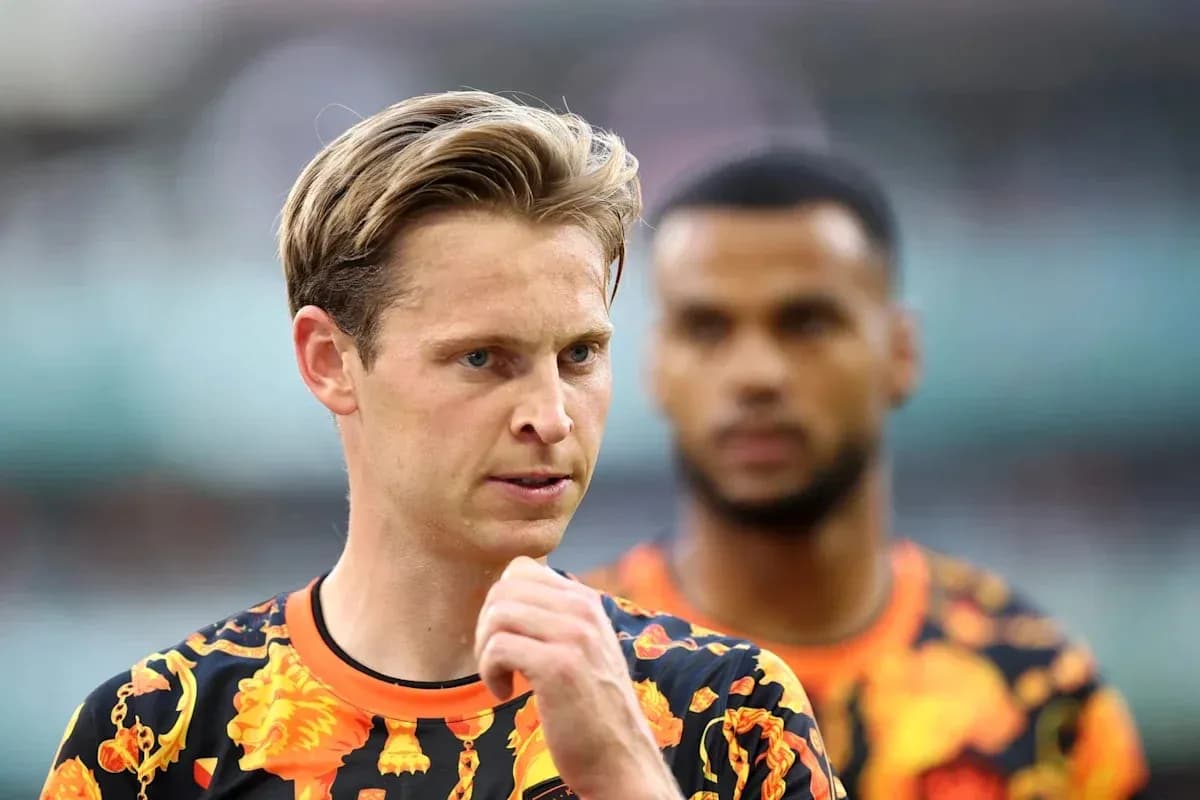
Frenkie de Jong: Captain Battling Injury and Defending Barça’s Future
Barcelona’s armband has felt unusually heavy this summer. Two of the club’s four captains, Ronald Araujo and Marc-André ter Stegen, have packed their bags and left on loan, heading to Liverpool and Ajax. The dressing room hierarchy has been stripped back, leaving Frenkie de Jong as the main standard-bearer.
And even he has spent the last weeks fighting on multiple fronts.
The Dutch midfielder is out for several months after aggravating an injury at the FIFA World Cup, a setback that has triggered a storm of criticism around his decision-making and professionalism. Reports in Spain have gone as far as to claim he has lost the manager’s trust. His recovery has stalled, the questions have not.
So De Jong chose to answer them.
In a long, emotionally charged interview with the club’s official media, the captain pushed back against what he called misinformation surrounding his injury and his situation at Barcelona. He laid out how the injury happened, insisting it was not down to recklessness on his part, and tried to reclaim control of a narrative that has spiralled away from him while he has been stuck on the sidelines.
From there, the conversation turned to what still makes him believe in the project.
La Masia, the club’s heartbeat
De Jong’s eyes lit up when the subject of La Masia came up. If the captain has doubts about certain things around him, the academy is not one of them.
“La Masia is incredible. Every year players come through that we don't even know, and then within a year they become very important players for the team. That is the DNA of the club,” he said.
It is a reminder of what Barcelona still wants to be: a club where unknown teenagers can become key pieces in a single season, where the academy doesn’t just fill gaps but defines the team’s identity. For a squad that has just seen two leaders walk out on loan and another stuck in the treatment room, that conveyor belt of talent is no luxury. It is a lifeline.
The irony is clear. While De Jong is sidelined, the very youngsters he praises may be the ones asked to carry the load he can’t.
Guiding the new faces
Even from the physio room, the captain’s responsibilities have not stopped. Barcelona reshaped parts of their squad in the summer, and De Jong has taken it upon himself to help the new signings understand what it means to play for this team.
“They are very good players and very good people. They are going to help us a lot, and I'm trying to help them adapt as easily as possible,” he explained.
No grand speeches. Just the day-to-day work of a captain: helping them read the rhythm of Barça’s positional play, the expectations of the fans, the pressure that never really eases in a club built on Cruyff’s ideals and Messi’s shadow.
His own absence on the pitch only sharpens that need. With Araujo in Liverpool red and ter Stegen in Ajax colours, the dressing room has lost two powerful voices. De Jong, injured or not, cannot step back.
The distant dream: Europe
All of this feeds into a single, towering ambition. The UEFA Champions League.
For De Jong and his teammates, the competition is not just another objective. It is the dream. The one that has repeatedly slipped away from Barcelona in painful fashion over the past decade.
He admitted as much: going all the way in the Champions League is what drives the squad. It is the trophy that would validate the rebuild, the faith in La Masia, the investment in new signings, the trust placed in a captain currently watching from the stands.
Right now, that dream feels a long way off for a player ruled out for months, battling to regain both fitness and trust. But if La Masia keeps producing, if the new recruits settle, if the captain’s voice still carries weight in that dressing room, Barcelona will not stop chasing it.
The question is simple and brutal: when that decisive night in Europe finally comes, will Frenkie de Jong be at the heart of it—or watching another chapter unfold without him?