Singapore's ASEAN Championship Hopes Dwindle After Loss to Thailand
SINGAPORE – The noise never really stopped. The belief did.
Singapore’s bid to reach a first ASEAN Championship final since 2012 is dangling by the thinnest of threads after a bruising 3-1 defeat to Thailand in the first leg of their semi-final at Jalan Besar Stadium on Aug 15.
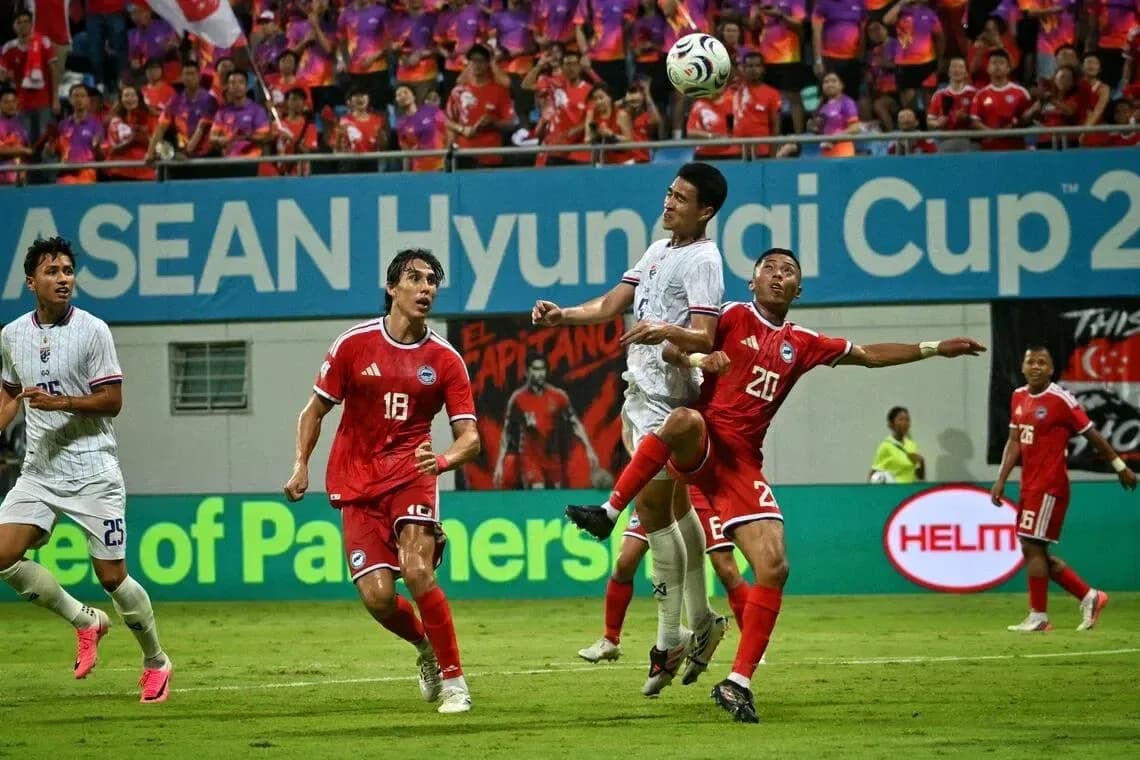
The Lions chased, harried and pressed high. The crowd roared them on – 5,358 strong, with President Tharman Shanmugaratnam and his wife Jane Ittogi among them. For a while, it felt like something was building.
Then Thailand showed why they are seven-time champions.
Thai ruthlessness, Singapore errors
The game turned on mistakes, not just magic.
Singapore started with intent, with Gavin Lee rolling the dice on his line-up. Irfan Fandi, Kyoga Nakamura and Shawal Anuar came in, replacing Hami Syahin, the suspended Song Ui-young and Ilhan Fandi from the 1-1 draw with Indonesia.
The press was aggressive, the tempo high. Thailand barely saw the ball – they finished with just 28 per cent possession – but they did not need much of it.
On 14 minutes, Nakamura was caught in possession in his own half. Thailand pounced. The ball fell to Teerasak Poeiphimai, who stroked a precise low finish into the bottom corner. One lapse, one goal.
Twelve minutes later, another. Teerasak was left unmarked in the box and climbed to steer a header past Izwan Mahbud. Two chances, two goals. Singapore’s bright start lay in pieces.
Lee’s side had a lifeline handed to them shortly after. A long throw from Lionel Tan caused chaos in the Thai box, and the video assistant referee spotted a push by Yotsakorn Burapha on Shawal. Penalty.
Up stepped Shawal in the 35th minute, only for Kampol Pathomakkakul to read him and spring to his right, pushing the spot kick away. The groan around Jalan Besar said everything. Thailand stayed 2-0 up and in control.
The War Elephants, who had made six changes from the team that beat Myanmar 2-0 on Aug 8, could even afford to take off their two-goal forward at half-time. Teerasak made way for Patrik Gustavsson, and the Swede-born attacker wasted no time making his mark.
Barely five minutes into the second half, Gustavsson outpaced Lionel Tan down the flank and squared for Seksan Ratree, who swept in Thailand’s third. Singapore’s high line was shredded. So, almost, was the tie.
Lions hit back late, but mountain looms
At 3-0 down, the only thing keeping Singapore afloat was the noise and Izwan. The goalkeeper produced several big saves as Thailand threatened to run riot. The final scoreline did not flatter the visitors; if anything, it spared the Lions further damage.
Lee’s unbeaten competitive start as national coach – eight games without defeat since he replaced Tsutomu Ogura in June 2025 – was disintegrating under the floodlights. The errors he later admitted were “unnecessarily difficult moments” kept piling up.
Yet the team did not fold.
Second-half substitute Ilhan Fandi, left out of the starting XI but thrown on to salvage something, finally cracked open the Thai defence in the 84th minute. Cutting in, he bent a shot off the post and in for his fourth goal of the tournament – and the first Thailand have conceded in four competitive matches.
The stadium erupted. For a brief spell, the old Jalan Besar surge returned. One goal back. A sliver of hope.
Lee clung to that thread afterwards. He spoke of the fans who “kept singing, cheering and pushing” and of a dressing-room pact: if the fans would not give up on them, they could not give up on themselves. The deficit is two. The belief, he insisted, is not gone.
Hudson’s Thailand in control – and not satisfied
On the opposite bench, Anthony Hudson cut a frustrated but satisfied figure. The Thailand coach had exchanged heated words with the Singapore bench after the final whistle, a sign of how spiky the contest had been.
He called it a “frustrating game” full of flying tackles, yet he praised his players for defending well and taking their chances. He also warned that this was not peak Thailand.
Hudson pointed out that his side are at their best when they connect with shorter passes and find runners in behind. Even after three goals, he felt they could have added “one or two more”. That was his only real disappointment.
Still, the bigger picture suits him. Thailand, ranked 94th in the world, have now won five straight games at this tournament despite missing several key names. They return to Bangkok not just with a 3-1 lead, but with the sense that there is another gear to hit at Rajamangala Stadium on Aug 18.
History, hype and a harsh reality
The numbers are stacked brutally against Singapore.
World No. 148, the Lions have not reached an ASEAN Championship final since their 2012 triumph, when they edged Thailand 3-2 on aggregate. They also beat the Thais in the 2007 final. Those memories fuel belief, but the format’s history is unforgiving.
Since two-legged knockout ties were introduced in 2004, teams that lost the first leg have gone on to qualify only five times. No one has ever overturned a two-goal deficit.
Yet this is not the same jaded Singapore side of recent years. Under Lee, the Lions have rediscovered some bite. They secured a historic Asian Cup qualification in November 2025 for the 2027 showpiece and muscled their way into these semi-finals by holding defending champions Vietnam 0-0 and drawing 1-1 with Indonesia in the group stage.
The country has responded. More than 4,000 home tickets for this semi-final first leg vanished in seven minutes when sales opened on Aug 12. Scalpers pounced, reportedly flipping a pair of Category 1 tickets with a face value of about $100 for as much as $2,500 online.
The buzz was real. The performance, Lee admitted, did not match it.
He conceded that while Thailand’s quality is a given, Singapore “made it easy for them” with their mistakes. His players, he said, are “kicking themselves” but desperate to “right the wrong”.
Bangkok awaits
Now comes the hard part.
The Lions head to Rajamangala as heavy underdogs, carrying a 3-1 deficit into a stadium where Thailand rarely show mercy. The War Elephants have a clean, simple brief: finish the job, then turn to a final against either Vietnam or Malaysia, who meet in their own semi-final with the first leg in Kuala Lumpur on Aug 16 and the return in Hanoi three days later.
For Singapore, the task is far more complicated. They must score at least twice, keep a rampant Thai attack quiet and avoid the kind of errors that shredded them at Jalan Besar.
They have the backing. They have a goal that keeps the tie alive. They have a coach convinced that “with this group, anything is possible”.
Now they have to prove it – in Bangkok, against history, and against a Thailand side that has not yet shown its full teeth.