Sevilla vs Real Sociedad: Tactical Analysis of a 1-0 Clash
Under the lights of the Estadio Ramón Sánchez Pizjuán, this was billed as a clash of necessity versus ambition. Sevilla, 17th in La Liga with 37 points and a goal difference of -14 heading into this game, were still looking nervously over their shoulders. Real Sociedad arrived from a very different vantage point: 9th place, 43 points, and a -1 goal difference, still clinging to the Europa League picture. Over 90 tense minutes, the home side ground out a 1–0 win, a scoreline that perfectly mirrored the season-long contrast between Sevilla’s defensive frailty and their capacity for stubborn, situational resistance.
Tactical Overview
The tactical story began with the shapes. Luis Garcia Plaza rolled the dice with a 4-4-2, a formation Sevilla had only used 3 times overall this campaign, against a Real Sociedad side deeply comfortable in their 4-2-3-1, a system they had deployed 11 times. It was a classic structural duel: Sevilla’s twin strikers and flat midfield line versus La Real’s single pivot pair and fluid attacking band of three behind Mikel Oyarzabal.
Sevilla’s seasonal DNA has been unstable but not toothless. Overall this campaign they have scored 41 goals and conceded 55 across 34 matches, averaging 1.2 goals for and 1.6 against. At home, they have been marginally more reliable: 22 goals scored and 23 conceded, with averages of 1.3 for and 1.4 against. Real Sociedad, by contrast, have built their campaign on a more expansive edge: 52 goals for and 53 against overall, averaging 1.5 scored and 1.6 conceded. At home they are almost free-flowing (32 goals, 1.9 per game), but on their travels the numbers flatten: 20 goals scored, 28 conceded, with away averages of 1.2 for and 1.6 against. This away fragility formed the backdrop to the night’s only goal.
Absences and Their Impact
The absences shaped the texture of the contest as much as the formations. Sevilla were without M. Bueno (knee injury), Marcao (wrist injury), and D. Sow (suspension due to yellow cards). That stripped depth from both their defensive rotation and their midfield energy. It made the selection of N. Gudelj and L. Agoume in the engine room even more central: they were not just starters, they were structural pillars.
Real Sociedad’s missing list was just as significant: G. Guedes (toe injury), J. Karrikaburu (ankle injury), A. Odriozola (knee injury), and I. Ruperez (knee injury). For Pellegrino Matarazzo, it meant fewer options to change the game out wide or to refresh the back line late on. The bench still carried quality—Brais Méndez, A. Zakharyan, and T. Kubo among others—but the absence of Guedes in particular removed a direct, vertical threat that could have stretched Sevilla’s back four.
Disciplinary Profiles
The disciplinary undercurrent was always going to matter. Sevilla’s season-long card profile shows a clear late-game spike: 19 yellow cards in the 76–90 minute window, accounting for 19.79% of their total yellows, plus another 18 yellows between 91–105 minutes (18.75%). Their reds are distributed in flashes of ill-discipline between 16–30, 31–45, 61–75, 76–90, and an additional cluster in the undefined range, each segment carrying 20.00% of their red total. This is a team that tends to live dangerously as fatigue and pressure mount.
Real Sociedad, meanwhile, compress much of their yellow-card risk into the heart of the second half: 22.22% of their yellows arrive between 46–60 minutes, with another 16.67% in the 76–90 period. Their reds are even more ominous late on: 25.00% between 46–60, 50.00% in the 76–90 window, and 25.00% between 91–105. Both sides are statistically primed for chaos in the final quarter of games, and that tension bled into every contested ball as the clock ticked past 70’.
Individual Profiles
Within this disciplinary landscape, individual profiles loom large. For Sevilla, José Ángel Carmona is La Liga’s leading yellow-card magnet with 11 yellows. His season numbers—59 tackles, 7 blocked shots, 34 interceptions, 290 duels with 157 won—underline a defender who lives on the edge. He blocked 7 shots overall, a testament to his front-foot defending that can so easily spill into fouls. L. Agoume mirrors that combative edge in midfield: 59 tackles, 5 blocked shots, 43 interceptions, but also 53 fouls committed and 10 yellows. Together they form a high-risk, high-contact axis on Sevilla’s right side and central lane.
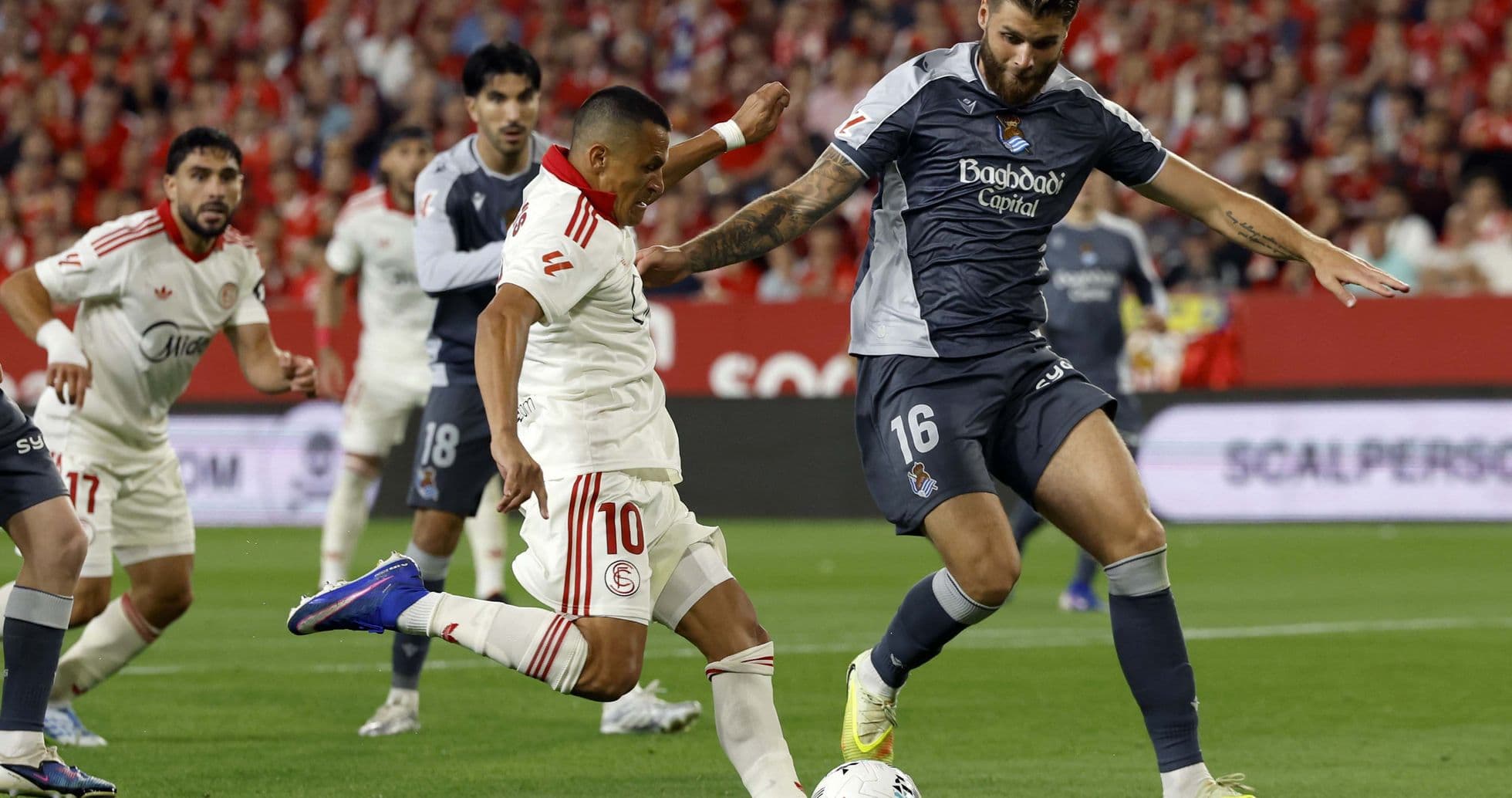
Real Sociedad’s mirror image is J. Aramburu. With 10 yellow cards, 96 tackles, 9 blocked shots, 43 interceptions, and 339 duels (193 won), he is both shield and potential liability on the right flank. His duel with Sevilla’s left-sided threat—G. Suazo overlapping behind C. Ejuke—was the game’s most combustible corridor. Each forward run from Suazo invited a decision from Aramburu: step in and risk another booking, or drop and concede territory.
Key Matchups
The “Hunter vs Shield” matchup was more nuanced than a simple striker-versus-defence narrative. Real Sociedad’s primary scoring reference is Mikel Oyarzabal, who has 14 league goals and 3 assists, supported by 58 shots (34 on target). He also brings 40 key passes and 6 penalties scored from 6 taken. His role in the 4-2-3-1 is hybrid: part finisher, part facilitator. Against a Sevilla defence that has conceded 55 goals overall, Oyarzabal’s movement between the lines and into the box should, on another night, have generated a higher-quality shot profile.
But Sevilla’s “shield” is collective rather than individual. Their 6 clean sheets overall are modest, yet at home they concede only 1.4 goals per game on average, and this match added another shutout to that pattern. O. Vlachodimos, protected by a back four of Carmona, Castrin, K. Salas, and Suazo, benefited from a compact 4-4-2 block that narrowed the spaces Oyarzabal usually exploits. N. Maupay and I. Romero worked relentlessly without the ball, screening passes into C. Soler and B. Turrientes, forcing La Real wide and into more predictable crossing zones.
Engine Room Duel
In the “Engine Room” duel, Agoume and Gudelj versus Turrientes and J. Gorrotxategi was decisive. Agoume’s 1,199 passes this season at 80% accuracy and 26 key passes show a midfielder capable of both recycling and progressing possession. Turrientes and Gorrotxategi, by contrast, are more about balance and distribution than high-risk creativity. That tilt allowed Sevilla to occasionally break Sociedad’s double pivot, especially when R. Vargas tucked inside from the right and Ejuke drove from the left, turning the nominal 4-4-2 into a 4-2-2-2 in possession.
Statistical Prognosis
From a statistical prognosis standpoint, this 1–0 result sits at the intersection of both teams’ seasonal tendencies. Sevilla’s home attack, at 1.3 goals per game, is rarely explosive but often sufficient if their defensive structure holds. Real Sociedad’s away defence, conceding 1.6 goals per match on their travels, is prone to conceding exactly the kind of narrow margin they suffered here. With Sevilla perfect from the spot this season (5 penalties taken, 5 scored, 100.00% conversion) and Real Sociedad also flawless from 7 out of 7, any penalty would likely have tilted xG sharply. But with no penalties awarded and no clear reference to a high xG event, the contest remained one of cumulative pressure rather than singular, high-probability chances.
Narrative Conclusion
Following this result, the narrative is clear. Sevilla, still fragile overall, showed that in a controlled, structurally disciplined game they can bend their chaotic disciplinary profile to their advantage, leveraging physicality without tipping into self-destruction. Real Sociedad, for all their attacking talent and Oyarzabal’s season-long numbers, were once again undermined by their away balance: enough possession and territory, not enough incision, and a defensive unit that, statistically and now concretely, concedes just enough to lose tight games.
In tactical terms, this was a night where the shield outlasted the hunter, where Sevilla’s patched-together back line and combative midfield found just enough control to make a single goal stand up against a side whose season has been defined by fine margins.