Sam Hutchinson: From Chelsea's Rising Star to Overcoming Adversity
Sam Hutchinson remembers the noise first. The Allianz Arena, the night Chelsea finally climbed Europe’s highest peak in 2012. Munich. Blue shirts, silver medals, the Champions League trophy glinting under the lights.
He was there. Part of it. Not on the pitch, but on the inside.
He had already played for Jose Mourinho, trained under Carlo Ancelotti, set up a goal for Frank Lampard in a 7-0 demolition of Stoke City. He had captained England Under-19s. Chelsea had raised him from the age of seven and, for a while, the path looked straight and clear.
Then his right knee gave way and everything he thought he knew about his career disappeared.
‘Everything fell apart. I was just a kid’
A chondral defect. A hole in the knee. A reserve game at Aston Villa and a serious injury that would not heal. The promising defender on the fringes of Chelsea’s first team suddenly found himself staring at a future without football.
“I had already played for the first team and Mourinho had said some encouraging things about me in interviews,” Hutchinson says. “Then the injury happened and everything fell apart. I was just a kid.
“After I retired I was in a bad place with dark thoughts.”
In 2010, aged just 21, he made the decision no academy graduate ever wants to make. He retired. The boy who had grown up at Cobham, who had been told he was a bright prospect, walked away from the game.
Depression followed. Real, heavy, suffocating.
“Unless you get help, you never know how bad you are,” he tells BBC Sport. “Even telling this story, it’s like therapy.
“It’s like the old saying – a problem shared is a problem halved. That’s true about mental health. If you’re suffering in silence, it’s not going to help.”
Treatment at the Priory helped pull him back. So did time. So did surgery. When his knee was finally repaired, the door that had slammed shut creaked open again.
In December 2011, Hutchinson came out of retirement and re-signed for Chelsea.
The fairytale never quite materialised. More injuries followed. He managed only six senior appearances for the club. But this time he refused to let the story end early.
He built a career elsewhere instead.
A career rebuilt in the shadows of the elite
Hutchinson found his footballing home not in west London, but in the Championship. More than 200 games, most memorably for Sheffield Wednesday, where supporters still talk about him with warmth and respect.
He went abroad too – to Vitesse Arnhem in the Netherlands and Pafos in Cyprus – and he added spells at Nottingham Forest, Reading and AFC Wimbledon. The starlet who had once been fast-tracked at Chelsea became the seasoned professional who knew how to grind through a season.
Sixteen years on from fearing it was all over, he is still playing at 37. A father of three, a survivor in more ways than one.
This summer he signed a two-year deal with non-league Farnham Town. Another new start. Another comeback.
The goal that nearly cost him his life
Monday, 26 May 2025. AFC Wimbledon’s promotion to League One, sealed at Wembley with a play-off final win over Walsall, will live forever in the club’s history.
But the Dons would not have been there without a moment three weeks earlier at Grimsby.
“It was Hutchinson’s winner at Grimsby,” the fans will tell you. The goal that clinched a play-off spot at Blundell Park. A tap-in after a centre-back’s header, a fingertip save, the ball dropping kindly.
Only Hutchinson knew that while the away end exploded, his own body was sounding an alarm.
“Throughout the first half my chest was getting increasingly tighter and I was in so much pain,” he recalls. “I felt dizzy and my hands started sweating.
“I was rapidly going downhill but then our centre-back won a great header, the keeper tipped it on to the bar, and it dropped down to me to tap over the line.”
He finished the game. He thought only of getting home to his wife and three children in Ascot. He did not make it that far.
On the journey back to London, his condition worsened so dramatically that the team coach diverted to a hospital in Nottingham. Tests were run. Then came the blue lights.
“I was put in the back of an ambulance and I remember hearing the blues and twos,” he says. “My blood levels had spiked so much, I was in a really bad way. A couple of the paramedics knew who I was because I had played for Nottingham Forest a few years earlier.
“They said: ‘You can thank us later for saving your life.’ I was told I’d had a heart attack.”
Five days in hospital followed. Heart surgery. A blocked artery – 75% closed – opened up by a specialist.
“I had an angiogram, external and had a stent put in by a specialist. The one thing that the professor – who had looked after both Tom Lockyer and Christian Eriksen – said was my situation was nothing like theirs.
“It was a blockage and it was all fixed, there was no need for a defibrillator to be fitted.”
The scare could have ended everything. Instead, it became another chapter.
Back from the brink, again
Messages poured in. One came from John Terry, his former Chelsea team-mate. The defender who once captained him in training now reached out as a friend.
Hutchinson recovered well enough to make it to Wembley and watch AFC Wimbledon complete the job against Walsall. A month later, the club announced he had signed a one-year extension after being given the all-clear to train again.
On paper, the story looked neat: heart attack, surgery, recovery, return.
Reality was harsher. In 2025-26 he managed only a handful of appearances. The body that had already endured a wrecked knee and a broken career asked more questions of him.
By May, 12 months on from that day at Grimsby, AFC Wimbledon confirmed he would be leaving at 36.
“Sam played a pivotal role in getting us over the line, not only with that iconic goal at Grimsby but his performances leading up to that,” read the club’s statement announcing his departure.
Many would have taken the hint. Heart surgery, limited minutes, a promotion secured, a career already rescued once from retirement. Time to stop.
Hutchinson chose differently.
Chelsea’s boy, Chelsea’s values
It is now 16 years since he slid a pass into Lampard’s path in that 7-0 rout of Stoke at Stamford Bridge. Fourteen years since he flew to Munich with Roberto Di Matteo’s squad for the Champions League final at the Allianz Arena.
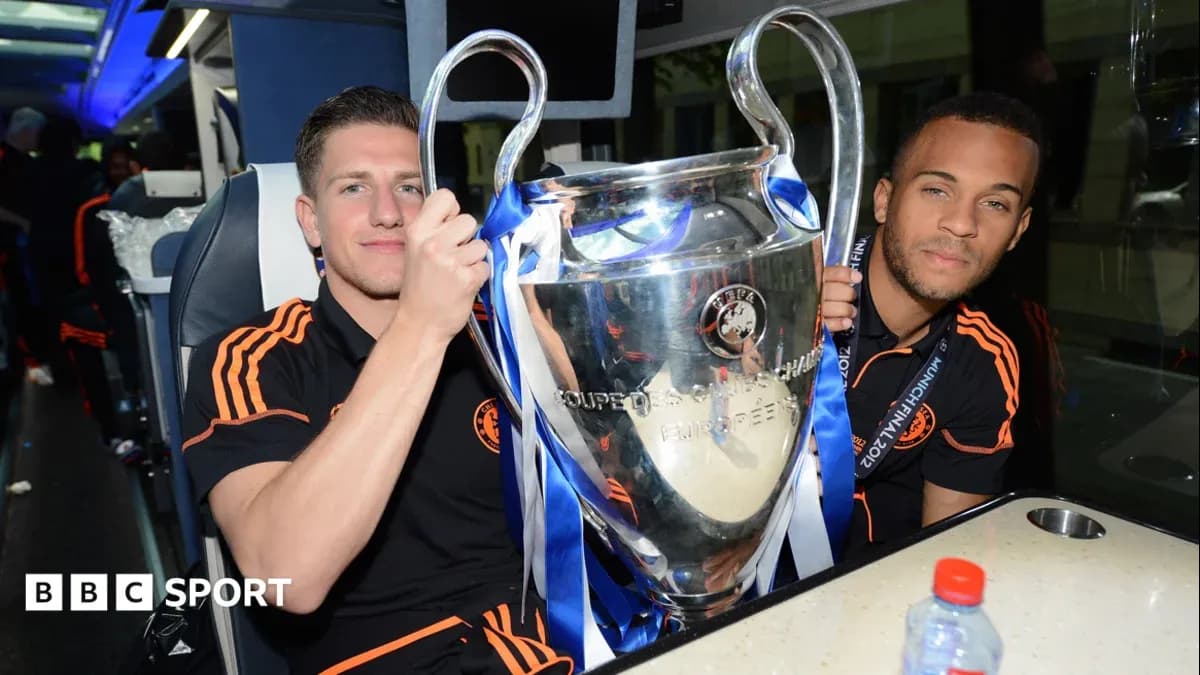
He did not play in that shootout win over Bayern Munich. He did not take a penalty. But he was in the dressing room, on the plane, on the bus at the trophy parade. A valued squad member, part of the group that made history.
The injuries, the regrets, the early retirement – all of it colours how he looks back at his time at Stamford Bridge. But he does not forget what Chelsea gave him.
“They brought me up and gave me values,” he says. “I look back at the club fondly and what they did for me. I do bits of work now for Chelsea TV.”
He has also thrown himself into causes that hit close to home. Work with the British Heart Foundation. Raising awareness around mental health, speaking from experience rather than theory.
When he is asked how his own mental health is now, the answer is honest, not sugar-coated.
“I’m in a different place,” he says. “I do have regrets [because of the injury] but I have also lived a life that has been good.
“There are many players who have gone through a lot worse than me.”
From Mourinho’s praise to a hospital ward in Nottingham, from a retirement at 21 to a new deal at 37 in non-league, Hutchinson’s story refuses to flatten into a simple tale of what might have been.
He is still lacing up his boots. Still chasing the ball. Still choosing, again and again, not to walk away.