Remembering John Thomson: Celtic’s Fallen Goalkeeper
In football, “tragedy” is thrown around far too easily. A late equaliser, a cup final defeat, a slip at the back post – none of that truly qualifies.
On 5 September 1931 at Ibrox, it did.
That afternoon, Celtic goalkeeper John Thomson went out to play an Old Firm league match and never came home. He was 22 years old. Many who knew him would later say that, in a way, two lives ended that day.
From the Fife Pits to Celtic’s Goal
John Thomson was born on 28 January 1909, not in the mining village with which his name is most closely tied, but in Kirkcaldy. Within a year, his family moved to Cardenden in Fife, the place that shaped him and would eventually lay him to rest.
Cardenden was a mining community and Thomson’s early life followed the familiar path. As a teenager he went down the pits, working as a labourer at Bowhill Colliery. Like countless boys in the area, he grafted underground and dreamed above it, hoping football might offer a way out.
He stood out at school level, but it was in Junior football that his reputation really began to grow. He first turned out for Bowhill Rovers before joining Wellesley Juniors in 1925. Local newspapers picked up on the young goalkeeper’s form and did not hold back, tipping him for the top level.
Trial matches followed with Raith Rovers and Cowdenbeath. The decisive moment, though, arrived in October 1926. Celtic scout Steve Callaghan travelled to watch an East of Fife Cup tie against Denbeath Star, intending to assess another goalkeeper. He left talking about only one – John Thomson.
On 1 November 1926, Celtic signed the 17‑year‑old for £10. The story has become part of club folklore: Thomson, persuaded by a tramcar journey to Glasgow’s east end, putting pen to paper on top of a fuse box. A working‑class goalkeeper stepping into a different world.
A Rapid Rise and a Growing Legend
Thomson made his Celtic first‑team debut on 12 February 1927 against Dundee at Dens Park. Celtic won 2–1, and the teenager impressed both supporters and coaching staff. Yet the detail that stuck with many was his reaction to conceding. He reportedly blamed himself for Dundee’s goal and vowed to improve. High standards, even in a winning debut.
By the end of that season, he had his first major medal. Thomson helped Celtic lift the 1927 Scottish Cup with a 3–1 victory over East Fife in front of almost 80,000 spectators. Four years later, he added another Scottish Cup winners’ medal as Celtic beat Motherwell 4–2 in a replay after a 2–2 draw.
He also collected three Glasgow Cup medals and became a fixture in the side. Between 1927 and 1931, he made 188 appearances for Celtic, establishing himself as the club’s undisputed No 1 and one of the most exciting young goalkeepers in Britain.
His form did not go unnoticed beyond Glasgow. Between 1930 and 1931, Thomson won four caps for Scotland, keeping three clean sheets and conceding just one goal. His debut came in Paris, where he helped Scotland to a 2–0 win. His final international outing was just as emphatic: a 2–0 victory over England at Hampden in front of 131,000 fans.
Thomson also turned out four times for the Scottish League XI, and interest from south of the border grew, with Arsenal among the clubs said to be keen on tempting him away.
What made him stand apart? Agility, certainly. But above all, courage. This was an era when goalkeepers had little protection and forwards charged in without restraint. Thomson never flinched. He threw himself into danger repeatedly, to the point that his mother was known to fear the worst every time he played. A serious injury against Airdrie in 1930 only deepened her anxiety.
Her fears would soon prove horribly justified.
Ibrox, 5 September 1931
On the morning of the Old Firm match, Thomson left his flat on Victoria Road on Glasgow’s south side. His destination lay a couple of miles away: Ibrox Park, where Celtic would face Rangers in a league clash.
By half-time the game remained goalless. Thomson had done what he usually did – steadying Celtic’s defence, giving his teammates the platform to attack the Light Blues.
Then, early in the second half, the moment that would define everything.
Rangers forward Sam English broke through the Celtic back line. Thomson saw the danger and charged from his goal, diving bravely at English’s feet in a bid to smother the ball. The two men collided with huge force. English’s knee or boot caught Thomson on the head.
At first, many in the crowd thought it was just another heavy clash. Such incidents were part of the game in that period. But the mood changed quickly.
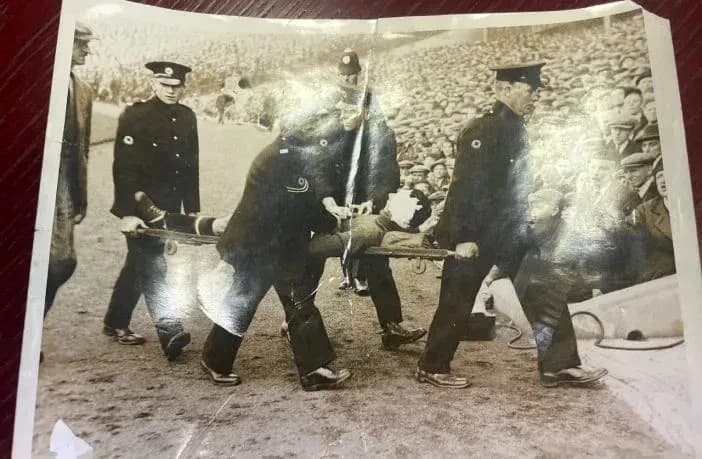
Thomson lay motionless. Medical staff sprinted onto the pitch. He was lifted onto a stretcher and carried away. In a decision that jars with modern sensibilities, the match went on. With no substitutes allowed, Celtic defender Chic Geatons, another Fifer, pulled on the goalkeeper’s jersey. The game finished 0–0, but almost nobody cared about the score.
A Life Lost, a Game Changed
Thomson was taken to the Victoria Infirmary in Glasgow. Doctors fought to save him, but the damage was catastrophic. A car was sent to bring his parents from Fife. Shortly after they arrived, their son died from a fractured skull and associated brain injuries.
He was 22.
An inquiry later ruled the death accidental. Those who saw the incident, including officials and witnesses, agreed that Sam English bore no blame. It was a brutal, tragic consequence of two committed players going fully for the ball.
That did not ease the burden on English. The Rangers forward was deeply affected, and the incident shadowed his career. He also had to endure abuse from some opposing supporters, despite the fact that Thomson’s own parents publicly forgave him and insisted he was not at fault.
Scottish football reeled. Celtic fans, Rangers fans, and neutrals alike were stunned by the loss. A memorial service at Trinity Church in Glasgow’s west end brought together both teams, including English. Crowds packed the streets outside so tightly that police had to help the players reach the building.
Cardenden Says Goodbye
On 9 September 1931, John Thomson was laid to rest in Cardenden. Around 40,000 people attended, many travelling from Glasgow. Some walked the 55 miles to Fife. His Celtic teammates carried the coffin, a final act of service for the goalkeeper who had so often carried them.
His gravestone bears a line that has become inseparable from his story:
“They never die who live in the hearts they leave behind.”
For Celtic supporters, that inscription is not just carved in stone; it has been sung, recited, and passed down through generations.
The emotional toll did not vanish with the funeral. Celtic struggled in the months that followed, the dressing room and terraces still raw with grief. Eventually, Canadian goalkeeper Joe Kennaway took over the position, but no one at the club mistook succession for replacement. Thomson’s absence lingered.
Poems and songs emerged, many still associated with Celtic to this day. Writers returned to his story again and again in articles and books. Supporters continued – and still continue – to visit his grave in Cardenden, often tying charity events and commemorations to his memory.
The Prince of Goalkeepers
Football arguments rage on about titles, tactics, and transfers. They fade. The loss of a young man in his prime does not.
John Thomson died playing for Celtic, in the most charged fixture Scottish football can offer, doing what he always did – throwing himself into danger to protect his goal. Decades later, he is still remembered by Celtic fans as their “Prince of goalkeepers”.
Ninety‑five years on from that afternoon at Ibrox, the question lingers: how different might Scottish football’s story have been if John Thomson had walked out of that stadium instead of being carried from it?