
Real Madrid's Right-Back Dilemma: Fortea or Jimenez?
Real Madrid’s right flank is about to lose its constant.
On Saturday, when Dani Carvajal walks off the pitch against Athletic Club, he will be doing it for the last time in the famous white shirt. A captain, a reference point, and the embodiment of the club’s competitive edge, he leaves behind far more than a vacancy at right-back. He leaves a standard.
The question now is who dares to follow.
A hole on the right – and a bold idea
Trent Alexander-Arnold is expected to remain the first-choice right-back, the marquee presence in that channel. But modern Madrid sides are built on depth and internal competition, not on one undroppable name. Carvajal’s exit strips away the experienced deputy, the voice who knew every inch of that touchline and every demand of the shirt.
The market offers names. Pedro Porro at Tottenham. Diogo Dalot at Manchester United. Both admired inside Valdebebas, both considered long shots. Their situations, and the cost of prising them away, make any move highly complicated.
So the club is looking inward.
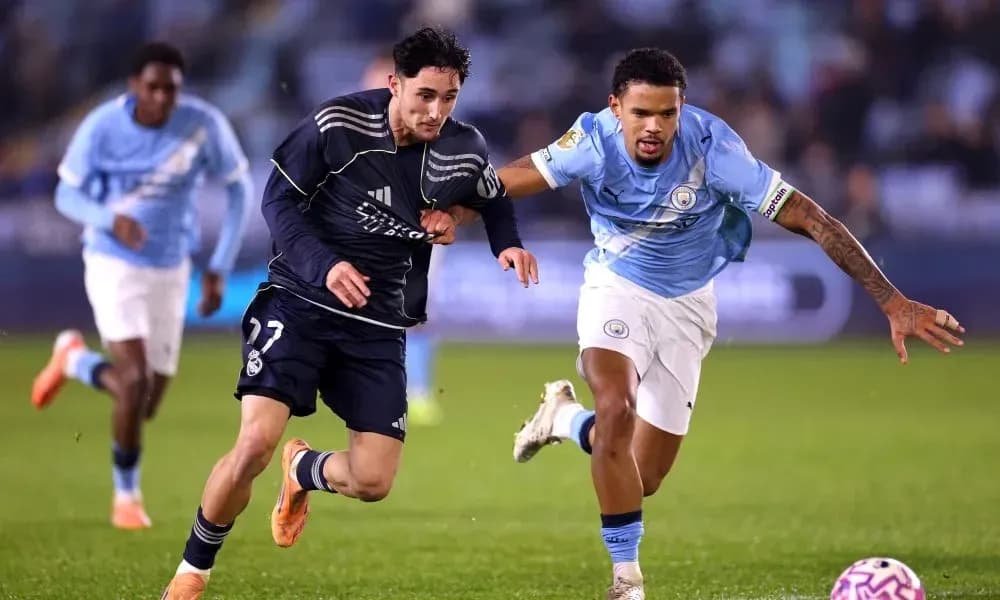
According to AS, Real Madrid are weighing a decision that says as much about their faith in La Fabrica as it does about their transfer strategy: promote from within, or break the bank outside. Two academy right-backs have emerged as genuine contenders to step into the space behind Alexander-Arnold – Jesus Fortea and David Jimenez.
Two very different profiles. One a prodigy. The other a quiet constant.
Fortea – the prodigy who broke a pact
Jesus Fortea’s story at Real Madrid began with a rupture.
To sign him, Madrid broke the long-standing non-aggression pact with Atletico Madrid, pulling the then-15-year-old from their rivals’ academy. You do not tear up such an understanding for a squad player. From day one, the message around Valdebebas was clear: this was Carvajal’s natural heir.
Now 19, Fortea stands 1.75m tall and plays like a winger trapped in a full-back’s body. He is fast, daring on the ball, and relentless going forward. His game is built on aggression in the final third, on the desire to break lines rather than simply patrol them.
His path, though, has not been smooth.
Instead of a direct promotion to Castilla, he found himself held at Real Madrid C, stuck in a holding pattern while others climbed. When he finally reached Castilla, the adaptation bite was real. Minutes were hard to come by. The position he was supposed to inherit felt a long way away.
He didn’t sulk. He fought.
Fortea worked his way into the team and became a key figure in the Juvenil A side that lifted the UEFA Youth League. On those European youth nights, his attacking instincts came alive: overlapping runs, constant width, and the kind of bravery on the ball that Madrid fans demand from their wide defenders.
There is still a clear caveat. His defensive game needs polishing. Positioning, one-on-one duels, timing his risk-taking – all remain areas to refine. Inside the club, they see him as a big bet for the future, not yet a finished article. His contract runs until 2029, a long-term statement of belief that the raw edges can be smoothed.
If Madrid want electricity and upside on the right, Fortea is their gamble.
Jimenez – the silent captain
On the other side of the argument stands David Jimenez, the antidote to hype.
He arrived at La Fabrica in 2013 from Mostoles URJC, a local boy with a clear idol: Alvaro Arbeloa, the current first-team manager. It fits. Jimenez’s game carries the same seriousness, the same sense of duty to the line he patrols.
He has climbed every rung of the academy ladder, quietly, steadily, until the captain’s armband of Castilla ended up on his arm. At Valdebebas, coaches and staff talk about his professionalism and his attitude before they even get to his football. They call him a “silent leader” for a reason. He does not shout for attention; he earns it.
On December 17, his patience met its reward. Jimenez made his first-team debut in the Copa del Rey against Talavera, under Xabi Alonso. That was not a token appearance. He has since added three more games, including a start against Valencia – a fixture that rarely forgives hesitation.
Nothing about Jimenez screams star. That is precisely his strength.
Inside the club, he is viewed as solid rather than spectacular, a right-back who rarely makes glaring errors but does not light up a highlight reel either. The comparison that floats around Valdebebas is Nacho Fernandez – another academy product, another quiet leader who built a career on reliability, not fireworks.
In a team that already has Alexander-Arnold’s expansive passing and attacking instincts, a profile like Jimenez’s carries weight. He offers balance. Security. The kind of presence a manager trusts when a game is tight and the margin for error vanishes.
A choice that reveals a philosophy
The decision Madrid now face is about more than who backs up Alexander-Arnold.
Pick Fortea, and the club leans into potential, into the idea of shaping the next great attacking full-back from within. It would be a statement that La Fabrica is not just a safety net, but a source of high-end talent ready to take risks on the biggest stage.
Turn to Jimenez, and Madrid choose certainty. A player who knows the badge, knows the demands, and has already worn the captain’s armband at Castilla. A defender whose game echoes the club’s tradition of unsung guardians like Nacho, who quietly held the back line together for a decade.
Or they ignore both paths and go back into a market that rarely sells cheaply to Real Madrid.
Carvajal’s farewell will draw the emotion this weekend. The Bernabeu will salute a captain who gave everything on that right flank. But the more intriguing story might be what happens after the applause fades.
Does the next right-back to emerge at Madrid come from a rival’s academy conquest, or from a local boy who has been there since 2013?
Soon enough, the club will have to decide.



