Real Madrid Triumphs Over Manchester City in Dramatic UEFA Clash
Under the lights at the Etihad Stadium on 17 March 2026, Real Madrid edged a dramatic UEFA Champions League Round of 16 tie, defeating Manchester City 2-1 (HT: 1-1) in a match that swung on a red card, a penalty and Vinicius Junior’s ruthless finishing deep into added time.
Coming in, City sat 8th in the competition’s overall table with 16 points and a +6 goal difference, described as promotion contenders from the play-off phase. Real Madrid, ranked 9th with 15 points and a +9 goal difference, carried a more volatile form line of “LWLWL” but with the firepower of 21 goals in eight matches. The context promised fine margins; the contest delivered exactly that.
The first key twist arrived early. In the 20th minute, Bernardo Silva was sent off for handling, leaving City to navigate seventy minutes with ten men. The numerical disadvantage immediately altered the tactical landscape: Pep Guardiola’s 4-2-3-1 had to compress, with Rodri and the double line of four forced into deeper, more reactive positions.
Real Madrid capitalised almost instantly. Two minutes after the red card, Vinicius Junior converted from the spot in the 22nd minute, his penalty putting the visitors ahead and validating their front-foot approach in a 4-4-2 that featured Brahim Díaz alongside Vinicius.
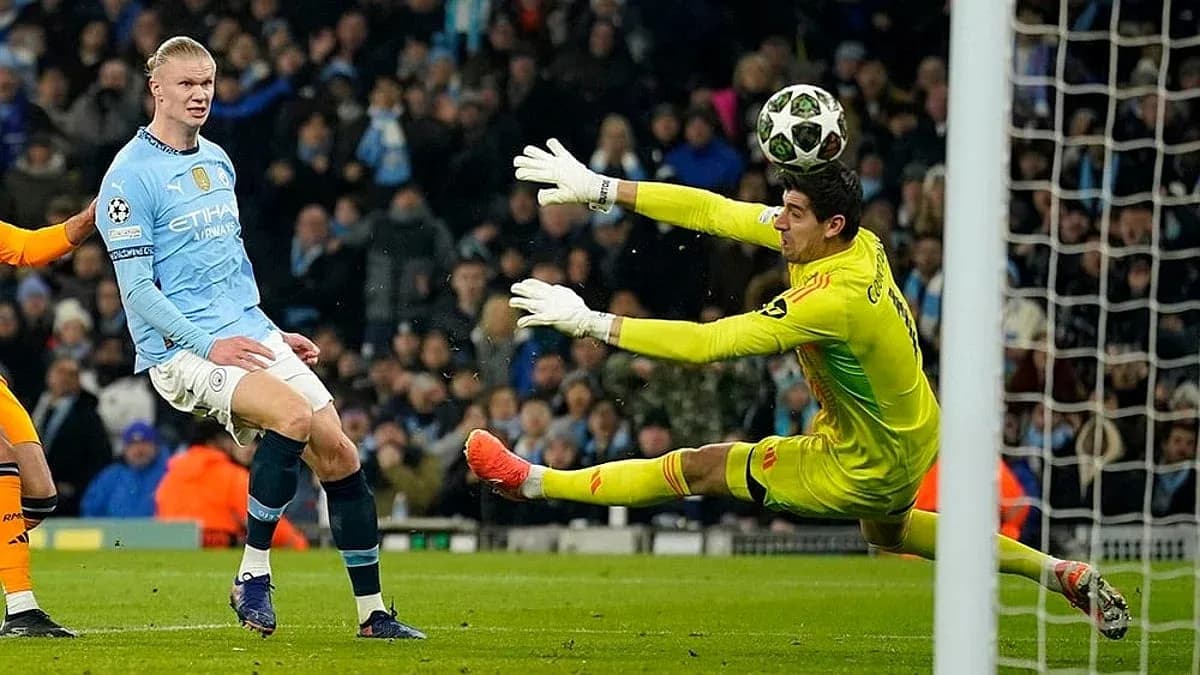
Yet City, whose Champions League campaign has been defined by resilience (five wins from eight), refused to fold. Despite being a man down, they continued to create, and Erling Haaland levelled with an open-play strike in the 41st minute to make it 1-1. That equaliser ensured the half-time score matched the official interval tally: Manchester City 1-1 Real Madrid.
A late first-half flashpoint underlined the game’s edge. In 45+4, Abdukodir Khusanov was booked for elbowing, adding to a fractious tone that had already seen Pep Guardiola himself cautioned for unsportsmanlike conduct in the 25th minute.
Both coaches moved quickly at the break. For City, Rúben Dias went off for Marc Guéhi and Tijjani Reijnders made way for Nathan Aké, both changes arriving at 46 minutes. Guardiola’s adjustments hinted at shoring up a back line that had to cope with a man disadvantage while still offering some progressive passing from deep. Real Madrid responded in kind: Thibaut Courtois was withdrawn at half-time, Andriy Lunin introduced in goal, a significant decision in a knockout tie.
The second half became a test of City’s structure and Real Madrid’s patience. Haaland was replaced by Omar Marmoush in the 57th minute, and Matheus Nunes made way for Antoine Semenyo at the same time, as Guardiola sought fresh legs and vertical threat on the counter. Later, Rodri, the metronome of City’s midfield, was withdrawn for Nico González in the 74th minute, underlining the physical toll of playing a man short.
On the opposite bench, Alvaro Arbeloa gradually turned the screw. Brahim Díaz came off for Kylian Mbappé in the 69th minute, adding explosive pace to an already dangerous attack. In the 74th minute, Arda Güler was replaced by Eduardo Camavinga and Thiago Pitarch by Manuel Ángel Morán, reinforcing both control and energy in midfield. Trent Alexander-Arnold, booked on 80 minutes for holding, was then substituted for Dani Carvajal in the 83rd minute, a pragmatic move to protect the right flank and manage his caution.
Statistically, Real Madrid’s superiority with an extra player was clear but not overwhelming. They shaded possession 52% to City’s 48% and completed 499 of 544 passes, matching City’s 92% pass accuracy (443 of 483). Madrid produced 14 shots to City’s 22, but with higher-quality opportunities: an xG of 2.93 against City’s 1.91. Inside the box, Madrid had 10 efforts to City’s 14, reflecting a game where both sides still found routes into dangerous areas despite the red card.
City, even with ten men, were more prolific shooters: 8 on target and 8 off target, plus 6 efforts blocked by Madrid’s defence. Real Madrid, by contrast, managed 7 shots on goal, 6 off target and saw only 1 attempt blocked by City. The “identity lock” of the defensive work is revealing: Madrid’s back line repeatedly stepped in front of City’s strikes, while City’s reduced numbers meant they relied more on positioning and goalkeeper interventions than on volume blocks.
In goal, Gianluigi Donnarumma made 4 saves but could not alter the outcome late on. Lunin, introduced at half-time, produced 7 saves, a crucial contribution in a match where City’s threat never completely disappeared. Notably, neither keeper registered any goals prevented beyond expectation, a sign that the finishing generally aligned with the quality of chances.
Discipline played its part. City finished with one yellow card (Khusanov) and the pivotal red for Bernardo Silva, while Real Madrid collected two bookings: Mbappé for delaying the game in the 76th minute and Alexander-Arnold for holding. Real’s ability to avoid further sanctions helped them maintain territorial pressure without sliding into chaos.
The climax was pure drama. In 90+1, Vinicius Junior had a goal ruled out for offside after VAR intervention, a let-off for City and a brief reprieve for the home crowd. But two minutes later, in 90+3, Vinicius struck again from open play, this time legally and decisively, finishing from an Aurélien Tchouaméni assist to seal the 2-1 away win.
In the broader Champions League snapshot, the result reinforces Real Madrid’s profile as a high-variance but devastatingly efficient knockout side: 5 wins from 8, 21 goals scored, and a +9 goal difference. For Manchester City, who came in with strong home numbers (3 wins from 4, 8 scored and just 3 conceded at the Etihad), this defeat with ten men will sting. Their overall record of 5 wins, 1 draw and 2 defeats, with 15 goals for and 9 against, still speaks of a formidable campaign, but on this night, the red card, the penalty and Vinicius Junior’s stoppage-time ruthlessness tilted a finely balanced tie Madrid’s way.