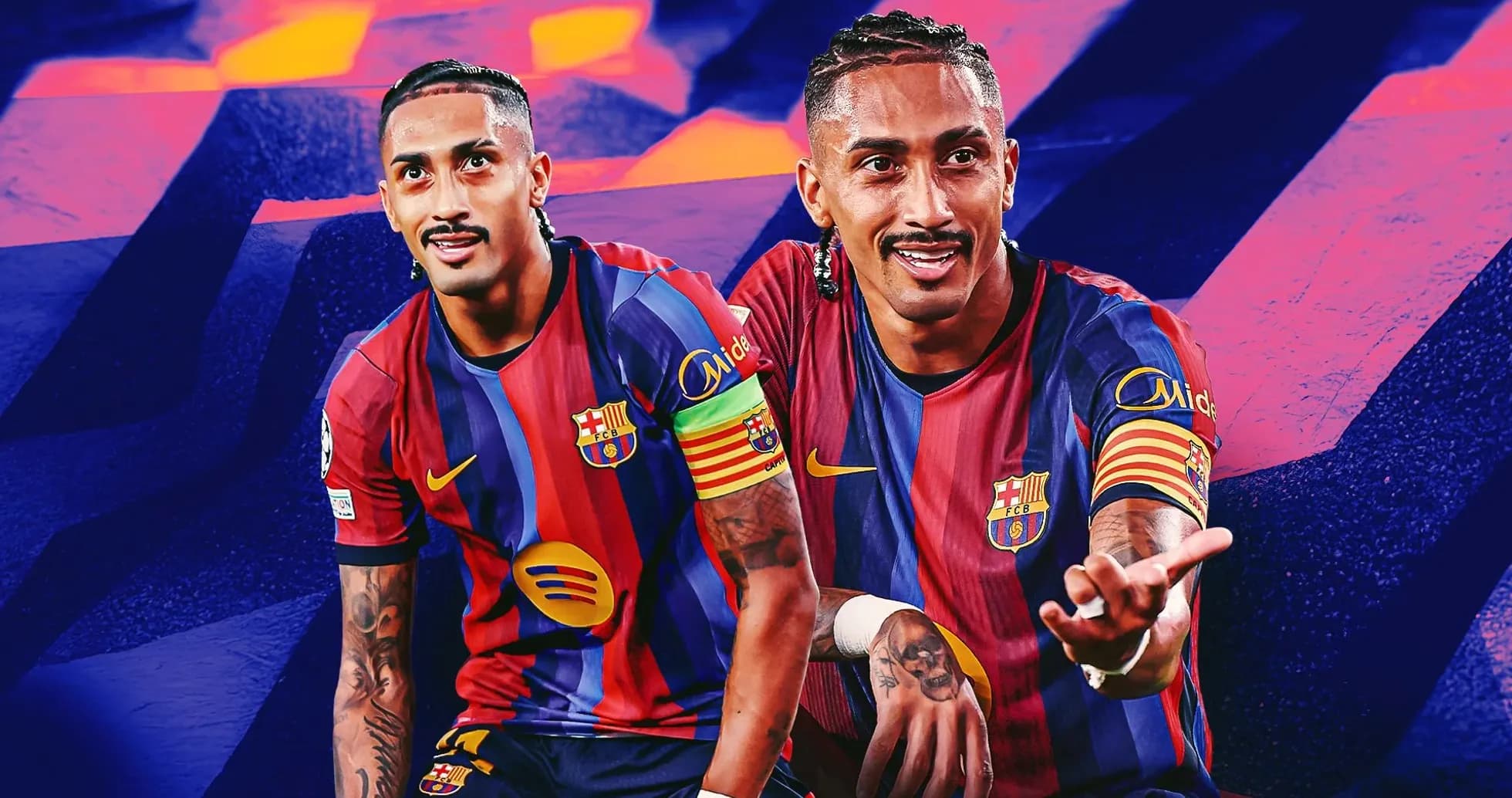
Raphinha's Transformation: From Injury Doubt to Barcelona's Star
A year ago, Raphinha was watching the biggest nights from the treatment room. Hamstring after hamstring. One hundred and twenty-five days gone, a World Cup wrecked, and a Ballon d'Or dream slipping through his fingers as his goal contributions fell from a staggering 60 to a modest 29.
Now he’s the man Hansi Flick builds everything around.
The Brazilian has shifted from touchline winger to roaming spearhead, and in the space of a few blistering weeks he has forced his way into a conversation usually reserved for club legends. Flick is adamant about it. “He (Raphinha) is far too good not to be on that list, but we can’t change it,” the Barcelona coach said, unimpressed that his captain didn’t even make the 30-man Ballon d'Or shortlist.
The numbers, and the eye test, are firmly on his side.
A Champions League statement
Flick’s verdict came straight after Raphinha tore Feyenoord apart in Barcelona’s Champions League opener. It wasn’t just a brace. It was a performance that announced a new version of him.
His first goal was pure theatre. He chased down a slightly wayward pass from Lamine Yamal, slipped past one defender, surged into the box and shaped to shoot. Then came the twist: a dummy so sharp it sent two Feyenoord defenders sliding past him, leaving the Brazilian with all the time he needed to roll the ball in with icy calm.
The second was straight from a centre-forward’s manual. Raphinha initially moved towards Dani Olmo, dragging his marker with him. Then he spun and exploded into the space behind, timing his run perfectly to meet Olmo’s through ball and whip a shot across the helpless goalkeeper.
Barcelona ran out 5-1 winners. Raphinha left with the Player of the Match award and the feeling that something had shifted. He played like a man who believes he is the best player on the pitch, and right now, he often is.
“Rapha has played fantastic,” Flick said. “He's on another level - he's unbelievable."
Historic start, historic company
The data backs up the hyperbole. Raphinha already has 11 goals this season, a mark no Barcelona player has reached this quickly in the last 60 years. Not Lionel Messi. Not Ronaldo.
Messi hit 10 in his first seven appearances of 2012-13, and reached nine by this stage in two other seasons. Ronaldo matched nine in 1996-97. Raphinha has gone beyond them.
That kind of start doesn’t happen by accident. It’s the product of a role tailored to his strengths and a team reshaped around his movement.
The perfect striker for Flick’s chaos
Robert Lewandowski gave Barcelona a classic reference point up front, a master with his back to goal. Ferran Torres stretched defences with clever runs in behind. Raphinha offers something different again.
At 29, he drifts between the lines rather than pinning centre-backs. He darts into pockets, combines with midfielders, and then suddenly bursts into the box. His acceleration and close control yank defenders out of shape, opening lanes for Yamal and Anthony Gordon on the flanks. When the gaps appear, he is usually the first to see them.
Racing Santander found that out the hard way.
In the 7-2 La Liga demolition, Raphinha helped himself to a hat-trick. Two goals came from the penalty spot, but the middle one summed up his new life through the middle. Olmo again spotted him. Raphinha slipped between the centre-backs, paused, waited for the pass, took a single touch and steered a half-volley into the corner. No fuss. No panic. Just a striker who knows exactly where the goal is.
On the ball, he makes the difficult look routine. Off it, he sets the tone. Barcelona’s press starts with him, chasing, harrying, forcing errors because he simply refuses to stop.
Flick wanted intensity and dynamism at the top end of the pitch. He has both, plus a ruthless streak in front of goal. Somewhere in the background, the club executives who once chased Julian Alvarez will quietly accept that missing out might have been a blessing. The front line is humming. The transfer budget can now be aimed at other weaknesses.
Walking in the footsteps of R9
Barcelona’s bond with Brazilian brilliance runs deep. Romario. Rivaldo. Ronaldinho. Neymar. And towering over all of them in terms of single-season impact, Ronaldo.
R9 arrived from PSV in 1996 for a world-record $19.5m fee and detonated La Liga. Forty-seven goals in 49 games. Copa del Rey, UEFA Cup Winners' Cup, Supercopa de Espana. Thirty-four league goals, the Pichichi Trophy, the European Golden Shoe, and the 1997 Ballon d'Or. He bulldozed through defences with terrifying power and speed, scoring solo goals that live on in grainy highlight reels and misty-eyed memories.
“He is the most spectacular player I've ever seen,” Sir Bobby Robson said. Laurent Blanc called him “a freight train coming at you with a ball at his feet.”
Ronaldo was more of a fixed target than Raphinha, a pure nine who lived on the shoulder. Yet the comparison doesn’t feel forced. Raphinha shares his compatriot’s hunger for goal, his directness, his willingness to rip teams apart in seconds.
If he keeps this up, matching Ronaldo’s output over a season no longer sounds fanciful. The bar is absurdly high: 47 goals and a trophy haul to match. But this version of Raphinha is playing at a level where those numbers stop being fantasy and start becoming a challenge.
A captain who refuses to stand still
For all the fireworks, Raphinha’s mindset might be his most valuable asset. After the Racing rout, he refused to bask in the praise.
“I will never say I am performing well; I always strive to improve everything I can,” he said. “I am happy with the goals, and with the win, and that is the most important thing, but we have to keep improving.”
He spoke of feeling “comfortable” through the middle and pointed straight at Flick for the transformation. “He is the coach who changed the way I think and how I see myself. I am extremely grateful.”
That relationship changed the course of his Barcelona career. Under Xavi, Raphinha never quite convinced, his first two seasons at Camp Nou underwhelming. A departure in 2024 felt likely.
Flick stopped that. He saw a different ceiling and handed Raphinha more responsibility from day one. When Marc-Andre ter Stegen left on loan to Ajax in the summer, Flick didn’t hesitate: Raphinha became Barcelona’s permanent captain.
The first Brazilian to wear the armband in Catalunya is playing like he’s been waiting his whole life for it. His work rate, his obsession with the team’s needs, and his refusal to hide in big moments have turned him into the dressing room’s reference point. When a game drifts, he is usually the one to grab it by the throat.
Depth, protection and a frightening partnership
Barcelona lost Lewandowski and Torres, and allowed Marcus Rashford to go back to Manchester United. On paper, that should have weakened their attacking options. On the pitch, Flick’s side look sharper than ever.
Raphinha is the headline act, but he’s not alone. Gordon, Karim Adeyemi and Gabriel Jesus have all slotted in quickly. There is also 18-year-old Hamza Abdelkarim, promoted from Barca B and already trusted as a genuine option up front.
“Raphinha, Gabby and Hamza are three different profiles, but there are other ways we could play,” Flick said. “Anthony and Karim can also play in this position (as striker). Or Dani Olmo. Dani has showed us in last two years he can play there - the same with Fermin [Lopez]. We have a lot of options.”
Those options matter for one key reason: Raphinha’s legs. Flick knows the scars of last season’s injuries. He hooked his captain early against Feyenoord, and did the same in league wins over Athletic Club and Racing. The message is clear. No risks. Not with this version of Raphinha.
The same caution applies to Yamal, who looks even more dangerous playing closer to his captain. Their understanding is instinctive. The moment a centre-back shifts his body towards Yamal, the teenager slides a pass into the space he’s just vacated, trusting that Raphinha is already on the move, cutting into the blind side.
Yamal doesn’t seem bothered about who gets the spotlight. Flick has star power everywhere he looks, but the egos are in check. The dressing room runs on a fierce collective spirit, and Raphinha embodies it better than anyone.
The club’s Hall of Fame already has a special corner for Brazilian magic. Ronaldo’s single season still stands as the gold standard. If Raphinha keeps bending games to his will like this, how long before he’s sitting alongside R9 in that pantheon – and doing it as the captain who dragged Barcelona into a new era?