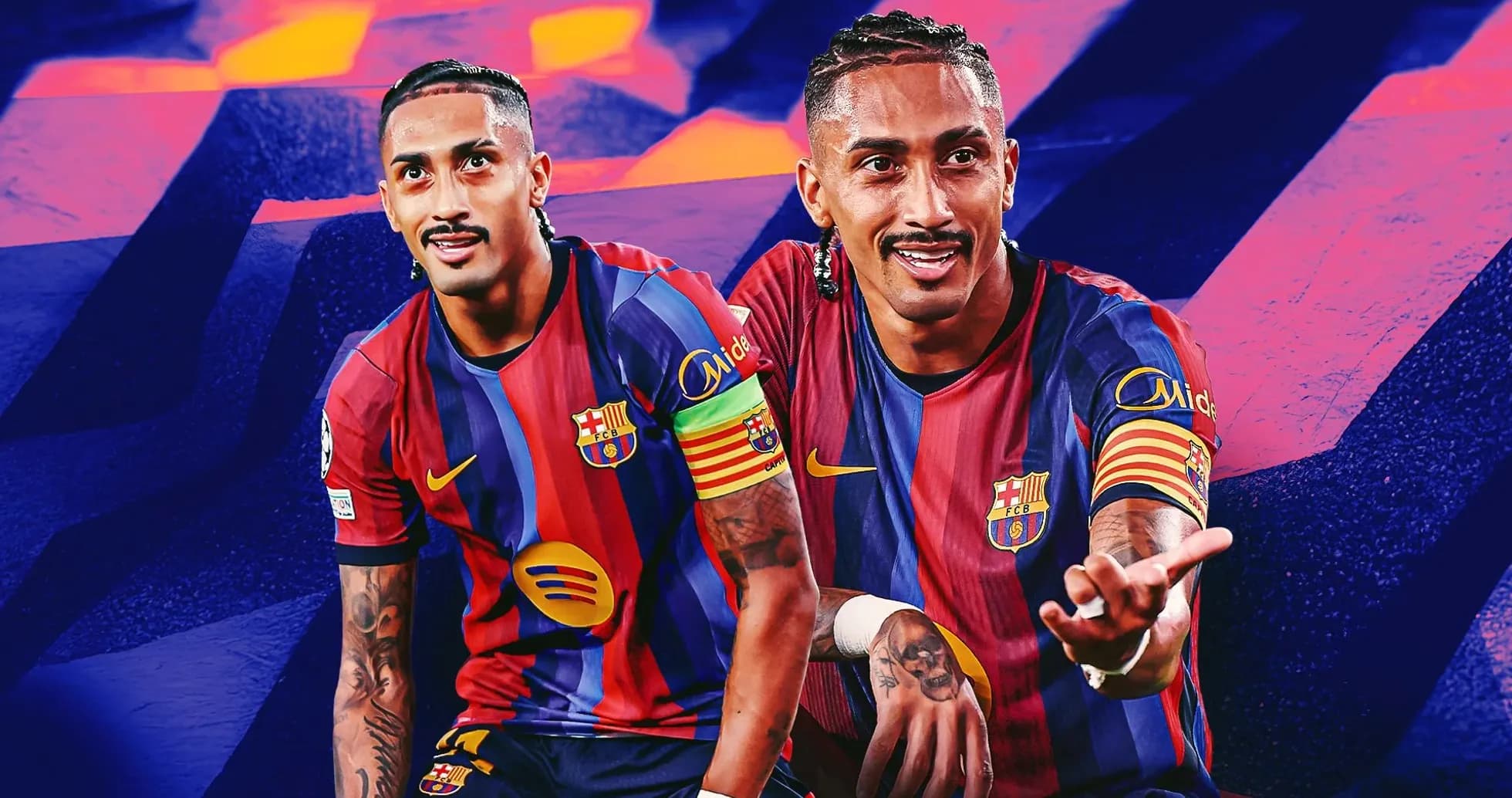
Raphinha’s Transformation: From Injury to Barcelona’s New Star
Hansi Flick didn’t even try to hide it. “He’s far too good not to be on that list,” the Barcelona coach snapped when asked about Raphinha’s Ballon d’Or snub.
You could see why he was so sure of himself.
Only a year ago, Raphinha’s story looked very different. The Brazilian’s 2024-25 campaign was Ballon d’Or calibre: 60 goal contributions, a constant menace cutting in from the left, a winger at the peak of his powers. Then his body broke. Persistent hamstring problems cost him 125 days on the sidelines, wrecked his rhythm, and ultimately ruined his World Cup. His numbers were slashed to 29 goal contributions. His status, and his confidence, took a hit.
This season, Flick has ripped up the script. Raphinha is no longer the touchline winger. He is the spearhead. And he is tearing Europe apart.
A central role, a central character
The night that set the tone came in the Champions League opener against Feyenoord. Raphinha didn’t just score twice. He announced a new version of himself.
The first goal was pure theatre. Chasing a slightly loose pass from Lamine Yamal, he shrugged off one defender, glided into the box and shaped to shoot. Then came the trick: an audacious dummy that sent two Feyenoord defenders crashing past him, leaving the goal suddenly wide and calm. One touch, one cool finish. Chaos behind him, serenity at his feet.
His second was straight from the centre-forward manual. When Dani Olmo picked up the ball in the centre-circle, Raphinha initially checked towards it, dragging his marker with him. Then he exploded in the opposite direction, disappearing into space. Olmo threaded the pass. Raphinha met it in stride and whipped a shot across the helpless goalkeeper. It was movement you expect from a seasoned No.9, not a converted winger.
Barcelona ran out 5-1 winners. Raphinha left with the match ball metaphorically under his arm and the Player of the Match award in his pocket. Flick left with confirmation that his bold idea worked.
“Rapha has played fantastic,” Flick said. “He’s on another level – he’s unbelievable.”
The numbers agree. Raphinha already has 11 goals this term, a start no Barca player has matched in the last 60 years. Not Lionel Messi. Not Ronaldo. Messi hit 10 in his first seven games of 2012-13 and reached nine twice more. Ronaldo reached nine in 1996-97. Raphinha has gone past them.
The perfect striker for Flick’s chaos
Robert Lewandowski gave Barca a classic reference point, a master with his back to goal. Ferran Torres stretched defences with clever runs in behind. Raphinha offers something else entirely.
At 29, he floats. He roams between the lines, sprints into channels, drops short to link play, then vanishes behind centre-backs before they’ve reset their feet. His explosive speed and tight control drag defenders out of shape, opening corridors for Yamal and Anthony Gordon on the flanks. And when that space appears for him, he attacks it like a predator who already knows how the story ends.
Racing Santander felt that ruthlessness in La Liga. Barca smashed them 7-2; Raphinha walked away with a hat-trick. Two of his goals came from the penalty spot, but the one in between was the clearest snapshot of his new identity.
Again, Olmo was the architect. Again, Raphinha’s movement made the difference. He drifted between Racing’s centre-backs, waited on the blind side, then burst into the gap the moment the pass was released. One touch to set, then a half-volley guided into the corner. Simple on the eye, brutally difficult to stop.
On the ball he looks like he’s playing on fast-forward. Off it, he’s the trigger. Barca’s high press starts with him, a captain sprinting himself into the ground to force mistakes. He doesn’t jog. He hunts.
This is exactly the intensity Flick demands. It is also why the coach can quietly live with the fact a move for Julian Alvarez never materialised. The frontline is humming without him, and the club can funnel resources into other areas in the coming windows.
Walking in the footsteps of R9
Barcelona know a thing or two about Brazilian superstars. Romario, Rivaldo, Ronaldinho, Neymar – each left a different kind of mark. But in terms of sheer, condensed devastation, one name still stands apart: Ronaldo.
R9 arrived from PSV in 1996 for a then-world record $19.5m fee. He was only 20. He played 49 games, scored 47 goals, and left a trail of broken defences across Spain and Europe. Copa del Rey, UEFA Cup Winners’ Cup, Supercopa de España – all fell under his spell. His blend of raw power, frightening pace and laser finishing made him feel unstoppable.
He took the Pichichi Trophy with 34 league goals, claimed the European Golden Shoe, and topped the 1997 Ballon d’Or vote. The highlight reel from that season still looks unreal: the slalom against SD Compostela, the hat-trick that dragged Barca back from 3-0 down to beat Atletico 4-3 in the Copa del Rey.
“He is the most spectacular player I’ve ever seen,” Sir Bobby Robson said at the time. Laurent Blanc called him “a freight train coming at you with a ball at his feet.”
Ronaldo was a fixed point, a pure No.9. Raphinha is more fluid, more involved in the build-up. But the instincts are similar. Both are direct. Both can slice through a defence in seconds with a mix of daring and technique. If Raphinha keeps this level, matching Ronaldo’s output over a full season is no longer a fantasy. The difference? Raphinha has the platform to chase a treble that would outstrip even R9’s single, spectacular year.
The captain who almost left
None of this felt inevitable. Raphinha’s first two seasons at Camp Nou, under Xavi, were underwhelming. He flashed quality but never truly owned a place in the team. A departure in 2024 looked entirely plausible.
Flick changed that. He saw a player with untapped ceiling, not a misfit winger. He handed him responsibility and, crucially, trust.
When Marc-André ter Stegen left on loan to Ajax in the summer, Flick didn’t hesitate. Raphinha became Barcelona’s permanent captain – the first Brazilian ever to wear the armband in Catalonia. It was a bold call. So far, it looks inspired.
Raphinha leads with running, with pressing, with the refusal to drift through games. Younger players watch a senior star track back 60 yards and take note. He doesn’t hide from big moments; he grabs them.
His own assessment remains harsh. After the Racing rout, he said: “I will never say I am performing well; I always strive to improve everything I can. I am happy with the goals, and with the win, and that is the most important thing, but we have to keep improving.”
He also made it clear how much Flick has shaped this version of him. “He is the coach who changed the way I think and how I see myself,” Raphinha said. “I am extremely grateful.”
Depth, protection and a new partnership
The beauty of this Barca is that it doesn’t all rest on one man’s hamstrings. Losing Lewandowski and Torres, and sending Marcus Rashford back to Manchester United, could have left a gaping hole. Instead, the attack looks sharper than ever.
Gordon, Karim Adeyemi and Gabriel Jesus have settled quickly. Behind them, 18-year-old Hamza Abdelkarim has stepped up from Barca B, giving Flick another option through the middle.
“Raphinha, Gabby and Hamza are three different profiles, but there are other ways we could play,” Flick said. “Anthony and Karim can also play in this position. Or Dani Olmo. Dani has showed us in last two years he can play there – the same with Fermin Lopez. We have a lot of options.”
That depth matters for one key reason: protecting Raphinha. Flick has been ruthless with his minutes, withdrawing him early against Feyenoord, Athletic Club and Racing. The captain’s legs are non-negotiable.
The same goes for Yamal. The teenager has become even more dangerous operating closer to Raphinha, their understanding growing with every game. Their movements are almost telepathic: the moment a centre-back shifts towards Yamal, the ball is slipped into the space Raphinha is already attacking on the blind side.
Yamal seems content to let the older man soak up the spotlight. Flick has star power across the front line, but no one’s ego is allowed to swell beyond the collective. The dressing room feels aligned, hungry, convinced that something big is building.
At the heart of it all is Raphinha, captain and cutting edge, a player who has turned a Ballon d’Or snub and an injury nightmare into fuel.
Barcelona’s Hall of Fame already has a place for R9. If this season continues on its current trajectory, how long before Raphinha’s name is etched alongside his?