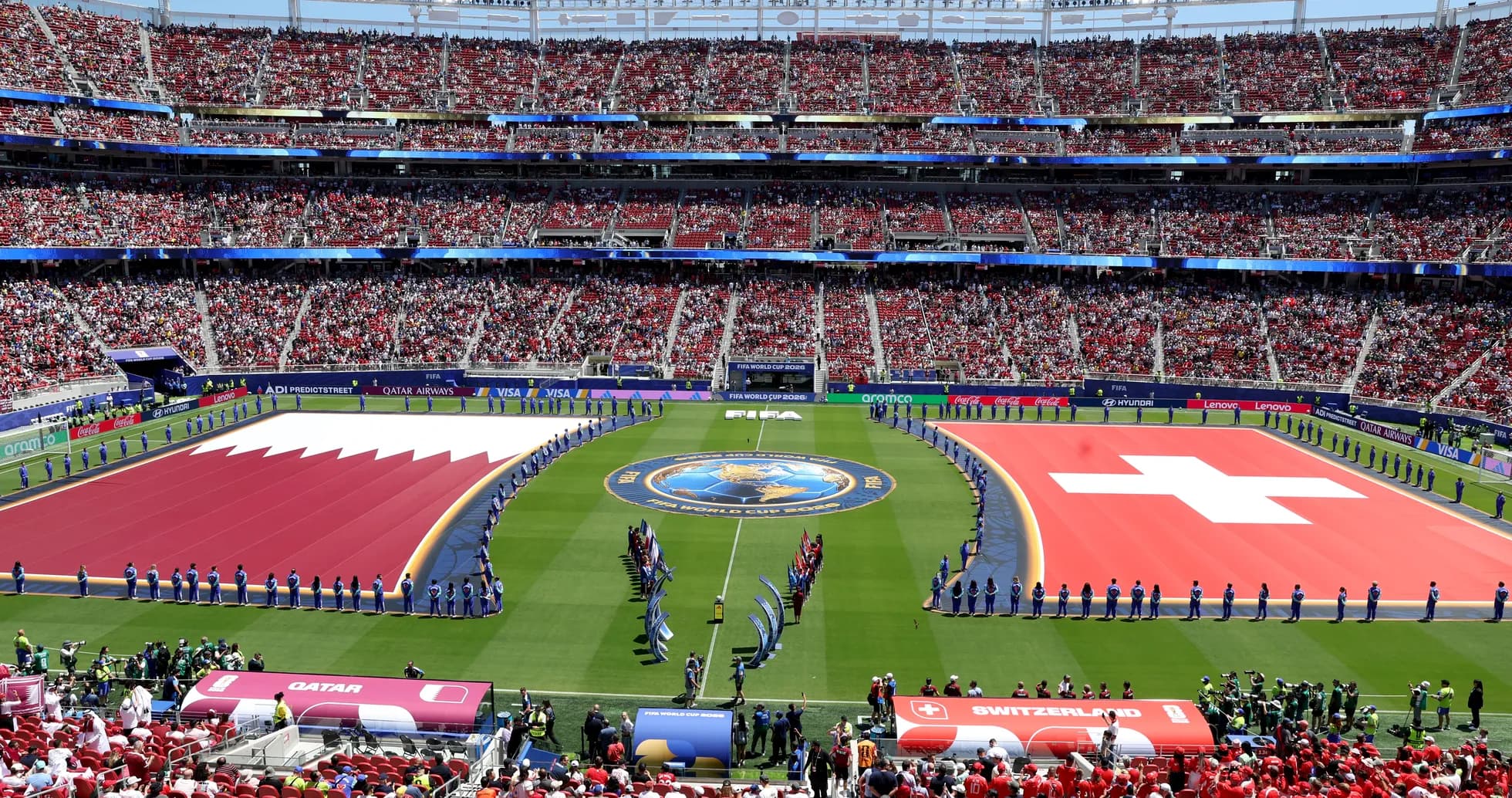
Qatar Holds Switzerland to 1-1 Draw: Tactical Analysis
Qatar’s 1-1 draw with Switzerland at Levi's Stadium was a classic case of tactical survival versus territorial dominance. Julen Lopetegui’s side spent long stretches under siege, yet emerged with a point thanks to a compact 4-3-3 block, high goalkeeper impact, and a late set-piece equaliser. Murat Yakin’s Switzerland, also in a 4-3-3, controlled space and tempo, but turned 68% possession and 26 shots into only one goal, exposing a structural issue in their final-third efficiency.
Qatar’s defensive plan was clear from the opening minutes. The back four of Homam Al-Amin, Boualem Khoukhi, Pedro Miguel and Ayoub Al Oui sat relatively narrow, with the three-man midfield screen of Issa Laye, Assim Madibo and Jassem Gaber Abdulsallam tasked with collapsing centrally around Granit Xhaka and Remo Freuler. Switzerland responded by building with Xhaka as the primary distributor, dropping close to the centre-backs Manuel Akanji and Nico Elvedi to create a 2-3 structure in the first phase. This allowed full-backs Denis Zakaria and Ricardo Rodríguez to push high and wide, stretching Qatar’s front three of Akram Afif, Edmilson Junior and Yusuf Abdurisag.
Turning Point
The turning point of the early phase came from Switzerland’s pressure inside the box. At 16', a penalty was confirmed by VAR for a foul involving Remo Freuler’s movement in the area, and Breel Embolo converted from the spot at 17'. That sequence underlined Switzerland’s main offensive pattern: repeated entries into the penalty area (18 shots inside the box) via wide overloads and cut-backs, rather than speculative long-range efforts.
From there, Switzerland settled into a territorial lock. Their 575 total passes, with 522 accurate at 91%, show how cleanly they circulated the ball around Qatar’s low and mid block. Xhaka orchestrated switches to the flanks, frequently finding Dan Ndoye and Rubén Vargas in 1v1 situations. Qatar, by contrast, completed only 196 accurate passes from 275 (71%), reflecting a game plan built around quick, often rushed transitions rather than sustained possession.
Defensive Strategy
Qatar’s 32% of the ball and just 7 total shots (5 inside the box) tell the story of a team prioritising compactness over pressing. The front three rarely engaged Switzerland’s build-up high; instead, they dropped behind the ball, trying to keep central lanes blocked. However, the lack of pressure on the ball allowed Switzerland to register 10 corners and 26 shots overall, with 9 blocked – evidence of Qatar’s last-ditch defending around their own box.
Individually, Mahmud Abunad (Qatar) was central to the defensive resistance. He made 5 saves and, combined with a goals prevented value of 0.43 against Switzerland’s xG of 3.24, effectively turned a statistically heavy defeat into a draw. His early yellow card at 16' for Time wasting, even at 0-0, hinted at Qatar’s intention to slow rhythm and manage Switzerland’s momentum. At the other end, Gregor Kobel (Switzerland) faced far less volume, making 3 saves with a goals prevented figure of 0.43 against Qatar’s xG of 0.76, and was largely a spectator until the final stages.
Substitution Patterns
The substitution patterns in the second half reflected the tactical tug-of-war. At 60', Lopetegui made a triple change to inject energy and slightly more vertical threat: Ahmed Alaaeldin (IN) came on for Yusuf Abdurisag (OUT), Karim Boudiaf (IN) came on for Jassem Gaber Abdulsallam (OUT), and Ahmed Fathi (IN) came on for Ayoub Al Oui (OUT). These moves freshened the midfield legs and added a bit more composure in transition, with Boudiaf in particular helping Qatar hold the ball slightly longer in rare attacking spells.
Yakin responded at 65' with a double substitution aimed at maintaining offensive pressure without sacrificing structure: Johan Manzambi (IN) came on for Dan Ndoye (OUT) and Fabian Rieder (IN) came on for Michel Aebischer (OUT). Later, at 79', Zeki Amdouni (IN) came on for Rubén Vargas (OUT), keeping Switzerland’s front line mobile and aggressive between the lines. The late full-back and midfield rotations at 89' – Miro Muheim (IN) for Ricardo Rodríguez (OUT) and Ardon Jashari (IN) for Remo Freuler (OUT) – were about fresh legs to defend transitions and close the game at 1-0.
Late Equaliser
Instead, Qatar capitalised on one of their rare advanced situations. In the 90+4' minute, a well-executed late move or set-piece saw centre-back Boualem Khoukhi arrive to score, assisted by Homam Al-Amin. It was a textbook example of a deep-lying side stealing a result with a single high-quality moment after absorbing sustained pressure.
Discipline and Statistics
Discipline also framed the tactical tone. Qatar collected two yellow cards: at 16', Mahmud Abunad (Qatar) — Time wasting; at 23', Jassem Gaber Abdulsallam (Qatar) — Foul, reflecting both game management and the need to break up Swiss moves. Switzerland’s lone booking came at 42', Denis Zakaria (Switzerland) — Foul, as he halted a Qatar transition down his flank.
The statistical verdict is stark. Switzerland’s xG of 3.24 versus Qatar’s 0.76 underlines how one-sided the chance quality was. Switzerland’s 26 shots to 7, 7 shots on goal to 4, and 10 corners to 3 all point to a side that repeatedly reached dangerous zones but lacked cutting edge and perhaps a bit of composure in the box. Their 91% passing accuracy and 575 passes suggest a well-structured possession side that moved Qatar around but did not translate superiority into a decisive scoreline.
Qatar, meanwhile, executed a classic underdog blueprint: low possession, high concentration, and reliance on their goalkeeper and centre-backs. With 0 blocked shots in attack and only 3 corners, they created very little sustained pressure, but maximised their limited opportunities. In group-stage terms, this 1-1 draw feels like two points dropped for Switzerland and a tactically-earned bonus point for Qatar, whose defensive resilience and late execution overturned the underlying numbers.