PSG vs Monaco: A Strategic Battle in Football
This was a textbook case of one team monopolising the ball while the other tried to play in moments. Paris Saint Germain held an enormous 80% possession, circulating the ball with 795 total passes at 92% accuracy, clearly aiming to control territory and tempo. Monaco, with just 20% possession and 197 passes at 73% accuracy, accepted a reactive role, looking to compress space and spring forward quickly when they could. The 4-3-3 of PSG acted as a positional play machine, while Monaco’s 4-2-3-1 increasingly became a low, compact block, especially after going down to ten men, ceding the ball but trying to protect central zones.
Offensive Efficiency
PSG’s game plan was to create volume and variety of chances. Their 30 total shots, including 13 inside the box and 17 from distance, plus 8 corners, show relentless pressure and sustained occupation of Monaco’s half. With 10 shots on goal and an xG of 3.09, they translated territorial dominance into genuine threat rather than sterile possession. The 3 goals match that xG profile, underlining that their finishing was broadly in line with chance quality rather than overperformance.
Monaco’s approach was almost the opposite: minimal volume, maximum impact. They produced only 7 total shots, 5 of them inside the box, and just 1 corner. Yet they still scored twice from an xG of 1.19, indicating a focus on high-quality, fast attacks rather than speculative efforts. Their 4 shots on target from 7 attempts point to a clear, direct route to goal when they did break PSG’s first line. However, the numerical disadvantage after the red card and the lack of sustained possession meant that their attacking presence faded, and they could not generate enough late pressure to change the outcome.
Defensive Discipline & Intensity
Defensively, Monaco were under siege. PSG forced 7 saves from goalkeeper P. Kohn, illustrating how often the hosts were pushed back into their own box. Monaco committed 11 fouls and picked up 2 yellow cards plus a red, suggesting a defensive strategy that relied on disrupting PSG’s rhythm and occasionally overstepping, especially as fatigue and pressure mounted. The red card further deepened their block and reduced their ability to contest midfield.
PSG, by contrast, defended largely through control of the ball. They committed only 4 fouls and received no yellow or red cards, reflecting a low-intensity defensive phase because they rarely had to defend long stretches. Their goalkeeper faced just 4 shots on target and made only 2 saves, showing how effectively the high possession and 10 blocked shots limited Monaco’s final-third actions before they became truly dangerous.
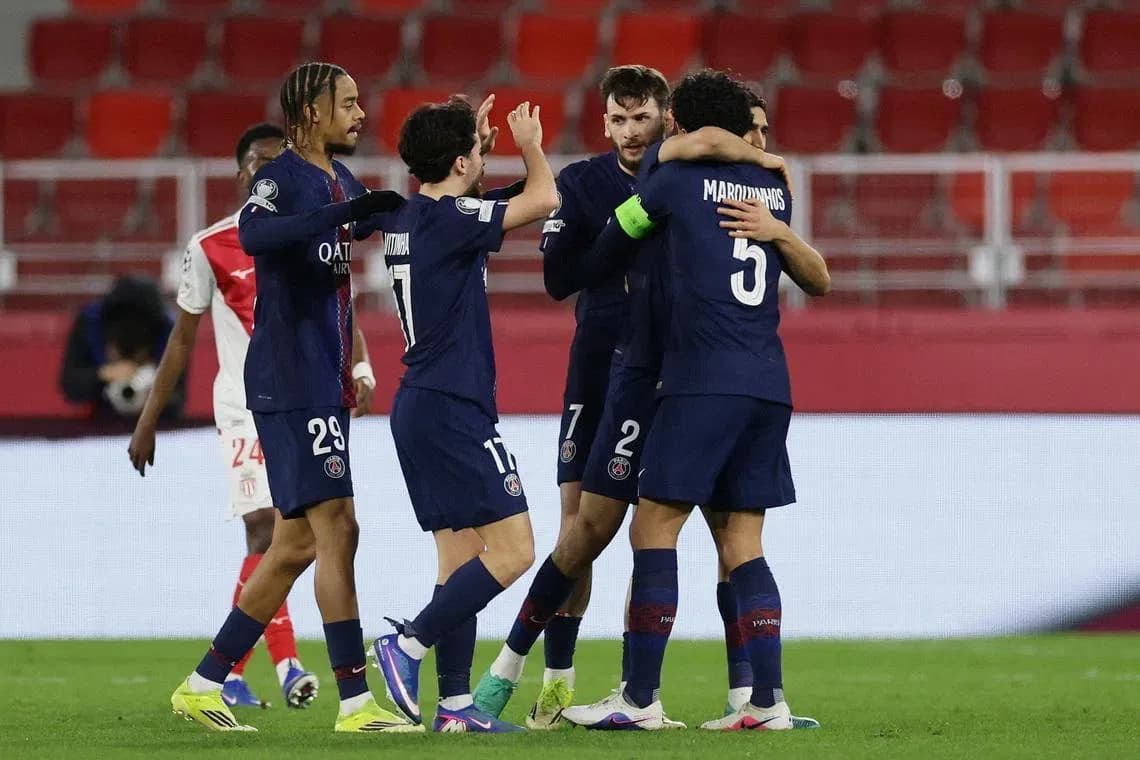
PSG’s territorial dominance and sustained chance creation (30 shots, 3.09 xG, 80% possession) wore down Monaco’s compact, counter-focused plan. Monaco’s early efficiency and direct attacks were not enough to overcome the numerical disadvantage and constant pressure, as PSG’s control of the ball and space dictated the match’s flow.